


No.188 Doubu Avenue, Hannan District, 430090 Wuhan, China


Views: 0 Author: Site Editor Publish Time: 2026-06-15 Origin: Site


An articulating boom lift is valuable when the target is not directly above the machine. Roof edges, walls, production equipment, trees, structural frames, and architectural projections can all block a straight path. In these jobs, maximum height alone gives an incomplete picture. The selection must be based on the shape of the reach envelope and the route the basket needs to follow.
The correct process is to map the obstacle first, then compare articulation points, horizontal outreach, payload at reach, chassis dimensions, turntable movement, and stabilization. This approach is especially important for compact tracked machines, where the lift may enter a confined area and then deploy outriggers before reaching around an obstruction.
A simple site sketch can prevent a poor equipment choice. Mark the machine position, the base of the obstacle, its height and width, the final work point, and any restricted zone that the boom or basket must avoid. The result should show four dimensions: vertical rise, horizontal offset, clearance above the obstacle, and the final approach angle.
For example, a façade maintenance task may require the basket to rise beside a canopy, pass above its edge, and then move inward toward the wall. A warehouse job may require the boom to pass over production equipment without placing the chassis inside the operating area. Tree work may need the boom to move around branches rather than directly through them. Each case depends on geometry, not only nominal working height.
Working height indicates the approximate upper access level. It is useful for initial screening, but it does not prove that the basket can reach a point that is offset from the machine. As the boom moves outward, available height and allowable load may change.
Outreach measures how far the basket can move from the machine's rotation center under specified conditions. It should be checked at the expected basket load. A value quoted at a lighter load cannot automatically be applied to a heavier crew and tool package.
The number and arrangement of boom sections determine how the platform can rise, fold, and approach the target. An articulated path can be more useful than a longer straight-line reach when walls, roofs, machinery, or vegetation interrupt access.
Turntable rotation allows the operator to change the working direction after setup, but surrounding space still matters. The site plan should include boom sweep, basket movement, the rear of the machine, outriggers, and nearby traffic or structures.
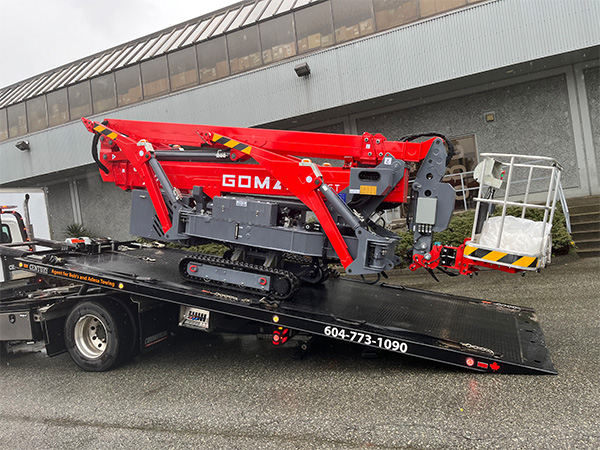
The 28m 230kg Hyper-Load Articulating Spider Lift illustrates how several figures combine to define job-site suitability. The official page lists a 28m working height, a 12.0m horizontal outreach at 230kg, a 230kg maximum load capacity, 360-degree continuous turntable rotation, and a 0.9m stowed width.
Specification | X28 reference | Selection question |
|---|---|---|
Working height | 28m | Is the target within the permitted envelope at the planned setup position? |
Horizontal outreach | 12.0m at 230kg | Can the basket clear the obstacle while carrying the actual crew and tools? |
Maximum load | 230kg | Does the total basket load remain within the applicable load chart? |
Stowed dimensions | 5.69 × 0.9 × 2.0m | Can the machine pass through the entrance and reach the setup zone? |
Approximate weight | 4750kg | Can the floor or ground support the machine and outrigger reactions? |
Gradeability | 30% | Can the tracked chassis travel along the access route before setup? |
Turntable rotation | 360° continuous | Is there enough controlled space for the complete boom sweep? |
These values should be confirmed against the latest manufacturer's documentation. A buyer should also request the working envelope and load chart, because the usable combination of height, outreach, and payload is more important than any single maximum figure.
The platform may need to rise outside the building line, clear a parapet, and then move toward the façade. The critical dimensions are parapet height, horizontal setback, basket approach angle, and the nearest stable setup position.
In a factory, floor-level equipment may prevent the chassis from approaching the work point. A compact tracked base can enter through a narrow route, while the articulated boom provides an elevated path over machines. Floor loading, overhead pipes, production schedules, and the exclusion zone must all be considered.
Tree care and park maintenance rarely provide a clear vertical route. Branches, fences, lawns, and public paths influence positioning. A tracked lift can distribute machine weight across a larger contact area during travel, but sensitive surfaces and outrigger loads still require protection.
A sign may be mounted behind an architectural frame or above a canopy. The basket needs controlled lateral positioning rather than only altitude. The operator should be able to approach the work face without forcing the boom against surrounding structures.
A machine can have the correct reach envelope and still fail the project because it cannot enter the site. Measure door width, corridor width, floor-to-ceiling clearance, turning corners, ramps, and the final setup footprint. The X28 page lists a stowed width of 0.9m, which can be useful for restricted access, but the complete route must be checked rather than relying on one width value.
Tracked travel helps on some soft or uneven surfaces and can improve access where wheeled equipment is less suitable. However, travel capability should not be confused with operating stability. The lift must be deployed according to the outrigger and leveling requirements before elevated work begins.
The product page describes proportional hydraulic control, PLC-based management, remote operation, and electric or diesel power choices. Proportional control is important when the basket must move slowly around a delicate obstacle or stop accurately beside a work surface. Remote functions can assist positioning and setup, while the chosen power source affects noise, emissions, operating duration, and indoor suitability.
For an indoor project, the team should review ventilation, floor protection, electrical supply, and noise limits. For an outdoor project, fuel logistics, weather exposure, ground condition, and shift length become more important. The best power configuration is therefore tied to the work environment rather than to a general preference.
Draw the target and obstacle. Record height, depth, width, and the direction of approach.
Choose possible setup positions. Exclude weak ground, traffic routes, doors, emergency exits, and restricted areas.
Add the expected basket load. Include operators, tools, materials, and accessories.
Compare the working envelope. Confirm that the required point is inside the permitted envelope at that load.
Check the access path. Verify stowed dimensions, weight, slopes, turns, and floor or ground support.
Review the full boom sweep. Consider basket movement, turntable rotation, outriggers, and the exclusion zone.
The first error is choosing by maximum height and ignoring horizontal distance. The second is using unloaded outreach figures for a task that requires two operators and heavy tools. The third is measuring the doorway but not the turning corner behind it. Another mistake is assuming tracked travel means the machine can operate safely on any slope or soft surface.
A final error is treating the obstacle as a two-dimensional object. Real sites contain overhead services, handrails, façade projections, temporary scaffolding, moving vehicles, and people. A three-dimensional access plan gives a more realistic picture of the boom route.
An articulating lift is preferred when the basket must move over, around, or behind an obstacle. A straight boom may be more direct where the target has a clear line of approach.
Not always. Outreach and allowable basket load may vary by boom position. The current load chart should be used for the planned task.
Indoor suitability depends on power source, machine weight, floor loading, dimensions, ventilation, surface protection, and the approved operating conditions.
Provide target height, horizontal offset, obstacle dimensions, entrance size, setup area, ground or floor condition, basket load, power restrictions, and photographs or drawings of the route.
Selecting an articulating boom lift is an exercise in spatial planning. Working height starts the comparison, but obstacle geometry, outreach at load, articulation, rotation, chassis access, stabilization, and power source determine whether the machine can complete the task. By mapping the basket route before comparing models, project teams can choose equipment that reaches the real work point rather than merely matching a height number on a specification sheet.
