


No.188 Doubu Avenue, Hannan District, 430090 Wuhan, China


Views: 0 Author: Site Editor Publish Time: 2026-09-22 Origin: Site


Maintaining multi-story facilities like atriums, municipal buildings, and commercial complexes presents a unique logistical challenge. Facility managers must reach extreme heights in environments never designed for heavy industrial machinery. You have to balance the need for 50-to-100-foot vertical access against strict operational constraints. These include fragile flooring, narrow doorways, tight alleyways, strict weight limits, and zero-emission indoor requirements. Relying on traditional scaffolding is slow and highly labor-intensive. Standard boom lifts are simply too heavy and bulky to navigate interior corridors. Proper specification of a compact spider lift requires a rigorous technical evaluation. You must assess facility bottlenecks, ground conditions, power requirements, and load capacities before bringing equipment on site. This guide provides a practical framework for evaluating and selecting the right access equipment to maximize productivity during complex indoor and outdoor facility maintenance.
Access vs. Reach: Stowed dimensions dictate facility entry through standard doors, while outrigger footprint and boom geometry determine usable reach; both must be measured against the facility's tightest bottlenecks.
Floor Loading & Ground Realities: Ground bearing pressure (measured in PSI/PSF) during transit and operation is the primary disqualifier for equipment on suspended slabs, delicate architectural flooring, or soft outdoor terrain.
Power Source Implications: Selecting a hybrid spider lift or fully electric model is mandatory for indoor use to comply with emission and noise regulations, though outdoor applications may require dual-fuel versatility.
Risk Mitigation & Efficiency: Successful deployment relies heavily on specialized operator training, surface protection protocols, and precise site assessments prior to procurement or rental to ensure maximum operational efficiency.
Facility entry points dictate your equipment options before any work begins. You must identify the absolute minimum clearance points across the entire transit path. Grab a tape measure and walk the site. Do not trust outdated blueprints. Measure the clear width of every single door. A standard 36-inch door often only provides 34 inches of clearance once you account for the hinges, the door stop, and the panic bar. If the machine is 35 inches wide, you will scrape the paint or damage the frame. You might have to pop the pins and remove the door entirely.
Next, look up. Check the height of the door closers, exit signs, and low-hanging HVAC ducts. A narrow access spider lift is designed to collapse down, but the operator still needs room to walk behind or beside it with the remote control. You must also account for the turning radius in tight corridors. Measure the required clearance for boom swing during transit. Many models feature removable operator baskets. Detaching the basket temporarily shaves critical inches off the stowed length, allowing the unit to fit inside standard freight elevators.
Measure all doorway widths and heights along the transit route, accounting for hinges and hardware.
Verify the internal dimensions and maximum weight capacity of freight elevators.
Check corridor intersection widths to ensure adequate turning radius for the tracks.
Confirm if the equipment basket can be easily removed without requiring specialized hand tools.
Ground bearing pressure is the most critical safety metric for indoor operation. You must differentiate between transit weight and operational weight. Suspended slabs in commercial buildings are often rated for 50 to 100 pounds per square foot (PSF). A 6,000-pound machine distributed over two rubber tracks might exert 150 PSF during transit. If you drive that across a second-story atrium floor, you risk structural failure. You must lay down heavy-duty track mats to distribute that transit weight.
Once you reach the work area and deploy the outriggers, the math changes entirely. The entire weight of the machine transfers to four small pads. This is the point load. A single outrigger might exert 1,500 pounds of force onto a 10-inch circle. If that circle sits on a hollow ceramic tile or a raised computer floor, the surface shatters instantly. Outdoor ground conditions require similar scrutiny. Assess soil compaction, mud depth, and uneven grades before performing exterior facility maintenance.
Metric Type | Measurement Focus | Primary Risk Area | Mitigation Strategy |
|---|---|---|---|
Transit Load (UDL) | Weight distributed over track area | Suspended concrete slabs, raised floors | Verify total machine weight against floor PSF limits; use track mats. |
Operational Point Load | Weight concentrated on outrigger pads | Cracking delicate tile, marble, or hardwood | Deploy specialized outrigger cribbing pads to spread the force. |
Ground Bearing Pressure | PSI exerted on exterior soil | Sinking in mud, turf damage, getting stuck | Use heavy-duty composite ground protection mats outdoors. |
Straight vertical reach is rarely the actual requirement. You usually need to reach up and over an obstacle. Imagine changing a high-bay light bulb directly above a permanent indoor waterfall, a glass balcony, or a massive lobby sculpture. You cannot park the machine directly underneath the work area. You have to park 15 feet away, boom up 40 feet, and then extend horizontally over the obstacle.
This requires an articulated boom with a jib. Review the manufacturer's range diagram carefully. Plot your exact setup location on the floor plan and draw a line to the work target. If the line crosses a structural beam or a mezzanine edge, you need a machine with a different articulation point. Ensure the horizontal outreach capacity aligns with your specific facility layout before finalizing the equipment specification.
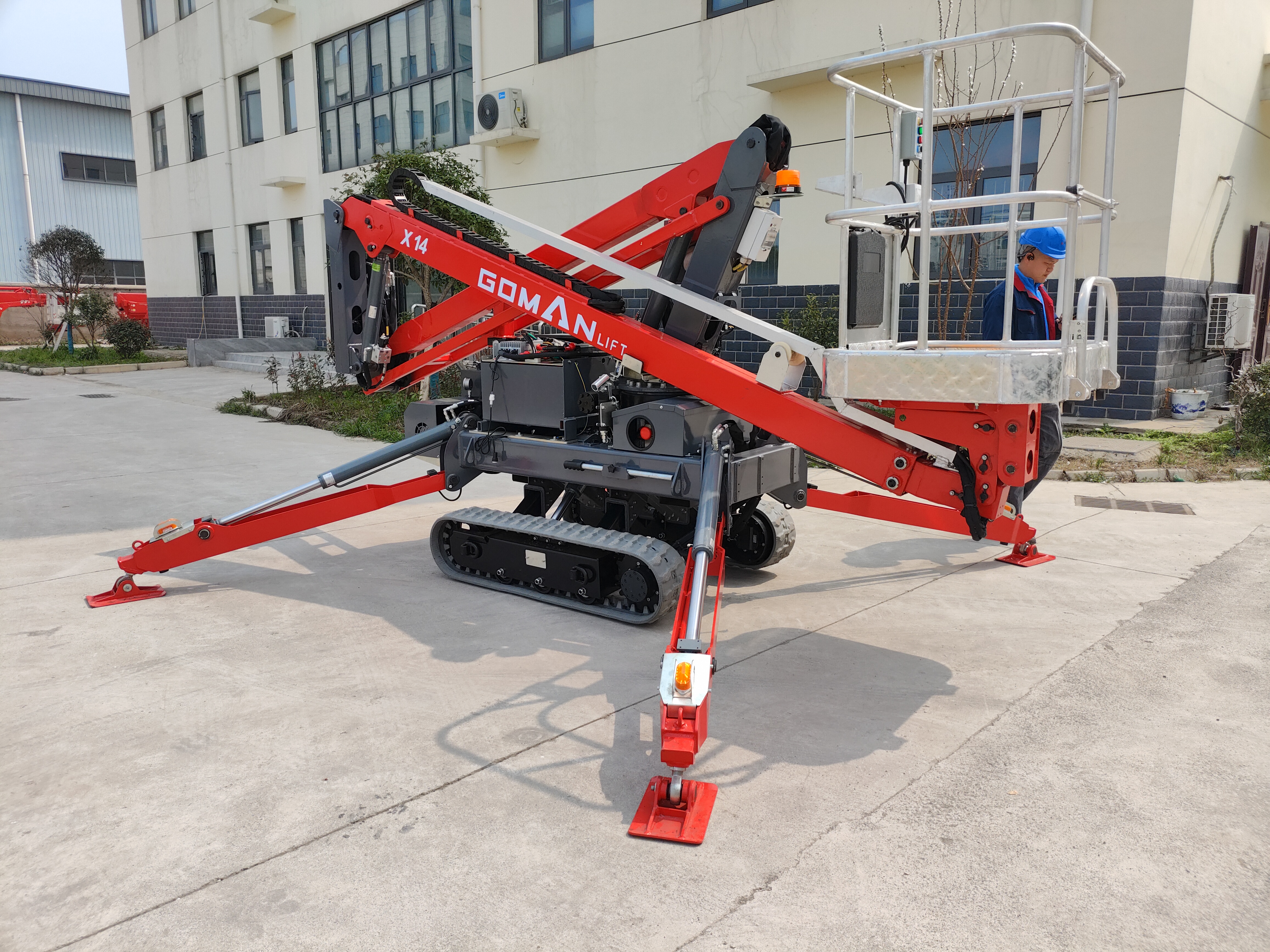
Indoor work means zero emissions. You cannot run a diesel or gas engine inside an occupied building. Carbon monoxide builds up rapidly, triggering alarms and endangering personnel. You have two main options for indoor power: plug-in electric or lithium-ion battery. Plug-in models run off standard 110V or 220V wall outlets. They require a heavy extension cord dragging behind the machine. This cord gets caught on corners, creates a massive trip hazard in public spaces, and limits your travel distance.
Lithium-ion systems eliminate the cord entirely. They provide full hydraulic power for a complete shift on a single charge. If you also need to work outside, specify a hybrid spider lift. This pairs a battery bank with a small combustion engine. You run the engine in the parking lot, drive up the loading ramp, shut the engine off at the door, and switch to battery power for the indoor work. Assess your facility's charging infrastructure to ensure it supports multi-shift maintenance schedules.
Wheels concentrate weight into four small contact patches. Tracks spread the weight over a massive surface area. A tracked spider lift floats over soft mud, wet grass, and loose gravel. It also climbs stairs. The long track base bridges the gap between stair treads, allowing the machine to crawl up a flight of concrete steps safely. Tracks provide superior grip when climbing steep loading ramps or navigating uneven exterior grades.
However, standard black rubber tracks contain carbon black. When you turn the machine on a polished concrete or terrazzo floor, the tracks leave thick black scuff marks that require heavy chemical solvents to remove. You must order the machine with non-marking tracks for indoor applications. These are made from a synthetic white or gray compound. They provide the exact same traction but leave the floors completely clean.
Tracked chassis offer superior weight distribution on soft ground and mud.
Non-marking tracks are mandatory for finished interior commercial floors.
Wheeled units may turn tighter but exert much higher point loads during transit.
Track tension must be inspected regularly to prevent derailment on stairs.
Rubber tracks can negotiate steep inclines better than standard tires.
You rarely get a wide-open, perfectly flat floor for setup. You usually have to set up in a narrow hallway, on a sloped ramp, or half-on/half-off a curb. This requires independent, multi-position outriggers. The operator can swing one outrigger wide to the left, keep the right outrigger tucked in tight against a wall, drop the front outriggers down a flight of stairs, and keep the rear outriggers flat on the landing.
The machine's computer monitors the exact position of each leg and automatically restricts the boom swing to prevent the machine from tipping over the narrow side. Always look for auto-leveling functionality. Manual outrigger leveling is time-consuming and prone to operator error. With auto-leveling, the operator pushes a single button, and the hydraulic valves automatically adjust all four legs until the chassis is perfectly level. This technology directly impacts setup speed and strict safety compliance.
When you are 60 feet in the air, maneuvering a basket between steel roof trusses, you need absolute control. Bang the basket into a fire sprinkler head, and you flood the building. A rigid straight boom cannot navigate around complex architectural spaces. Articulated sections allow the boom to bend around corners. The addition of a terminal jib provides a final point of articulation. This lets the operator tuck the basket directly under a ceiling overhang or behind a structural pillar.
Evaluate the machine's control systems. Proportional controls are non-negotiable for indoor work. Cheap machines use bang-bang valves. You push the joystick, and the boom moves at full speed. You let go, and it stops violently. Proportional controls measure exactly how far you push the joystick. Push it a millimeter, and the boom creeps forward a fraction of an inch. This allows the operator to feather the controls and glide the basket into tight spaces without sudden, jerky movements.
Time is money on maintenance shutdowns. If you have to change 50 high-bay lights in a gymnasium, you want to do it fast. Selecting the correctly sized lift prevents severe workflow bottlenecks. A machine that is too large will spend hours maneuvering through tight corridors. A machine that is too small will require constant repositioning to reach different sections of a ceiling.
Discuss the role of multi-function hydraulics. Older machines have single-function hydraulics. The pump can only supply fluid to one cylinder at a time. You have to boom up, stop. Rotate, stop. Extend, stop. Modern machines feature load-sensing, multi-function hydraulic manifolds. The operator can boom up, rotate the turret, and extend the jib all at the same time. The machine moves in a smooth, continuous arc from the ground directly to the light fixture. This drastically cuts down on total task duration.
The ANSI A92.20 standard completely changed how these machines operate. They now require active load sensing in the basket. If the basket is rated for 440 pounds, and two heavy operators load it up with 100 pounds of tools, the machine will refuse to lift. A sensor measures the weight and locks out the boom functions until you remove the excess load.
The machines also feature tilt sensors. If the ground settles under an outrigger pad and the chassis tilts past a certain degree, an alarm sounds and the boom stops extending. You must also verify the emergency descent system. If the engine dies or the battery fails while the operator is 80 feet in the air, the ground crew must be able to manually bleed the hydraulic valves to lower the basket safely to the ground.
You have to decide between buying one massive machine that does everything poorly, or a small machine that does one thing perfectly. An ultra-compact unit might collapse down to 31 inches wide. It fits through any door. But it might only reach 40 feet high. If your atrium is 60 feet high, that machine is useless for ceiling work. It excels at specific indoor tasks but fails during exterior facade maintenance.
A larger unit might reach 80 feet, but it measures 39 inches wide when stowed. It will not fit through a standard commercial door. You have to evaluate your facility. You may need to perform minor facility modifications, such as temporarily removing door frames or clearing hallway fixtures, to allow the larger unit to enter certain areas. Map out your maintenance tasks. Count how many tasks fall into the 40-foot range versus the 80-foot range. Select the machine that handles the vast majority of your daily workload.
Tracked machines require daily undercarriage maintenance. The rubber tracks stretch over time. If they get too loose, they will derail when you turn sharply on a high-friction surface. The operator must check the track tension with a straight edge and pump grease into the tensioning cylinder to keep the track tight. You also have to inspect the hydraulic hoses. A spider lift has dozens of exposed hoses running down the boom and out to the outrigger legs.
If a hose rubs against a steel edge and blows a leak indoors, you will pump five gallons of hydraulic oil onto a carpeted floor in seconds. Wrap all exposed hoses in protective nylon sleeves. Keep a spill kit strapped to the chassis at all times. Ensure your chosen manufacturer has a robust local service network. You need rapid access to replacement sensors, hydraulic valves, and proprietary electronic control modules.
Establish a daily pre-shift inspection routine for track tension and roller wear.
Keep spill kits attached to the machine for immediate hydraulic leak response.
Verify local dealer response times for emergency on-site repairs.
Stock common wear items like outrigger pads and basket control covers in your shop.
Never put a steel outrigger foot directly on a finished floor. The point load will crush the surface. You must use outrigger cribbing pads. These are thick, engineered plastic squares that sit under the steel foot. They take the massive point load and spread it out over a larger area, reducing the pounds per square inch hitting the floor.
If you are setting up on hollow raised access flooring, cribbing pads are not enough. You have to pull up the floor tiles and build solid wood cribbing directly up from the concrete subfloor to support the outriggers. For transit, lay down 4x8 sheets of 3/4-inch plywood or interlocking composite track mats. Drive the machine over the mats to protect the floor from track scuffing and weight damage.
Do not hand the keys to an operator just because they drove a standard boom lift five years ago. Spider lifts are classified differently. They require specific familiarization training. The operator has to learn how to deploy the outriggers manually if the auto-level fails. They have to learn how to read the bubble level on the chassis. They have to understand the range diagram and know which boom sections to extend first.
Bring in a certified trainer. Have them walk your crew through the exact machine you purchased. Make every operator practice setting up the machine on a staircase and manually bleeding down the boom. Lack of specific training leads to setup errors, tip-overs, and severe property damage.
Moving the machine between buildings requires a heavy-duty trailer. A large spider lift can weigh 8,000 pounds. You cannot tow that with a half-ton pickup truck. You need a one-ton dually truck and a dual-axle equipment trailer. The trailer must have heavy-duty ramps. Standard landscape ramps will buckle under the concentrated weight of the rubber tracks.
Once the machine is on the trailer, the operator must tie it down correctly. Do not throw chains over the hydraulic cylinders or the aluminum basket. Use the manufacturer's designated steel tie-down rings on the chassis. Cross the chains in an X pattern to prevent the machine from walking sideways on the trailer deck during transit.
Hire a structural engineer to calculate the exact PSF load limits of your suspended slabs and raised access floors.
Measure the clear width and height of every doorway, hallway, and elevator along your intended equipment transit routes.
Schedule an on-site demonstration with a dealer to physically test outrigger deployment in your tightest atrium space.
Procure specialized outrigger cribbing pads, composite track mats, and non-marking tracks before the equipment arrives.
A: Working heights typically range from 40 feet to over 100 feet, depending on the specific model's footprint and boom configuration. This extensive vertical reach allows facility teams to access the highest atrium ceilings, perform exterior facade inspections, and manage tall indoor landscaping safely.
A: Yes, provided you take specific precautions. You must equip the machine with non-marking rubber tracks to prevent scuffing. Additionally, operators must use large outrigger cribbing pads to distribute the machine's weight, preventing point-load damage on fragile surfaces like tile, hardwood, or marble.
A: Many models feature a highly compact layout designed to collapse to widths between 31 and 35 inches. This narrow profile allows the equipment to easily pass through standard single doors, double doorways, freight elevators, and tight exterior alleyways without requiring facility modifications.
A: A hybrid system offers maximum versatility. It uses a combustion engine for powerful outdoor transit and heavy-duty exterior work. Once indoors, the operator switches to a lithium-ion battery or electric motor, ensuring the zero emissions and low noise levels required for occupied facilities.
A: Yes. Standard boom lift experience does not fully cover the complexities of this equipment. Operators require specific familiarization training. This focuses heavily on manual outrigger deployment, auto-leveling systems, track maneuvering, and managing asymmetric setup footprints on uneven terrain.
A: The equipment features independently adjustable outrigger legs. Operators can set each leg at a different angle and height. Combined with auto-leveling technology, this allows the machine to establish a perfectly level and stable operating base on sloped gradients, uneven terrain, or directly over stairwells.
