


No.188 Doubu Avenue, Hannan District, 430090 Wuhan, China


Views: 0 Author: Site Editor Publish Time: 2026-09-08 Origin: Site


Moving high-reach access equipment into confined spaces creates a severe operational bottleneck. Facility managers and contractors constantly face the challenge of transporting heavy machinery through narrow corridors. Miscalculating stowed dimensions leads to immediate logistical failures. It causes property damage, delays project timelines, and forces crews to rent expensive secondary equipment like cranes just to bypass narrow access points. You must rigorously evaluate the exact folded dimensions, weight distribution, and transport requirements of a machine before bringing it to a job site. Understanding how small these machines actually get when fully retracted prevents costly delays and structural damage. We will break down exactly how these machines fold, what dimensions matter most, and how to safely navigate tight corridors, standard doorways, and transport trailers.
Stowed Width vs. Working Height: A true compact spider lift can achieve working heights of 50 to 100+ feet while folding down to less than 36 inches wide to pass through standard single doorways.
Component Detachment: Achieving minimum transport dimensions often requires the temporary removal of the operator basket and strategic positioning of the outriggers.
Transport Logistics: Folded dimensions dictate trailer selection; buyers must account for the machine's weight, loading angle, and track footprint, not just its physical volume.
Power Source Trade-offs: Selecting a hybrid spider lift or fully electric model may slightly alter the stowed weight or height profile due to battery bank placement compared to standard diesel units.
You must define specific success criteria when evaluating compact access equipment. The primary metric contrasts the stowed footprint against the maximum working height and outreach. A machine is only truly compact if its folded length, width, and height allow passage through restrictive architectural barriers without sacrificing vertical reach. Industry averages for folded dimensions remain remarkably tight across various manufacturers. A standard 60-foot class machine typically measures between 31 and 35 inches wide. The stowed height usually hovers around 78 inches. This specific height clears standard commercial door frames with a few inches to spare. You must verify these baseline numbers against your specific site requirements. A compact spider lift achieves this density through highly engineered folding mechanisms. When you look at the spec sheet, always compare the transport mode dimensions to the working envelope. A machine that reaches 80 feet but cannot fold down to fit through a standard double door fails the basic definition of compact access. Never trust the spec sheet blindly; always measure the physical machine with a tape measure before signing a rental agreement or purchase order.
Machine Class (Working Height) | Average Stowed Width | Average Stowed Height | Average Stowed Length (Without Basket) |
|---|---|---|---|
40 - 50 Feet | 31 inches | 78 inches | 14 feet |
60 - 75 Feet | 35 inches | 78 inches | 16 feet |
80 - 100+ Feet | 39 inches | 82 inches | 18 feet |
Engineers design articulating boom and jib sections to tuck tightly against the primary chassis footprint. The lower boom sections fold flat over the track system. The upper sections nest inside the lower boom structure. This nesting capability drastically reduces the overall transport length. Zero tail swing is a mandatory feature during this folding process. The turret and boom assembly must not protrude beyond the tracks when rotating or stowing. The resting position of the jib dictates the final transport length required on a trailer. If the jib cannot fold completely underneath the main boom, it adds several feet to the machine's footprint. Operators must ensure all boom sections lock into their designated transport cradles to achieve the advertised minimum length. In the field, failing to seat the boom properly in its cradle adds unnecessary height and length. This oversight often leads to the machine striking the top of a door frame or extending past the rear of a transport trailer. Hydraulic lock valves and physical transport pins must be engaged to prevent the boom from bouncing out of its cradle during highway transit.
The undercarriage dictates the final stowed width of the machine. These units utilize hydraulically adjustable, non-marking tracks. The tracks retract inward for transport and expand outward for operational stability. When fully retracted, the tracks sit flush against the central chassis. This mechanical action directly impacts the machine's ground clearance. Retracting the tracks often lowers the machine's belly pan closer to the ground. You must account for this reduced clearance during the loading process. Steep trailer ramps can easily high-center a machine with retracted tracks. Operators often expand the tracks slightly while climbing ramps to gain clearance, then retract them once flat on the trailer deck. Track tension also plays a minor role; loose tracks can bulge outward, adding an inch or two to the overall width and causing the machine to scrape against tight door jambs.
Position the machine on flat, level ground before adjusting track width.
Engage the hydraulic track control valve from the ground station.
Retract one side fully until the track frame contacts the main chassis.
Retract the opposite side to achieve the minimum transport width.
Verify the locking pins or hydraulic check valves are engaged before driving.
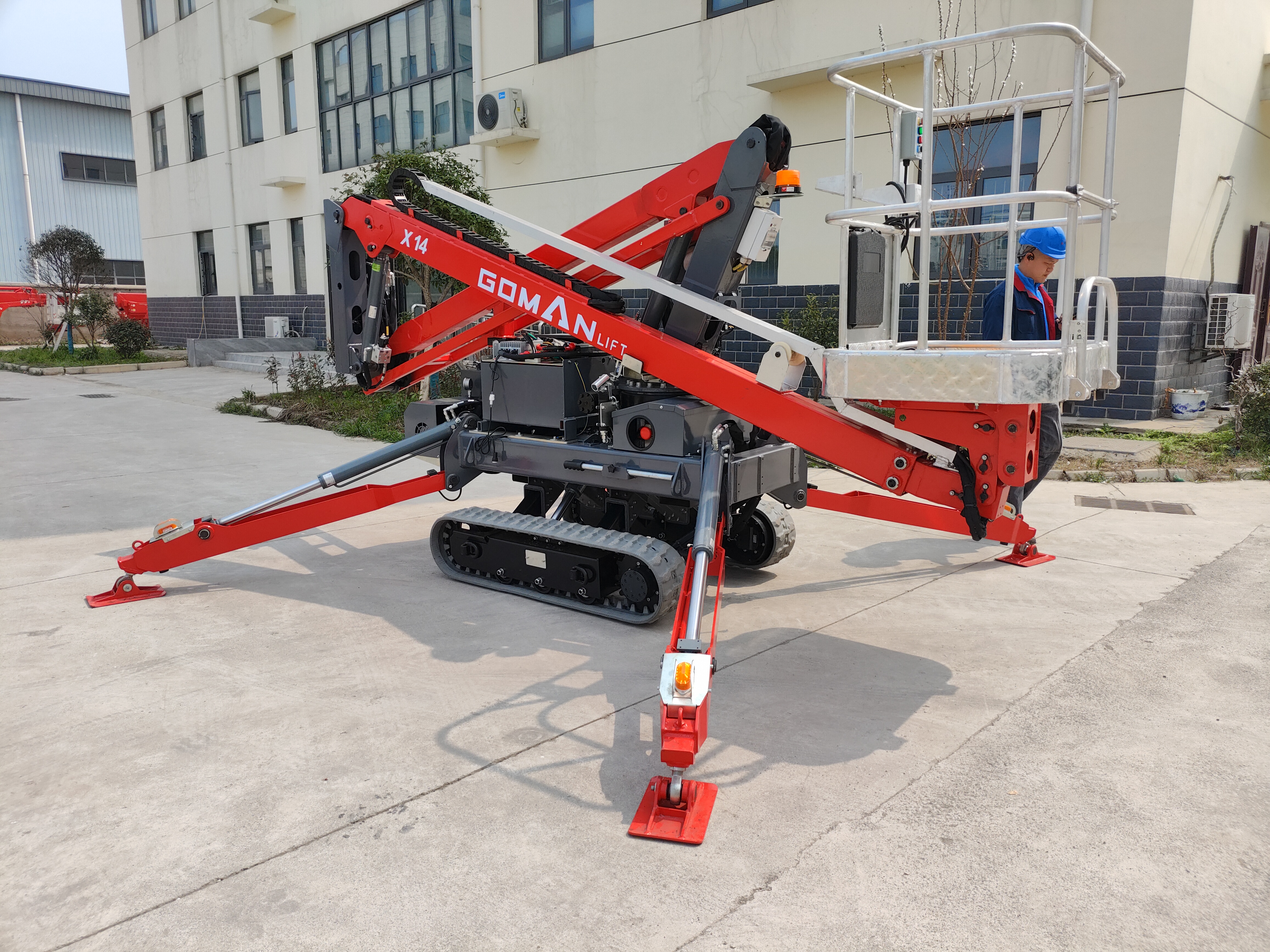
Indoor facility access requires precise dimension evaluation. Standard commercial single doors measure 36 inches wide by 84 inches high. Double doors offer more breathing room, typically spanning 72 inches in width. A purpose-built narrow access spider lift is specifically engineered to clear single door thresholds. You do not need to remove door frames or alter building architecture. The machine drives straight through the opening. However, operators must maintain perfect alignment. A deviation of just a few degrees can cause the tracks or chassis to scrape the door jamb. You must measure the actual clear opening of the door. Panic hardware, heavy-duty hinges, and weather stripping reduce the usable width. A 36-inch door frame often only provides 33 inches of actual clearance. You must measure the tightest point of the opening before attempting to drive the machine inside. Additionally, threshold ramps or uneven floor transitions at the doorway can pitch the machine sideways, instantly eliminating your clearance margins.
The multi-position outriggers fold alongside or over the chassis during transport. Manufacturers use different stowing geometries. Some outriggers fold vertically, while others swing horizontally against the machine's flanks. You must analyze the potential for outrigger overhang. Even when fully stowed, outrigger pads or hydraulic cylinders might protrude past the tracks. This overhang affects the actual transport length and complicates the turning radius in tight hallways. If an outrigger catches a wall during a tight turn, it can cause severe structural damage to the building and the hydraulic system. Micro-switches and sensors on the outriggers must also be protected; if they protrude and strike a wall, the machine's safety computer will lock out all drive functions, stranding the unit in the middle of a hallway.
Outrigger Stow Style | Impact on Transport Width | Impact on Transport Length |
|---|---|---|
Vertical Fold | Minimal (Stays within track width) | Adds height, keeps length short |
Horizontal Swing | Can add 1-2 inches if pads protrude | Extends past chassis, increasing length |
Over-Chassis Nesting | Zero impact on width | Zero impact on length, highly compact |
You cannot achieve the advertised minimum stowed width and length with the operator platform attached. Removing the basket is a mandatory operational requirement for narrow access. Top-tier manufacturers utilize quick-disconnect systems for this exact purpose. These systems allow a single operator to detach the basket in minutes without specialized tools. You must factor this detachment time into your operational schedule. Reattaching the basket on the other side of the obstacle requires careful alignment of the securing pins and verification of the control connections. Storing the detached basket on the transport trailer is common, but if you need it indoors, you must manually carry it or use a separate material cart to move it through the facility.
Disconnect the safety harness anchor points from the main boom bracket.
Unplug the electronic control cable from the basket console.
Remove the primary securing pins holding the basket to the jib bracket.
Lift the lightweight aluminum basket off the mounting hooks.
Store the basket separately on a transport cart or carry it manually through the doorway.
Transporting a folded lift between floors in multi-story facilities presents unique logistical hurdles. Shopping malls, atriums, and office buildings rely on freight elevators for equipment movement. You must cross-reference the machine's stowed length, height, and gross weight against the elevator's payload capacities. Standard freight elevators often max out at 5,000 to 8,000 pounds. A high-reach machine can easily exceed these limits. You must also measure the internal cabin dimensions. A machine might fit through the elevator doors but prove too long for the cabin depth. Diagonal loading is sometimes possible, but it requires precise steering and carries a high risk of damaging the elevator walls. Always verify the elevator's weight capacity plate before loading the machine. Furthermore, the point load of the tracks on the elevator floor can cause damage; placing steel plates or heavy plywood on the elevator floor distributes the weight safely.
Matching the folded length and operating weight of the lift to the correct trailer ensures safe transport between job sites. Standard tilt-deck or drop-deck trailers work well for smaller models. You must verify the trailer's payload capacity exceeds the machine's gross weight, including any detached accessories like the basket or heavy-duty track mats. DOT compliance dictates weight limits for non-CDL transport. Smaller units often fall under these thresholds, allowing transport with standard heavy-duty pickup trucks. However, 90-foot models require heavy-duty hauling setups. You must ensure the trailer deck is long enough to accommodate the stowed boom without exceeding rear overhang regulations. A trailer that is too short forces the boom to hang over the rear edge, creating a severe traffic hazard and violating transport laws. Check the trailer's axle ratings and tongue weight limits before loading.
Loading a folded lift onto a trailer ramp introduces breakover angle constraints. The breakover angle is the maximum angle a vehicle can drive over without the undercarriage scraping the apex. These machines feature a very low center of gravity. This design provides excellent stability during operation but creates severe ground clearance challenges during steep ramp transitions. If the ramp angle is too aggressive, the machine will high-center. The tracks will lose traction, and the chassis will drag against the ramp hinge. Operators must use longer ramps or position the trailer on a slope to decrease the loading angle. Expanding the tracks slightly during loading can also raise the chassis just enough to clear the transition. For extremely steep ramps, using a trailer-mounted winch to assist the machine prevents track slippage and provides controlled loading.
Securing the chassis requires strict adherence to standard ANSI/OSHA compliant tie-down protocols. You cannot simply strap the machine down anywhere. Manufacturers provide designated, reinforced tie-down points on the lower chassis. You must use appropriately rated chains and binders. The folded configuration heavily shifts the machine's center of gravity. The heavy turret and engine block sit at one end, while the lighter boom extends to the other. Operators must position the machine precisely over the trailer axles. Incorrect load distribution causes severe trailer sway at highway speeds. Too much weight behind the axles lifts the tow vehicle's rear wheels, while too much weight forward overloads the hitch. Always cross your chains to prevent lateral movement during transit.
Rolling transport is sometimes impossible. Lowering a machine into a subterranean shaft or lifting it over a high retaining wall requires crane hoisting. You must utilize the OEM-designated lifting eyes integrated into the folded chassis. Never wrap slings around the boom sections or outriggers. Rigging requirements demand a four-point lift to maintain a balanced load. The rigger must calculate the exact center of gravity for the folded machine. Using spreader bars prevents the lifting chains from crushing the stowed boom components or hydraulic lines during the hoist. Tag lines must be attached to the chassis to control the machine's rotation in the air, especially in windy conditions.
The chosen power source directly impacts the physical space requirements of the chassis. Internal combustion engines require fuel tanks, radiators, and exhaust systems. These components dictate a specific chassis volume. Fully electric motors and battery packs offer a different spatial footprint. A hybrid spider lift integrates both systems. This dual-power approach provides unmatched versatility for both indoor and outdoor use. Engineers must package a small diesel engine alongside an electric motor and a battery bank. Surprisingly, this dual setup rarely increases the overall stowed length. Manufacturers optimize the internal chassis layout to absorb the extra components without expanding the external dimensions. The internal packaging simply becomes much denser, requiring careful routing of cooling lines and electrical harnesses to maintain proper airflow.
Integrating heavy battery banks requires structural compromises. Lithium-ion batteries offer high energy density in a small package, minimizing footprint changes. Lead-acid batteries are significantly larger and heavier. Engineers typically place these heavy battery banks as low as possible within the chassis. This placement lowers the machine's center of gravity, improving transport stability. However, accommodating large battery packs can sometimes force a slight increase in the overall stowed height. The chassis covers might sit an inch or two higher to clear the battery terminals. You must verify the exact stowed height of the specific power configuration you select, as it may differ slightly from the standard diesel model. The added weight of lead-acid batteries also shifts the center of gravity, which you must account for when positioning the machine on a transport trailer.
Assuming a machine that fits through a door can also turn in the adjacent hallway is a dangerous mistake. You must calculate the turning radius of the folded machine. While a tracked spider lift features zero-turn track capabilities, the physical length of the machine limits maneuverability in tight corridors. When the machine spins on its axis, the front and rear ends sweep a wide arc. You must account for the swing tail and boom overhang when folded. If a hallway intersects at a 90-degree angle, the machine might lack the necessary clearance to complete the turn, even if the hallway width exceeds the machine's stowed width. Always use spotters at the front and rear when navigating blind corners to prevent the boom tip from punching through drywall.
Driving a dense, heavy machine across sensitive flooring poses massive risks. Marble floors, raised computer floors, and gymnasiums have strict weight limits. When the machine's tracks are fully retracted for transport, the entire weight concentrates onto a very narrow footprint. This drastically increases the point-load pressure (PSI) exerted on the floor. You must verify the subfloor structural integrity before tracking the machine indoors. Mitigation strategies are mandatory to prevent cracking tiles or collapsing raised floors.
Lay down heavy-duty track mats to distribute the weight across a larger surface area.
Use thick plywood sheets over sensitive tile or marble floors.
Calculate the exact PSI based on the machine's gross weight and track contact area.
Avoid sharp turns on finished floors to prevent track scuffing and tile cracking.
Relying solely on spec sheet chassis dimensions often leads to failure. Spec sheets sometimes list the bare chassis width without accounting for protruding components. Hydraulic hoses, external control boxes, and safety sensors often extend past the primary steel frame. A control box mounted on the side might add two inches to the overall width. An emergency stop button or a poorly routed hydraulic line can catch on a door frame and rupture. You must conduct physical site surveys. Measure the widest fixed point of the specific machine model you intend to use. Never assume a 35-inch machine will glide through a 36-inch door without careful guidance and spotters.
To ensure successful deployment and avoid logistical failures when transporting your access equipment, execute the following steps:
Request detailed technical dimension sheets from the manufacturer for your exact model and power configuration.
Schedule a physical site walk-through to measure the clear openings of all doors, hallways, and freight elevators.
Match the machine's folded dimensions and gross weight to an appropriate transport trailer with adequate payload capacity.
Establish a clear field protocol for basket detachment and floor protection before the machine arrives on site.
A: Most models retract to a width between 31 and 35 inches. This narrow profile allows the machine to pass easily through standard 36-inch commercial single doorways without requiring building modifications or door frame removal.
A: Yes. These machines feature hydraulic track retraction systems. The operator can pull the tracks inward flush against the chassis, reducing the overall width specifically to clear standard commercial door frames.
A: Transport weights vary significantly by reach capacity. Small 40-foot units weigh around 3,000 to 4,000 pounds. High-reach models exceeding 90 feet can weigh over 10,000 pounds. This weight directly impacts trailer selection and indoor floor loading limits.
A: Yes, basket removal is standard practice to achieve the minimum advertised transport length and width. Manufacturers equip the baskets with quick-release pins and disconnect cables to make this process fast and efficient for a single operator.
A: Trailer size depends on the specific model's folded length and gross weight. Generally, you need a tandem-axle utility or tilt-deck trailer with a payload capacity exceeding the machine's weight by at least 20% to ensure safe highway transport.
