


No.188 Doubu Avenue, Hannan District, 430090 Wuhan, China


Views: 0 Author: Site Editor Publish Time: 2026-08-24 Origin: Site


High-value indoor facility maintenance demands significant working height. Atriums, museums, gymnasiums, and airports all require regular elevated access for lighting, HVAC, and architectural upkeep. However, traditional heavy booms and wheeled scissor lifts pose catastrophic risks to sensitive flooring. They often cause cracked tiles, crushed subfloors, and permanent tire scuffs. Facility managers face a highly complex logistical balancing act. You must meet demanding vertical reach requirements. At the same time, you must strictly adhere to architectural floor load limits (measured in psf or kPa). These indoor projects also carry strict zero-damage mandates from building owners.
A tracked spider lift solves this complex challenge. It utilizes engineered weight distribution and specialized undercarriage materials. The design relies on precise, calculated load management. This allows operators to deploy heavy access equipment safely on highly fragile surfaces. In this article, you will learn the exact mechanics behind ground bearing pressure. We will explore how multi-position outriggers bypass weak structural grids. You will also discover key equipment shortlisting criteria for your next sensitive indoor project.
Displacement over Point Load: Continuous rubber tracks distribute the machine’s weight over a vast surface area, drastically lowering Ground Bearing Pressure (GBP) compared to solid tires.
Surface Material Compatibility: White non-marking rubber tracks and specialized outrigger pads prevent scuffing and friction damage on polished stone, wood, and epoxy.
Zero-Emission Operation: Hybrid and lithium-ion power options eliminate exhaust soot and reduce the risk of hydraulic/combustion fluid spills on finished floors.
Controlled Deployment: Multi-position outriggers allow operators to bypass weak subfloor sections (like access panels or utility trenches) and anchor only on structural strong points.
A floor's weight capacity relies heavily on how an object meets the surface. It is not simply a matter of total machine weight. Point load refers to mechanical force concentrated on a microscopic footprint. Distributed load spreads this exact same force across a much larger surface area. Brittle materials like ceramic tile and marble possess very low tensile strength. They snap instantly under excessive point loads. Architectural engineers calculate floor limits carefully to prevent this structural failure.
Traditional wheeled lifts create severe point load hazards indoors. They concentrate thousands of pounds onto four small contact patches. Solid rubber tires press aggressively into the finished floor. This localized force frequently exceeds the PSI (pounds per square inch) tolerances of raised access flooring. It stresses the underlying subfloor joists. Over time, heavy wheeled equipment will permanently compromise the structural integrity of commercial lobbies. The intense pressure easily shatters expensive granite slabs.
A continuous tracked undercarriage eliminates this critical structural threat. These access machines utilize long, reinforced rubber belts. The tracks spread the equipment mass evenly along the entire length of the chassis. Because of this drastically expanded contact patch, the machine exerts exceptionally low ground bearing pressure. In fact, a heavy tracked model often exerts less ground pressure per square inch than an average adult wearing high heels. Facility managers can confidently drive them across polished museum floors. The physics of weight displacement ensures the surface remains completely intact.
Floor protection begins long before the equipment reaches the actual workspace. Abrasions and door frame damage frequently happen during initial facility entry. Tight door traversals leave operators very little room for error. Construction crews often scrape hallway walls attempting to squeeze standard equipment into confined indoor lobbies. Building owners routinely spend thousands repairing entryways after maintenance projects conclude.
A narrow access spider lift prevents architectural damage through variable track widths. The chassis uses an advanced hydraulic retracting mechanism. It shrinks the overall machine footprint to fit smoothly through standard 36-inch or 48-inch single doorways. You never have to remove architectural mullions or dismantle glass entranceways. Once inside the main facility, the operator expands the tracks outward again. This wider stance provides vital driving stability across the open floor.
Implementation realities dictate highly careful steering procedures indoors. Tracks distribute weight beautifully in a straight line. However, tracked machines utilize skid steering to turn. Skid steering drives one track forward while reversing the other. This twists the dense rubber directly against the floor surface. This sheer action can cause severe friction burns on sensitive finishes. Polyurethane surfaces and varnished hardwood basketball courts are especially vulnerable to this specific friction.
Best practices dictate strict operational rules during navigation. Operators must use dedicated transition mats on delicate floors. Alternatively, they should execute wide 3-point turns instead of zero-radius pivots. You must strictly avoid pivoting in place. This simple steering adjustment completely eliminates track-twist friction. It preserves the protective clear coat on commercial flooring.
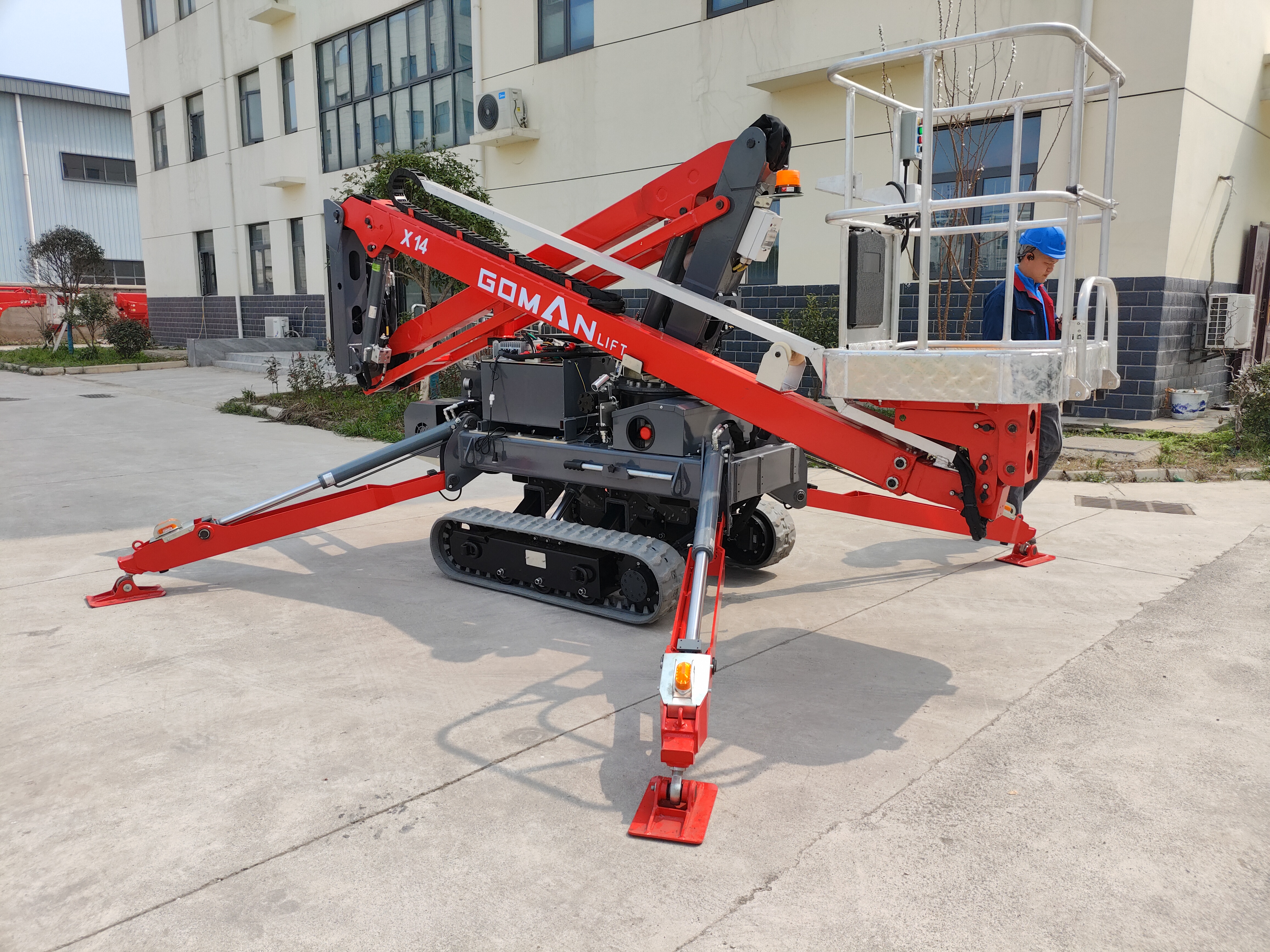
Driving safely into position represents only the first operational phase. Next, the lift must transfer its total weight from the tracks to four outriggers. This deployment phase creates the absolute highest risk for catastrophic floor damage. The machine lifts its entire mass onto four relatively small stabilizing feet. Ground pressure spikes dramatically during this transition. A poorly placed outrigger will instantly crush a hollow floor tile.
Spider lift outriggers feature multi-position articulation to manage this risk. They do not deploy in a fixed, rigid square shape. Operators can place them asymmetrically to suit the immediate environment. This mechanical flexibility proves crucial in complex indoor spaces. You can span safely over delicate floor grids. You can easily avoid HVAC grates and decorative glass floor panels. The operator simply reaches the articulating arms past the fragile zones. They transfer the machine load directly to solid structural concrete seams.
High-density polyethylene (HDPE) outrigger pads are an absolute necessity for indoor work. You cannot place steel or hard rubber outrigger feet directly onto finished stone. Aftermarket or integrated HDPE mats serve as dedicated load spreaders. They take the intense point load of the outrigger foot and disburse it. This effectively brings the final operating pressure well below standard commercial flooring tolerances.
Do not rely on makeshift wooden supports. Never use standard plywood squares for heavy outrigger deployment. Plywood easily splinters and compresses unevenly under dynamic loads. It absorbs moisture and loses structural integrity. Always mandate engineered HDPE pads designed for specific PSI ratings. These synthetic pads resist deformation and protect the floor perfectly.
An equipment footprint involves more than just physical weight pressure. Chemical transfer and fluid stains pose massive risks to indoor aesthetics. Standard black rubber tracks use aggressive carbon black compounds. These heavy compounds leave permanent dark friction lines on floors. Indoor-approved lifts prevent this aesthetic issue entirely. They utilize specialized non-marking white or gray tracks. Manufacturers formulate these tracks using silica instead of carbon black. They glide cleanly across polished surfaces. They leave absolutely zero black transfer marks behind.
Internal power sources also directly impact floor and environmental safety. Diesel engines vibrate aggressively during operation. They inevitably leak small drops of engine oil. They emit thick exhaust particulates. This exhaust eventually settles as a greasy, dark film on polished floors and expensive artwork. Evaluating a hybrid spider lift is highly recommended for pristine environments. You can also select a full lithium-electric model.
Electric models ensure zero harmful atmospheric emissions. They produce very low ambient vibration. They also rely on significantly reduced internal fluid capacities. This drastically lowers the overall risk of chemical contamination. Indoor air quality remains perfectly balanced during the entire maintenance operation.
Even fully electric models use hydraulic systems for boom articulation. Blown hydraulic hoses remain a serious threat in museums or hospitals. Secondary protection layers provide vital spill containment. Many sensitive facilities mandate the use of chassis diapers. You should also install protective hydraulic line wraps. These specialized wraps catch spraying hydraulic fluid before it touches the expensive flooring. They buy operators critical time to shut down the machine safely.
Facility managers must thoroughly evaluate equipment specifications before finalizing a rental. You must carefully align machine capabilities with internal building structural data. Choosing a compact spider lift requires a highly structured approach. Guesswork leads directly to architectural damage. Use a strict decision matrix to guide your procurement process.
First, verify the exact floor load limit. You must locate the facility’s official structural PSF (Pounds per Square Foot) documentation. Match this engineering data against the lift’s listed maximum track pressure. You must also check the dynamic outrigger bearing pressure. Ensure the floor can handle the localized load when the boom fully extends.
Second, deeply assess the reach-to-weight ratio. Different models offer vastly different operational efficiencies. You want a tracked spider lift providing maximum vertical and outreach capabilities. It should achieve this while maintaining the lightest gross vehicle weight possible. Superior high-strength steel booms make this ratio possible.
Third, confirm the power source compatibility. Electric models require specific charging infrastructure. Ensure your facility electrical system supports the machine's plug-in requirements. Look closely at voltage and amperage constraints before the machine arrives. An incompatible plug renders the machine useless indoors.
Finally, match the outrigger pads to your specific floor type. Hardwood gym floors react very differently than marble stone lobbies. Synthetic running tracks require distinct friction coefficients. You must select pads preventing slippage during full boom extension.
Evaluation Parameter | Focus Area | Facility Requirement |
|---|---|---|
Floor Load Limit Verification | PSF and Point Load matches | Validate structural documentation against lift specifications. |
Reach-to-Weight Ratio | Vertical outreach vs. Gross weight | Prioritize models maximizing height with minimal total mass. |
Power Source Infrastructure | Voltage, amperage, charging time | Ensure facility outlets support specific plug-in/recharge needs. |
Floor Type Compatibility | Friction coefficients of pads | Use distinct load pads for stone, hardwood, or synthetic surfaces. |
You must establish strict protocols before the equipment enters the building. Follow a logical sequence to guarantee a damage-free deployment.
Review the architectural blueprints for hidden utility trenches beneath the floor tiles.
Measure the exact dimensions of all tight doorways along the intended travel path.
Select the correct non-marking track compound and verify outrigger pad material.
Brief the operator on transition mat usage for all major turns.
Tracked access equipment fundamentally transforms high-reach indoor maintenance. These specialized machines completely eliminate severe structural hazards. They turn complex logistical nightmares into highly routine operational tasks. Engineered rubber tracks distribute dense machine mass safely across broad surfaces. Articulating outriggers effortlessly bypass delicate structural zones. Non-marking compounds and electric power units ensure absolute protection for aesthetic finishes.
Take highly proactive steps before finalizing your next equipment selection. You must physically audit your facility floor load limits. Measure every doorway dimension along your intended path. Finally, contact a qualified rental partner or manufacturer directly. Request an on-site equipment sizing consultation. A professional site survey ensures your high-reach project proceeds safely. It guarantees your sensitive floors remain pristine from start to finish.
A: While non-marking tracks distribute weight safely for most commercial floors, 3/4-inch plywood or engineered track mats are highly recommended. You need them for pivoting or turning on ultra-sensitive floors, like basketball courts. This absolutely prevents sheer friction damage caused by the rubber tracks twisting against delicate varnish.
A: It depends heavily on the specific point-load rating of the raised floor. While the tracks may be safe to drive on, you must carefully map the outrigger deployment. Outriggers must align directly with the structural pedestal grid underneath the tiles. You often need custom load-spreading steel plates.
A: A tracked machine typically exerts a highly manageable 4 to 8 PSI while driving on its tracks. Contrast this heavily with wheeled boom lifts, which often exceed 50 PSI. Note that pressure spikes under the outriggers during operation. Because of this localized weight transfer, engineered outrigger pads are completely non-negotiable.
