


No.188 Doubu Avenue, Hannan District, 430090 Wuhan, China


Views: 0 Author: Site Editor Publish Time: 2026-09-27 Origin: Site


Facility maintenance and indoor construction teams face a consistent bottleneck. You must achieve high-level reach in environments burdened by restricted access points, sensitive flooring, and strict zero-emission mandates. Over-specifying your equipment leads to costly problems. A massive machine might fail to fit through standard doors or crack delicate tiles upon entry. Conversely, under-specifying leaves your operators with insufficient up-and-over reach. This failure to clear critical indoor obstacles compromises project safety and creates immediate delays.
Selecting the wrong aerial platform introduces substantial financial and safety risks for any project. To prevent these missteps, you need a transparent, dimension-focused evaluation framework. We will explore how to match the right Crawler Boom Lift to your exact site constraints. You will learn to navigate the realities of floor loading, power mandates, and boom geometry. This guide provides the operational criteria required to ensure a safe, seamless fit for your next indoor application.
Access vs. Deployment: Stowed dimensions dictate entry, but active footprint dictates operational viability—especially when comparing outrigger vs. no-outrigger models.
Floor Loading Realities: Tracked chassis distribute weight effectively, but gross machine weight and ground bearing pressure must align with facility floor limits.
Power Source Mandates: Indoor applications strictly require zero-emission setups (lithium-ion or direct AC power), while bi-energy options bridge the gap for mixed indoor/outdoor projects.
Boom Geometry: Articulating booms are mandatory for up-and-over reach over indoor obstacles (HVAC, production lines, shelving).
Every successful indoor lift deployment begins long before the machine arrives on site. You must meticulously evaluate the physical constraints of your facility. Access pathways dictate whether a machine can even enter the workspace. A failure to measure correctly stops a project on day one.
The stowed width and height of the lift must clear your facility’s narrowest bottlenecks. Standard commercial single doors typically measure 36 inches wide by 80 inches tall. Double doors generally offer about 72 inches of clearance width. However, you cannot rely solely on standard architectural dimensions. You must physically measure the actual clear opening. Door hardware, hinges, and threshold ramps often reduce the usable width by several inches. Operators must also consider the approach angle. A tight hallway turning directly into a narrow doorway requires a machine with an incredibly compact stowed footprint and excellent maneuverability.
Moving a heavy piece of machinery across an indoor floor requires careful mathematical planning. You must understand ground bearing pressure. We measure this in kilopascals (kPa) or pounds per square inch (psi). Ground bearing pressure determines whether your equipment will safely traverse a surface or cause catastrophic structural damage.
You must differentiate between point load and distributed load. Point loads occur when a machine transfers its entire weight onto four small outrigger pads. This concentrates intense pressure on specific spots. Distributed loads occur when tracks spread the machine’s weight over a much larger surface area. Tracked chassis excel at reducing ground bearing pressure. This makes them ideal for fragile surfaces like suspended slabs or raised access floors.
Furthermore, you must mandate the use of non-marking tracks for indoor applications. Standard black rubber tracks leave deep, unsightly scuff marks. White or gray non-marking tracks prevent cosmetic damage to commercial flooring, tiling, or epoxied surfaces. This protects the facility's aesthetic integrity and saves significant cleaning labor.
Indoor operation introduces strict environmental and safety regulations. You must comply with OSHA and ANSI indoor air quality standards. These frameworks strictly prohibit the operation of standard internal combustion engines in unventilated indoor spaces. The buildup of carbon monoxide poses an immediate, fatal risk to workers. Additionally, occupied buildings often enforce strict noise limits to avoid disrupting ongoing operations. These regulatory constraints necessitate specific powertrain choices. You will typically need to specify pure electric or advanced hybrid systems to meet these zero-emission and low-noise mandates safely.
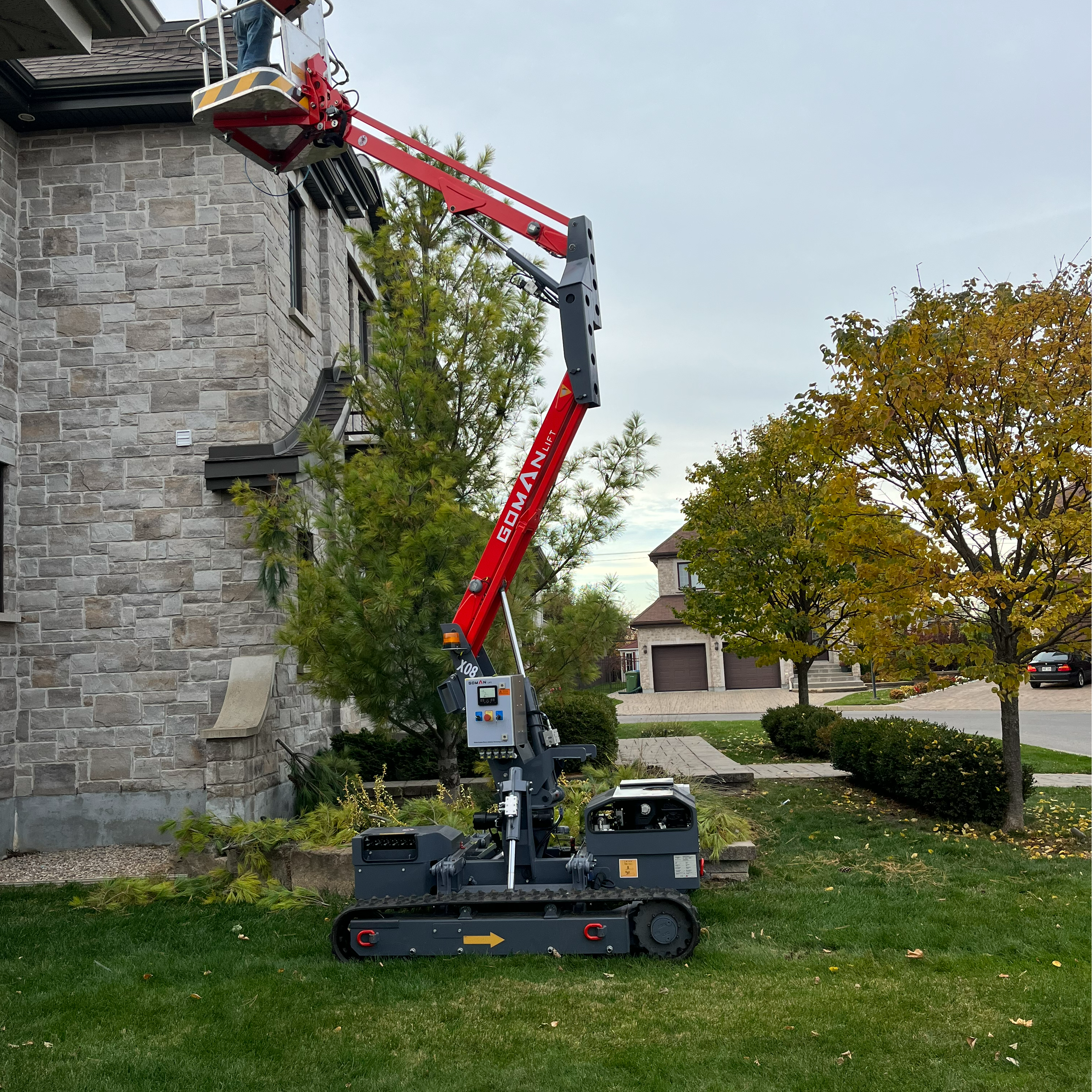
The physical space a machine occupies during operation dictates its usefulness. We must distinguish between the stowed footprint used for travel and the active footprint required for elevation. This distinction fundamentally changes how you approach narrow space maintenance.
Traditional spider lifts provide excellent reach from a very light base machine. However, they achieve this stability by deploying four long outriggers. This outrigger spread creates a massive active footprint. You often cannot deploy these stabilizers in narrow warehouse aisles, crowded production floors, or densely packed retail environments. If an obstacle blocks even one outrigger pad, the machine cannot safely elevate. This severely limits where traditional models can operate.
Advancements in equipment engineering offer a powerful alternative. A crawler boom lift without outriggers eliminates this massive deployment zone. Instead of relying on a wide stabilization web, these machines use heavy internal counterweights. They combine this ballast with a variable-width tracked chassis. The tracks extend slightly for operational stability but remain incredibly compact compared to an outrigger spread. This allows operators to set up the machine in tight corridors where traditional lifts would never fit.
Choosing a no-outrigger aerial lift transforms daily productivity. The most significant advantage is the "drive-at-height" capability. Traditional spider lifts force operators to descend, retract all four outriggers, drive ten feet, and then redeploy the outriggers just to reach the next work zone. This setup and teardown process consumes hours of labor every week. A model lacking outriggers allows operators to remain elevated while driving slowly to the next position. This immediate repositioning eliminates wasted cycle times in confined zones.
You must acknowledge the engineering reality of this design. Eliminating outriggers requires a massive increase in the gross machine weight. The internal counterweights must be heavy enough to prevent tipping. This heavier base impacts floor loading limits. You must carefully verify that the facility floor can support this increased distributed load before deployment.
Reaching the target work area involves more than just vertical elevation. Indoor environments present a complex three-dimensional puzzle. Pipes, ductwork, shelving, and machinery constantly block direct vertical access. The physical geometry of your lift’s boom dictates whether you can navigate this maze.
You must choose between two primary boom structures: telescopic and articulating. Telescopic booms extend straight out like a telescope. They excel at providing pure vertical or horizontal reach. If you have an unobstructed path to a high ceiling, a telescopic boom offers excellent stability. However, they struggle immensely when obstacles sit between the machine base and the target.
An articulating, or knuckle boom, features multiple hinged sections. This geometry is absolutely crucial for a narrow space boom lift. The hinged joints allow the operator to elevate vertically and then reach horizontally over obstacles. You can navigate the basket up and over existing infrastructure. This proves mandatory when servicing HVAC units situated above active assembly lines or suspended lighting above retail shelving.
You must carefully evaluate tailswing when working indoors. Tailswing refers to the rear counterweight extending past the machine's tracks when the turret rotates. In a confined aisle, a large tailswing causes the rear of the machine to smash into walls or racking systems. You should prioritize machines featuring zero or near-zero tailswing. With a zero tailswing model, the counterweight always remains within the width of the chassis. The operator can rotate the boom 360 degrees without fearing a rear collision.
Micro-positioning near delicate indoor infrastructure requires a delicate touch. Moving the entire base machine to adjust the basket by six inches is inefficient and dangerous. A rotating jib extension solves this problem. The jib acts as a final wrist joint at the end of the main boom. It provides small, precise movements up, down, and side-to-side. Operators use the jib to slip the basket between pipes or drop down behind structural beams without ever moving the tracks.
Indoor lifts rarely live their entire lives inside a clean facility. They usually arrive on a flatbed trailer and must navigate the chaotic exterior environment before slipping through the doorway. The transition from rough outdoor terrain to sensitive indoor flooring dictates your traction and powertrain choices.
Before an indoor machine reaches the smooth concrete, it often faces mud, gravel, or steep inclines. A robust tracked boom lift for uneven terrain handles these challenges effortlessly. Tracked chassis feature wide surface contact, preventing the machine from sinking into soft mud. Many models feature track oscillation, allowing the undercarriage to flex over debris while keeping the main chassis level. Excellent gradeability specifications mean these machines can easily conquer 30%+ grade ramps or crawl up short staircases to reach elevated building entrances.
Once inside, the powertrain dictates compliance. You must match the power source to the facility's air quality and logistical requirements.
Direct AC / Plug-in: This setup involves plugging the lift directly into a wall outlet via an extension cord. It provides continuous, unlimited power. However, operators must constantly manage the trailing cable. Cords snag on shelving and limit the operational radius.
Lithium-Ion Battery: This represents the premium standard for an indoor crawler boom lift. Lithium-ion systems offer true cordless, zero-emission operation. They charge rapidly and maintain consistent power output even as the battery depletes. While they command a higher initial capital or rental premium, the operational freedom justifies the expense.
Bi-Energy / Hybrid: These systems provide the ultimate flexibility. They combine a small diesel engine with a robust electric motor and battery bank. You use the diesel engine for outdoor transit, navigating mud, and charging the batteries. Once the machine crosses the threshold indoors, you switch to silent, zero-emission battery power. This configuration proves ideal for phased construction sites where the building envelope remains partially open.
Selecting the right equipment requires a disciplined approach. Haphazard rentals lead to expensive delays. You must process your site constraints through a definitive evaluation matrix. We developed this shortlisting logic to guide buyers and renters toward the safest, most capable equipment choice.
Use the following criteria to narrow your equipment options systematically. Never assume a machine will fit based on a cursory visual inspection. You must verify the engineering specifications against your facility data.
Equipment Evaluation Matrix
Evaluation Category | Critical Question | Pass / Fail Criteria |
|---|---|---|
Stowed Dimensions | Does it fit through the narrowest chokepoint? | Width and height must clear doors, elevators, and corridors. |
Working Outreach | Does it provide horizontal reach over obstacles? | Up-and-over clearance must exceed the height of floor obstacles. |
Floor Load Capacity | Does machine weight exceed structural limits? | Gross weight and ground bearing pressure must remain under facility maximums. |
Emissions | Is it strictly indoor or mixed-use? | Must feature electric or Li-ion for indoors, hybrid acceptable for mixed-use. |
Do not finalize your procurement based solely on a spec sheet. We highly recommend conducting a physical site survey. Walk the exact path the machine will travel from the delivery truck to the final work zone. Measure every door frame and ceiling height along the route. For complex industrial environments, request 3D BIM (Building Information Modeling) models from your rental partner or the manufacturer. Inserting the machine's 3D model into your facility’s digital twin guarantees a flawless fit before the equipment ever arrives on site.
Choosing the correct equipment for tight indoor environments requires a delicate balancing act. You must carefully weigh stowed compactness against active footprint requirements. You must also balance total machine weight against the necessity for profound up-and-over reach. Understanding the distinction between outrigger models and counterweighted tracked units empowers you to optimize your spatial footprint.
Proper selection directly impacts your business outcomes. It mitigates the risk of catastrophic property damage to delicate floors. It ensures strict compliance with indoor air quality regulations. Most importantly, it drastically reduces project downtime by keeping operators safe, mobile, and efficient.
We urge you to take these metrics seriously. Consult with a specialized lifting equipment engineer before your next major indoor project. Browse specific equipment spec sheets meticulously to ensure the machine parameters perfectly match your facility constraints.
A: Yes. Most models are designed specifically to transition from outdoor construction sites to indoor spaces. They feature track oscillation and high gradeability specifications. This allows the undercarriage to navigate deep mud, gravel, and gradients exceeding 30%. The tracks distribute the machine's weight, preventing it from sinking into soft ground before it climbs the ramp into the facility.
A: Spider lifts use four deployable outriggers to create a wide, stable base. This keeps the machine weight very low but requires a large deployment footprint. No-outrigger models use heavy internal counterweights for stability instead. This results in a heavier gross machine weight, but it provides a much smaller active footprint and allows operators to drive the machine while elevated.
A: You must specify "non-marking tracks" when ordering your equipment. These tracks use white or gray rubber compounds that do not leave black scuff marks on tile, epoxy, or concrete. For highly delicate surfaces, you should also utilize temporary floor protection mats. Placing mats under the tracks during sharp turns prevents friction from tearing the floor's top layer.
