


No.188 Doubu Avenue, Hannan District, 430090 Wuhan, China


Views: 0 Author: Site Editor Publish Time: 2026-07-12 Origin: Site


Utility crews and arborists constantly battle unforgiving environments to access high-voltage infrastructure. You frequently navigate restricted right-of-ways, muddy off-road trails, and sensitive residential terrains. Traditional heavy bucket trucks simply cannot reach these confined operational zones. Deploying an insulated spider lift elegantly solves this physical access problem. It provides extreme mobility and unmatched reach in challenging site conditions.
However, acquiring this equipment without meticulously verifying its dielectric and mechanical certifications introduces severe compliance gaps. Failing to audit these crucial documents exposes your entire operation to catastrophic safety liabilities. You face massive regulatory fines and fatal electrical risks if equipment fails. You need a reliable strategy to vet equipment before finalizing any procurement decisions.
This article provides a rigorous framework for evaluating and shortlisting these specialized machines. We will explore how you can definitively verify compliance across various regulatory standards. You will learn to identify key engineering features, ensuring complete high-voltage protection for your frontline operators.
An insulated spider lift must possess verifiable, independent certifications (ANSI/CE) specific to its dielectric rating, not just structural stability.
OEM insulated aerial lifts significantly reduce liability compared to aftermarket retrofits, ensuring factory-tested fiberglass boom sections and compliant hydraulic isolation.
Operator certification (OSHA guidelines) and machine certification are distinct; fleets must account for ongoing periodic dielectric testing to maintain compliance.
Procurement should evaluate units based on specific voltage ratings (e.g., 46kV), ground-bearing pressure, and footprint.
Utility contractors and tree care professionals face intense logistical hurdles daily. You often encounter strict backyard easements requiring narrow gate access. You must cross soft, muddy ground during storm recovery efforts. These environmental factors quickly disqualify heavy, road-going bucket trucks. Standard tracked machines easily solve this physical access problem. They navigate rough terrain and distribute their weight effectively. However, standard models offer absolutely zero high-voltage electrical protection.
This limitation creates a dangerous operational gap. You need a specialized high-voltage insulated lift to bridge it safely. These highly specialized units combine tracked mobility alongside dielectric fiberglass boom sections. They protect operators working in close proximity to energized distribution or transmission lines. The fiberglass insert prevents electrical current from traveling down the boom structure to the ground.
Ignoring proper equipment specifications invites immediate disaster. Procuring uncertified or improperly rated equipment leads to massive regulatory fines. It voids your corporate liability insurance policies instantly. Most importantly, it introduces fatal electrocution risks for your ground crews and operators. You cannot compromise on dielectric integrity to save money. Rigorous risk mitigation must drive every procurement decision you make.
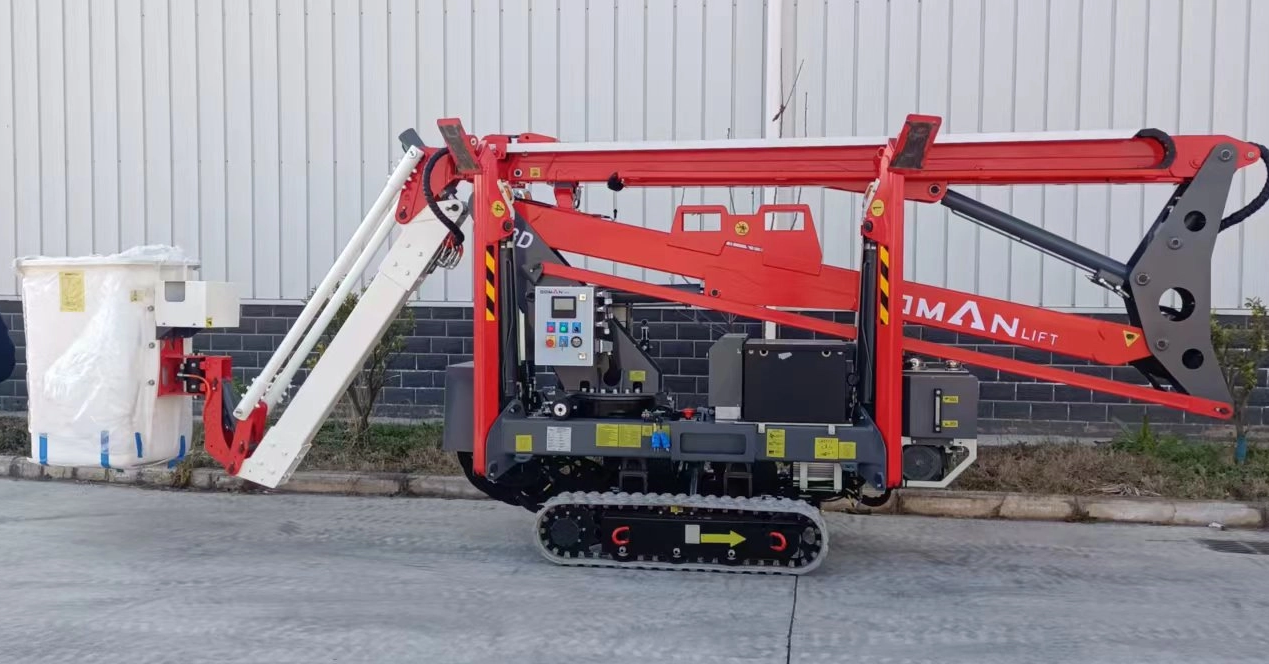
North American operations rely heavily on stringent safety standards. You must understand what an ANSI certified boom lift actually entails for utility work. The ANSI A92.2 standard governs vehicle-mounted elevating and rotating aerial devices. This specific standard explicitly defines dielectric testing protocols. It mandates rigorous baseline testing for fiberglass components before market deployment. Manufacturers must prove the boom can withstand specific kilovolt loads while maintaining acceptable leakage current levels.
European markets and global fleets follow different certification directives. A proper CE certified spider lift meets the EN 280 standard. EN 280 primarily dictates structural stability, chassis leveling, and load calculations. However, insulated models require additional specialized electrical isolation proofs. Manufacturers must demonstrate complete physical separation between the operator basket and the chassis ground. They must also certify the non-conductive nature of the hydraulic hoses traversing the boom.
Procurement officers must demand specific documentation from vendors. Never sign a purchase order without reviewing these critical files. You should request original factory test certificates showing exact leakage current measurements. You must also secure third-party dielectric validation reports from accredited testing laboratories. These documents provide the objective proof required to protect your organization from liability.
Certification Standard | Primary Engineering Focus | Dielectric Testing Protocol | Primary Market Region |
|---|---|---|---|
ANSI A92.2 | Vehicle-mounted aerial safety devices | Mandates specific high-voltage testing criteria | North America |
EN 280 (CE Marking) | Machine stability and load safety | Requires supplementary electrical isolation proofs | Europe / Global Fleets |
Many fleet managers consider retrofitting standard machines to bypass long lead times. You must actively avoid this aftermarket trap. Adding a simple fiberglass basket liner provides a dangerous false sense of security. Wrapping standard steel booms in insulated sleeves creates a massive compliance liability. These superficial fixes completely ignore un-isolated ground controls. They also overlook the severe danger of highly conductive hydraulic fluid traveling down the boom structure.
You must specify an OEM insulated aerial lift for true operational safety. Original Equipment Manufacturers engineer these machines systematically from the ground up. They incorporate dedicated factory-engineered isolation gaps within the boom architecture. They utilize integrated fiber-optic controls to eliminate all conductive copper wiring between the basket and the base. OEM solutions also provide comprehensive manufacturer-backed warranties covering both structural and dielectric performance.
You should carefully audit all manufacturer engineering claims before purchasing. Look closely for fully insulated fiberglass boom sections integrated directly into the structural design. Do not accept temporary sleeves or basic basket liners as a substitute for true isolation.
Best Practice: Always request the exact engineering schematic showing the dielectric gap placement and hose isolation methods.
Common Mistake: Assuming a standard machine becomes safe simply by changing the hydraulic oil to a non-conductive variant. The entire physical structure must completely isolate the operator from the ground.
Procuring compliant equipment represents only the first step in your safety journey. You must clearly understand the strict difference between machine and operator certification. A machine possesses a specific dielectric rating based on laboratory testing. Conversely, operators require dedicated regulatory training for working near power lines. One certification does not replace or negate the other. Both must remain active and documented.
Institutional-grade inspection protocols prevent catastrophic field accidents. Implement robust pre-operation checklists across your entire fleet. Operators must inspect the equipment meticulously every single day.
Inspect all fiberglass sections closely for microscopic cracks, abrasions, or deep scratches.
Check the entire insulated boom surface for dirt, grease, salt, or moisture contamination.
Verify there are absolutely no hydraulic leaks near the isolated sections.
Ensure the internal desiccant canisters remain active to prevent moisture buildup inside the boom.
Dielectric properties degrade naturally over time due to field conditions. Constant UV exposure, dirt accumulation, and physical wear slowly reduce insulation effectiveness. You must schedule periodic recertification. Industry regulations demand strict annual or bi-annual dielectric testing based on usage intensity. This ongoing maintenance keeps your fleet fully compliant and your crews safe.
Selecting the right machine requires careful operational alignment. You must match the equipment capabilities directly to your daily field challenges. A properly specified insulated spider lift completely transforms your workflow efficiency. Follow these key evaluation criteria when building your procurement shortlist:
Define the Voltage Threshold: Match the dielectric rating to your specific environmental hazards. Distribution lines require different protective ratings than high-voltage transmission lines. Target units offering verified 46kV or 69kV categories based on your typical project scope.
Assess Terrain and Footprint: Evaluate the machine's ground-bearing pressure (psi) carefully. Ensure it safely traverses sensitive residential lawns without causing damage. Check the outrigger leveling capabilities for deployment on steep off-road slopes. Verify the stowed dimensions fit easily through standard 36-inch yard gates.
Power Source Evaluation: Analyze your typical daily deployment environments. Diesel engines suit remote, rugged locations exceptionally well. Lithium-ion or hybrid power systems meet strict municipal emissions compliance and reduce noise in residential zones.
Next Steps: Request comprehensive on-site demonstrations from top vendors. Review the vendor's service level agreement (SLA) in detail. Ensure they provide rapid replacement parts and offer reliable annual dielectric testing support.
Investing in specialized aerial equipment represents a significant operational commitment for any fleet. However, it is primarily an investment in risk mitigation and guaranteed site access. You secure reliable physical entry into tough environments while actively protecting human lives. Uncompromising electrical safety must remain the ultimate priority for any utility contractor or arboriculture operation.
Rigorous documentation review stands as your crucial first line of defense. Auditing ANSI, CE, and OEM testing certificates is just as important as evaluating the physical track capabilities. Do not let impressive mobility specs distract you from mandatory electrical safety requirements. The machine must protect the operator completely under energized conditions.
Take immediate action to protect your field crews. Consult directly with a dedicated aerial lift specialist today. Review your current inventory carefully and request updated, specific compliance documentation for every insulated unit currently in your fleet.
A: A boom lift represents a broad category of aerial work platforms. Many standard boom lifts hold ANSI certification for structural safety but offer zero electrical protection. An insulated spider lift specifically requires stringent dielectric ratings under ANSI A92.2. It combines high-voltage electrical isolation with specialized track-based mobility for off-road access.
A: Industry standards typically require comprehensive dielectric testing annually. However, this timeline varies based on local jurisdiction, specific OSHA guidelines, and overall usage intensity. Frequent use in harsh, dirty environments may necessitate bi-annual testing to guarantee the fiberglass boom maintains its protective non-conductive properties.
A: No, you should never attempt this. Retrofitting introduces severe engineering and liability risks. Standard machines feature conductive hydraulic lines and un-isolated ground controls. A simple aftermarket fiberglass basket cannot protect an operator from current traveling down the boom. We strongly advocate against non-OEM retrofits.
A: Yes. Operators need specific training to run aerial lifts safely. Additionally, working in proximity to high-voltage lines requires specialized electrical hazard training under OSHA guidelines. The machine's dielectric certification protects against accidental contact, but the operator must still hold proper regulatory credentials for the job site.
