


No.188 Doubu Avenue, Hannan District, 430090 Wuhan, China


Views: 0 Author: Site Editor Publish Time: 2026-01-02 Origin: Site


A self-propelled boom lift is a powerful and versatile machine designed to provide elevated access for workers performing tasks at great heights. Unlike traditional lifts that require external power sources or manual labor to move, self-propelled boom lifts come with their own drive system, allowing them to be driven and maneuvered around a job site. Understanding the category of self-propelled boom lifts and how they fit into the larger aerial work platform (AWP) classification is essential for professionals looking to choose the right equipment for their projects. In this article, we will break down the different types of aerial work platforms, explore the unique features of self-propelled boom lifts, and discuss their applications across various industries. Goman Heavy Industry Technology Co., Ltd., a leading manufacturer of aerial work platforms, including self-propelled boom lifts, offers top-of-the-line equipment that enhances safety and productivity on job sites.
Before delving into the self-propelled boom lift category, it's essential to understand where it fits in within the broader classification of aerial work platforms (AWPs). AWPs are equipment used to lift personnel and materials to elevated work areas, and they come in a variety of types, each suited for different tasks.
Scissor lifts are commonly used for tasks that require vertical elevation in a stable environment. They operate using a crisscrossing scissor mechanism that extends and contracts to lift the platform. While they offer great stability and load-bearing capacity, scissor lifts are typically restricted to vertical movement and are best suited for tasks in confined spaces or with minimal horizontal reach.
Mast lifts are similar to scissor lifts but are designed for use in narrower spaces and can be more easily maneuvered in tight environments. These lifts are compact and lightweight, making them ideal for indoor applications like maintenance in warehouses, retail environments, and office buildings.
Boom lifts, including self-propelled boom lifts, are designed to offer both vertical and horizontal reach. These lifts use a hydraulic arm (the "boom") to extend the platform to greater heights and farther distances. Unlike scissor lifts, boom lifts are capable of navigating obstacles and reaching over structures, making them ideal for outdoor and complex tasks. They can be equipped with jibs for increased flexibility and precision.
Bucket trucks, or cherry pickers, are a type of AWP commonly used in utility work, such as power line maintenance and tree trimming. These trucks have a bucket on the end of a hydraulic arm, allowing workers to be elevated to desired heights. Unlike boom lifts, bucket trucks are typically mounted on vehicles, making them more suited for transportation across longer distances.
A self-propelled boom lift is distinct from other boom lifts in the AWP category due to its ability to move on its own. The self-propelled feature sets it apart from towable boom lifts, which require an external power source to move the lift from one location to another.
The key difference between self-propelled boom lifts and towable boom lifts lies in their mobility. While towable boom lifts must be hauled to the job site by another vehicle, self-propelled boom lifts can drive themselves to the work area, reducing the setup time and making them more efficient for jobs requiring frequent repositioning.
Self-propelled boom lifts are ideal for job sites where the terrain or layout requires the lift to move over various obstacles, and the ability to drive the lift directly to the required location saves time and effort compared to towing the lift.
Self-propelled boom lifts offer several key features that make them stand out in the AWP category, enhancing their performance and usability.
Self-propelled boom lifts are powered by either electric or internal combustion engines, depending on the model and intended application. Electric models are suitable for indoor tasks where emissions need to be minimized, while gas or diesel-powered models are ideal for outdoor tasks where longer run times and more power are required.
The self-propelled feature enables these lifts to move easily across job sites without needing external equipment. The platform can be driven by the operator directly from the platform, giving them the ability to position the lift exactly where it is needed. This reduces downtime and increases the overall efficiency of the operation.
The addition of self-propelled mobility to a boom lift provides several advantages that make these machines essential for a wide range of industrial applications.
Self-propelled boom lifts can move across rough terrain and tight spaces without requiring a tow vehicle. This mobility is especially beneficial in construction sites, industrial plants, or outdoor environments where the ability to move the lift with ease significantly improves workflow.
Because self-propelled boom lifts offer both vertical and horizontal reach, they are ideal for tasks that require access to hard-to-reach areas. Operators can position the platform precisely over the work area, minimizing the need for additional adjustments or repositioning.
The ability to move the boom lift independently means that setup time is drastically reduced. Unlike towable models, which require external equipment to move them, self-propelled lifts can get to the job site faster and start working immediately. This results in higher productivity and less time spent on logistical tasks.
Self-propelled boom lifts are used across various industries where mobility, reach, and flexibility are paramount. Below are some typical applications where these lifts shine.
On large construction sites, self-propelled boom lifts are invaluable for quickly reaching high work areas such as building facades, rooftops, and structures in expansive environments. These lifts can easily traverse the site without the need for external transportation, ensuring that the operators can work efficiently without delay.
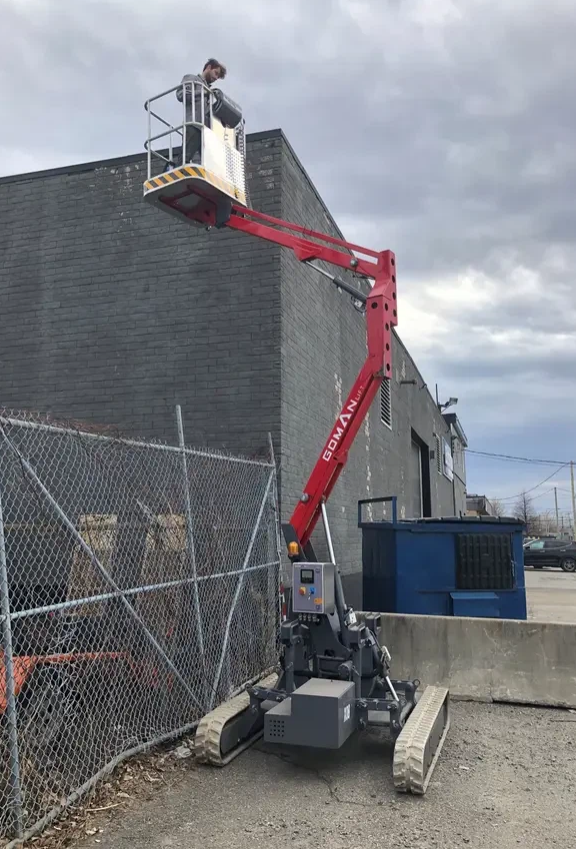
Self-propelled boom lifts with tracks (crawler boom lifts) are particularly useful for rough terrain operations. Their ability to navigate uneven ground, muddy surfaces, or gravel makes them ideal for outdoor construction, forestry work, or maintenance tasks in rugged environments.
Goman Heavy Industry Technology Co., Ltd. offers a range of self-propelled boom lifts, including the crawler boom lift, which is designed for use on challenging outdoor job sites. These products come equipped with advanced features that provide enhanced mobility, stability, and precision.
Tracked Base: Crawler models offer superior stability on uneven ground, making them ideal for construction and maintenance in areas with rough or rocky terrain.
Enhanced Reach: With both vertical and horizontal reach, self-propelled boom lifts can access a wide range of areas, reducing the need for repositioning.
These self-propelled boom lifts are designed to meet the highest industry standards, providing operators with reliable, flexible, and safe solutions for aerial work.
In conclusion, self-propelled boom lifts are an essential tool in the boom lift category, offering unmatched mobility, flexibility, and efficiency for various industries. By combining self-driving capability with the versatility of a boom lift, these machines allow for faster, safer, and more precise access to elevated work areas. Goman Heavy Industry Technology Co., Ltd. provides top-quality self-propelled boom lifts that enhance productivity and safety on the job site. For more information about how self-propelled boom lifts can improve your projects, contact us today.
1. What is the main difference between a self-propelled boom lift and a towable boom lift?
A self-propelled boom lift has its own power and drive system, allowing it to move independently, while a towable boom lift requires an external vehicle to be moved.
2. How does a self-propelled boom lift improve work site efficiency?
It reduces setup time and allows for quick repositioning across the site, improving the workflow and reducing downtime.
3. What are the benefits of using a crawler self-propelled boom lift on rough terrain?
Crawler boom lifts provide superior stability and traction on uneven surfaces, making them ideal for outdoor construction, forestry, or maintenance tasks.
4. Can self-propelled boom lifts be used indoors?
Yes, electric self-propelled boom lifts are suitable for indoor applications, offering the same mobility and flexibility as outdoor models without emissions.
