


No.188 Doubu Avenue, Hannan District, 430090 Wuhan, China


Views: 0 Author: Site Editor Publish Time: 2026-09-01 Origin: Site


Deploying the wrong Mobile Elevating Work Platform (MEWP) on challenging terrain introduces severe operational risks. Sinking equipment, tipped lifts, damaged property, and cascading project delays happen when you mismatch machinery to ground conditions. Traditional wheeled boom lifts require stable, flat, and heavily compacted surfaces. This leaves contractors, arborists, and facility managers struggling to safely access heights on slopes, soft turf, or fragile indoor flooring.
A tracked spider lift provides a specialized solution designed for low ground pressure and multi-terrain leveling. By utilizing an expanding track base and independent outriggers, these machines bypass the limitations of wheeled lifts. You must evaluate specific site conditions against the machine's mechanical limits before deployment. This guide outlines how to assess load-bearing capacities, navigate extreme gradients, and transition between rugged outdoor environments and sensitive indoor spaces safely.
Ground Pressure Distribution: Tracked chassis distribute machine weight over a larger surface area, preventing sinkage in soft soils and minimizing damage to delicate landscaping or indoor flooring.
Slope and Gradient Superiority: Independent, multi-position outriggers allow these lifts to self-level on uneven terrain, embankments, and gradients where traditional lifts cannot legally or safely operate.
Indoor-to-Outdoor Versatility: Utilizing a hybrid spider lift with non-marking tracks enables seamless transitions from rugged outdoor terrain to sensitive indoor environments without emissions or surface damage.
Operational Realities: While highly capable, spider lifts require rigorous site assessment for subsurface voids, proper outrigger cribbing, and a higher degree of operator proficiency compared to standard aerial lifts.
Evaluating ground pressure requires understanding two distinct operational phases: transit and deployment. During transit, the rubber tracks distribute the machine's entire weight over a wide surface area. This results in exceptionally low ground pressure, often measured in pounds per square inch (PSI) or kilopascals (kPa). A tracked machine can easily drive over soft turf without leaving deep ruts. However, the physics change entirely once the machine reaches the work zone.
During operation, the tracks lift off the ground. The entire weight of the machine, plus the operator and materials in the basket, transfers to four independent outrigger pads. This creates intense point loading. You must calculate the required load-bearing capacity of the soil or floor to prevent catastrophic punch-through. If an outrigger exerts 4,000 pounds of force on a 10-inch pad, the ground must support that concentrated load without yielding. Failing to calculate this metric accurately leads to destabilization the moment the boom extends.
Operational Phase | Weight Distribution Method | Typical Ground Pressure | Primary Terrain Concern |
|---|---|---|---|
Transit (Stowed) | Rubber Tracks | 4 to 7 PSI | Surface traction and track slip |
Deployment (Elevated) | Four Independent Outriggers | 3,000+ PSI (Point Load) | Subsurface voids and punch-through |
Terrain evaluation demands a clear distinction between gradeability and leveling capability. Gradeability refers to the maximum slope the machine can physically drive up or down while stowed. Many tracked lifts feature exceptional gradeability, allowing them to climb steep embankments or navigate ramps to reach a work area. The low center of gravity during transit keeps the machine stable.
Leveling capability dictates the maximum slope on which the machine can safely deploy its outriggers and elevate the boom. Industry standards generally cap operational slopes at specific angles, often between 15 and 20 degrees, depending on the manufacturer's load chart. The outriggers must articulate enough to create a perfectly level chassis base. If the slope exceeds the stroke length of the downhill outrigger cylinders, the machine cannot achieve a zero-degree operating base and will lock out boom functions to prevent a tip-over. Operators frequently encounter situations where a machine can easily drive up a 30-degree grade but cannot legally or mechanically deploy outriggers on that same incline.
Terrain evaluation extends beyond the final setup site; it must include the entire pathway required to get there. Standard boom lifts often fail simply because they cannot fit through the access points leading to the work zone. You must measure gate widths, doorway clearances, and the turning radius of tight corridors.
A narrow access spider lift solves these logistical bottlenecks. These machines feature hydraulically retractable tracks that shrink the overall width, allowing them to pass through standard single doorways or narrow residential gates. Arborists frequently use these lifts for backyard crown reductions. The machine navigates tight side-yards, bypasses residential bottlenecks, and tracks over manicured lawns without tearing up the surrounding terrain. Once through the bottleneck, the tracks expand back out for transit stability before final outrigger deployment.
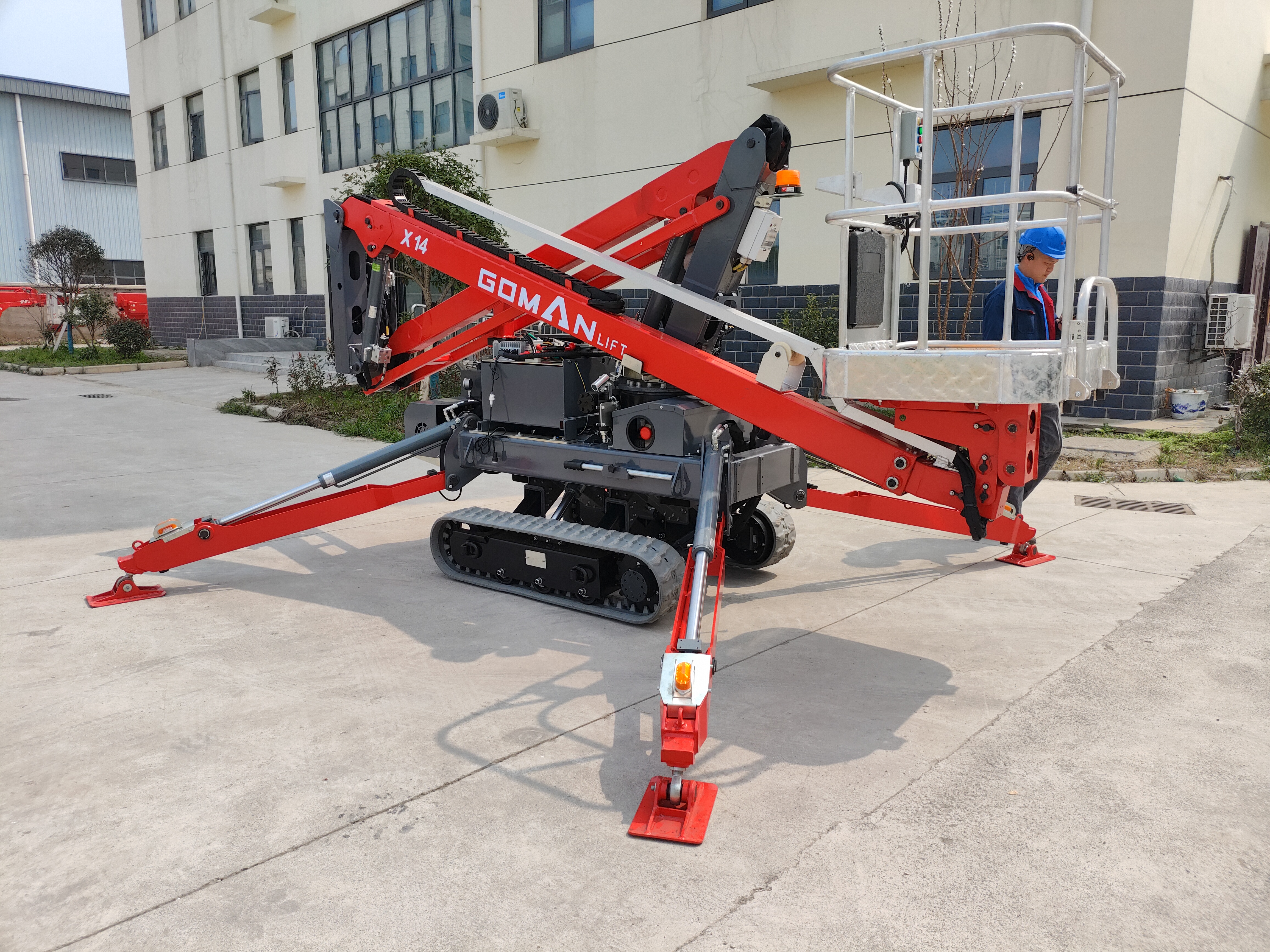
Tracked lifts excel on soft ground because the elongated track footprint prevents the machine from sinking. On loamy soil, wet mud, and manicured lawns, the weight distribution keeps the chassis moving forward where wheeled lifts would immediately bog down and spin out. Track tread selection plays a vital role here. Aggressive rubber treads provide maximum traction in deep mud or loose dirt but can tear up delicate grass during sharp turns. Standard or block-profile treads offer a balance, protecting turf while maintaining adequate grip.
Despite their capabilities, tracks have limitations. When soil becomes overly saturated, it loses all shear strength. Operating in deep, soupy mud risks track-slip. If mud packs tightly into the undercarriage and drive sprockets, it can derail the rubber track entirely. You must assess soil moisture levels before attempting to traverse heavily saturated fields.
Follow these steps to assess soft ground before transit:
Perform a visual inspection for standing water or deep tire ruts left by lighter vehicles.
Use a soil probe or heavy steel rod to test the compaction depth; if the rod sinks easily past six inches, the soil lacks shear strength.
Check the weather history for the past 48 hours to account for recent rainfall that may not be visible on the surface.
Deploy track mats over the travel path if the soil feels spongy underfoot.
Navigating uneven terrain requires a chassis capable of absorbing surface irregularities. Tracked lifts utilize articulating undercarriages that conform to dips and mounds in the ground. This keeps the machine moving smoothly over gravel driveways, construction debris, and rutted paths without violently pitching the mast side to side.
Rocky surfaces present a specific hazard to rubber components. Sharp, jagged rocks can slice into the rubber tracks, exposing the internal steel cables to moisture and rust. Furthermore, driving over large, loose rocks places immense stress on the track tensioning system. If a rock wedges between the idler wheel and the track, it can stretch or snap the rubber. Operators must clear large debris from the travel path and avoid aggressive steering maneuvers on highly abrasive rocky terrain to preserve track longevity. Daily inspections of the undercarriage are mandatory to ensure proper track tension is maintained after navigating rocky sites.
Deploying on steep inclines is the primary reason contractors choose spider lifts. The variable-position outriggers act as spider legs, articulating downward to find solid ground. To achieve a zero-degree operating base on an embankment, the downhill legs extend to their maximum stroke, while the uphill legs remain tucked close to the chassis.
Tight spaces often prevent uniform leg extension. Asymmetric outrigger deployment allows the machine to set up safely even when physical obstacles block a leg. The lift's internal computer calculates the exact position of each outrigger and restricts the boom's swing radius and outreach accordingly to maintain stability. When setting up on multi-tiered terrain, such as near retaining walls, you must ensure each individual outrigger pad rests on solid footing. Placing a pad too close to the edge of a retaining wall risks collapsing the soil beneath it once the boom extends and applies downward force.
Freezing temperatures alter the physical properties of both the machine and the terrain. Hydraulic fluid viscosity increases in extreme cold, which slows down track transit speeds and outrigger leveling functions. You must allow the machine to warm up thoroughly to ensure smooth, predictable boom movements.
Frozen ground provides an excellent, hard surface for outrigger deployment, but ice and snow introduce severe slipping hazards. Rubber tracks lose significant traction on solid ice. Operating on wet or ice-covered slopes risks lateral sliding during transit. Furthermore, outrigger pads can slip on icy surfaces once deployed. You must clear the deployment zones of snow and ice down to bare earth or pavement before setting the outriggers. Winter operations also mask ground hazards beneath snowpack, requiring careful probing of the setup area to identify hidden ditches or debris.
Operating heavy machinery indoors requires absolute surface protection. Standard black rubber tracks leave permanent scuff marks and transfer chemical compounds onto finished floors. Non-marking tracks are mandatory for indoor deployments on tile, hardwood, marble, and polished concrete. These tracks use a different rubber compound that eliminates surface staining.
Navigating smooth indoor surfaces changes the traction dynamics. Polished concrete and sealed tile offer significantly less friction than outdoor dirt or asphalt. Operators must avoid sudden acceleration or sharp, pivoting turns, which can cause the tracks to break traction and slide. Smooth, deliberate joystick inputs are necessary to maneuver safely through lobbies and corridors without damaging the flooring.
Deploying on raised floors, stages, or historic building interiors requires strict adherence to weight limits. While a compact spider lift offers a lower overall machine weight, the point-loading during outrigger deployment remains a critical factor. Suspended floors are engineered to support distributed live loads, not massive concentrated forces on four small points.
You must evaluate the floor's structural capacity before bringing the machine indoors. This often requires consulting structural engineers to verify that the flooring joists and subfloor can handle the anticipated outrigger pressure. Using large, rigid spreader plates under each outrigger pad is universally required indoors to distribute the point load across multiple floor joists, preventing the outriggers from punching through the floorboards.
Standard Commercial Raised Floors: Often rated for 250 pounds per square foot, requiring massive spreader plates to distribute outrigger loads safely.
Polished Concrete Slabs: Generally capable of supporting high point loads, but highly susceptible to scratching from debris embedded in rubber tracks.
Hardwood and Historic Flooring: Extremely fragile; requires non-marking tracks, thick plywood transit pathways, and engineered outrigger cribbing to prevent structural damage.
Facility maintenance often requires a machine that can drive across a muddy courtyard and immediately enter a pristine atrium. A hybrid spider lift provides the ultimate operational advantage for these transitions. These models combine a traditional diesel or gasoline engine with a lithium-ion battery pack and electric motor.
The internal combustion engine provides the high torque and continuous power needed to traverse rugged outdoor terrain and climb steep loading ramps. Once the machine reaches the building entrance, the operator switches to battery power. This eliminates carbon monoxide emissions and engine noise, allowing safe, compliant operation in enclosed, unventilated spaces. The hybrid system ensures you never compromise on outdoor capability or indoor safety.
The defining characteristic of a spider lift is its ability to transform its footprint. In the stowed position, the footprint is exceptionally narrow and compact, designed purely for transit through tight spaces. However, to achieve maximum vertical height and lateral outreach, the machine must deploy its outriggers into a wide, expansive stance.
This creates a spatial trade-off. While the machine can fit through a standard door, it requires a significant amount of clear floor space to actually set up and work. Traditional wheeled boom lifts maintain a static footprint; their heavy counterweights allow them to lift directly from their wheels without deploying outriggers. You must measure both the access pathway and the final deployment zone to ensure the spider lift has enough room to spread its legs.
Efficiency on the job site looks different depending on the machine type. Wheeled boom lifts offer drive-and-lift capabilities. An operator can elevate the basket and slowly drive the machine along a flat concrete slab to paint a wall or install conduit. This allows for rapid repositioning.
Spider lifts require a time trade-off. They cannot be driven while the boom is elevated. Every time you need to move the machine, you must lower the boom completely, retract the outriggers, drive to the new location, deploy the outriggers, and auto-level the chassis before lifting again. The auto-leveling sequence follows a strict mechanical logic. The onboard computer typically lowers the downhill outriggers first to establish a baseline, followed by the uphill outriggers. The system then makes micro-adjustments, pulsing hydraulic fluid to individual cylinders until the chassis inclinometer registers a perfect zero-degree level. Operators must keep their hands clear of the controls during this automated process, as interrupting the sequence forces the computer to restart the leveling cycle from the beginning. You must factor this setup time into your project schedule.
Arborists and specialized tradespeople often note a distinct love/hate dynamic with these machines. On one hand, tracked spider lifts save immense physical endurance. They replace exhausting manual tree climbing, allowing operators to reach the canopy of tall trees safely and comfortably with heavy chainsaws. They eliminate the fatigue of hauling gear up ropes.
On the other hand, they demand high technical proficiency. The multi-terrain setup process requires patience and spatial awareness. The machines are equipped with highly sensitive safety lockouts. If an outrigger loses ground contact by a fraction of an inch, or if the chassis shifts slightly off-level, the onboard computer will instantly lock out all boom functions to prevent a tip-over. Operators must learn to read the terrain, set the outriggers perfectly the first time, and operate the hydraulic controls smoothly to avoid triggering these frustrating but necessary safety systems.
Even with low ground pressure and wide outrigger pads, exceptionally soft or fragile ground requires additional mitigation. Outrigger pads and cribbing blocks are essential tools for dispersing weight. When deploying on soft turf, placing large, high-density polyethylene (HDPE) pads under the outrigger feet increases the surface area, drastically reducing the PSI exerted on the soil.
If the ground is uneven beyond the stroke capacity of the outrigger cylinders, operators use engineered cribbing blocks to build a stable, level base for the outrigger pad to rest on. When building a cribbing stack, operators must use the box crib method. This involves laying two heavy timber blocks parallel to each other, then placing two more blocks on top at a 90-degree angle. This interlocking structure transfers the outrigger weight straight down into the ground without risking lateral collapse. Never stack blocks in a single vertical column, as the vibration from the boom will cause the stack to tip over. Track mats are also used during transit over highly sensitive landscaping to prevent the rubber treads from tearing the grass during turns. You must carry adequate cribbing and matting on every job site to adapt to unexpected ground conditions.
The surface terrain only tells half the story. The most severe implementation risks lie beneath the ground. Deploying heavy machinery over hidden voids guarantees a catastrophic collapse. Residential and commercial sites are riddled with subsurface hazards, including septic tanks, underground utilities, drainage vaults, and poorly compacted backfill.
You must conduct a rigorous pre-operation site survey. Check municipal utility maps, look for manhole covers, and consult with property owners regarding the location of septic fields. Never deploy an outrigger directly over a known trench line or utility corridor. If you suspect a void, relocate the setup zone entirely. The outrigger point loading will easily punch through the thin concrete lid of a septic tank or collapse a loosely filled trench.
Ground conditions are not static; weather alters the load-bearing capacity of soil rapidly. A site that tested perfectly safe in the morning can become hazardous by the afternoon. Sudden downpours saturate the soil, turning hard-packed dirt into slick mud and severely reducing its shear strength.
Thawing ground presents a similar risk. If you set up on frozen earth in the morning, the afternoon sun can thaw the top layer of soil, causing the outriggers to slowly sink. You must continuously monitor outrigger sinkage during operation. If you observe an outrigger pad pressing deeper into the soil, immediately lower the boom, retract the outriggers, and reposition the machine using larger spreader plates to stabilize the load.
To ensure safe deployment and protect your job site terrain, execute the following steps before operating your lift:
Conduct a physical site walk to map out access bottlenecks, measuring all gates and doorways to determine if a narrow access model is required.
Calculate the exact point-loading requirements using the manufacturer's load charts and verify that the soil or indoor flooring can support the concentrated weight.
Procure high-density outrigger pads and engineered cribbing for every deployment to mitigate sinkage on soft turf or uneven slopes.
Specify a hybrid power system if your project requires traversing outdoor terrain before operating inside enclosed, unventilated facilities.
Monitor weather conditions continuously during the workday, adjusting your setup if rain or thawing temperatures compromise the soil's load-bearing capacity.
A: Most tracked spider lifts can safely deploy outriggers and operate on slopes ranging from 15 to 20 degrees, depending on the specific model and manufacturer load charts. The machine's internal sensors will lock out boom functions if the chassis cannot achieve a zero-degree level base.
A: During straight transit, the low ground pressure of the rubber tracks minimizes turf damage. However, sharp turns can tear grass. Using track mats during transit and large spreader plates under the outriggers prevents ruts and protects delicate landscaping.
A: Yes, many narrow access models are designed to climb standard staircases. The tracks span multiple steps, distributing the weight. Operators must verify the structural integrity of the stairs and ensure the slope does not exceed the machine's maximum gradeability.
A: Outriggers provide a wide stabilization footprint, allowing the machine itself to remain incredibly lightweight. This design eliminates the need for massive, heavy counterweights, making the lift light enough to operate on fragile indoor floors and soft outdoor soils.
A: Non-marking tracks are manufactured using a specialized rubber compound that lacks carbon black. This prevents the tracks from leaving dark scuff marks or transferring chemical stains onto polished concrete, tile, or hardwood floors during indoor operation.
A: If an outrigger sinks, the chassis loses its level base. The machine's tilt sensors will immediately detect the shift and trigger a safety lockout, disabling all boom extension and swing functions. You will only be able to retract and lower the basket safely.
