


No.188 Doubu Avenue, Hannan District, 430090 Wuhan, China


Views: 0 Author: Site Editor Publish Time: 2026-10-23 Origin: Site


Traditional aerial lifts handle flat concrete slabs effortlessly. However, they fail quickly on uneven, soft, or steep terrain. They become massive compliance liabilities. You waste countless hours building cribbing. You wrestle manual outriggers just to reach heights safely. We solve this critical problem by merging continuous tracks and active leveling chassis technology. This combination empowers you to work securely on steep grades. You never sacrifice setup speed or safety.
Our guide explores how a Crawler Self-Leveling Scissor Lift actually works in the field. We will help you understand the core mechanics. You can evaluate operational ROI confidently. You will learn how to determine if this tracked equipment is the right investment for your specific job site. Let us dig into what makes these machines essential for modern rough terrain projects.
Purpose: A crawler self-leveling scissor lift combines low ground pressure tracks with a dynamic, sensor-driven hydraulic chassis to maintain a perfectly horizontal platform on steep inclines.
Primary Benefit: Eliminates the need for manual cribbing or outriggers, drastically cutting setup time and mitigating tip-over risks on uneven ground.
Ideal Applications: Essential for agriculture, forestry, exterior building maintenance on slopes, and early-phase construction sites lacking paved surfaces.
Buying Criterion: Procurement should balance gradability specs (often up to 15-20 degrees) against the increased upfront cost and specific track maintenance requirements.
Modern lift chassis rely on highly sophisticated gravity sensors. They constantly communicate tilt data to a central hydraulic brain. The system commands independent cylinders in real-time. This adjusts the machine base automatically. Operators no longer guess elevation angles. Every automatic leveling aerial lift actively monitors its own center of gravity. It corrects slight terrain deviations before they become dangerous. The hydraulic response happens nearly instantaneously. You feel secure as the platform remains perfectly horizontal.
Smart chassis technology removes human error from the stabilization process. You drive onto an uneven patch of dirt. The sensors detect the exact angle of the slope. They engage specific hydraulic rams to compensate. One side of the chassis raises while the other lowers. This creates a safe, level foundation for aerial work. You maintain compliance with strict elevation standards easily.
Standard lifts use pneumatic or foam-filled tires. Tires create high point-loading on the soil. Crawlers distribute the machine weight across a massive surface area. This lowers ground pressure significantly. You get an ideal scissor lift for soft ground. Operators traverse deep mud easily. They drive over loose sand without fear. They navigate wet turf without digging deep ruts. Continuous tracks provide exceptional traction everywhere.
Rubber tracks dominate these machine designs. They grip slippery slopes far better than rubber tires. Steel tracks exist for extreme rocky environments. However, rubber tracks protect sensitive surfaces during transit. They allow you to move from muddy fields to concrete pathways. You avoid damaging finished driveways or sidewalks. Tracked systems keep your projects moving forward despite bad weather.
Traditional outriggers demand excessive physical space. They take valuable time to deploy properly. Active leveling removes them entirely. The chassis geometry changes instead to provide stability. You keep a highly compact footprint. This helps significantly in tight urban alleys. You can work much closer to building walls.
The absence of outrigger pads means fewer trip hazards. Site safety improves immediately. Workers can walk past the machine freely. You never worry about an outrigger sinking into unseen soft pockets. Internalized stabilization forces make the entire lifting process safer. You simply position the machine and elevate.
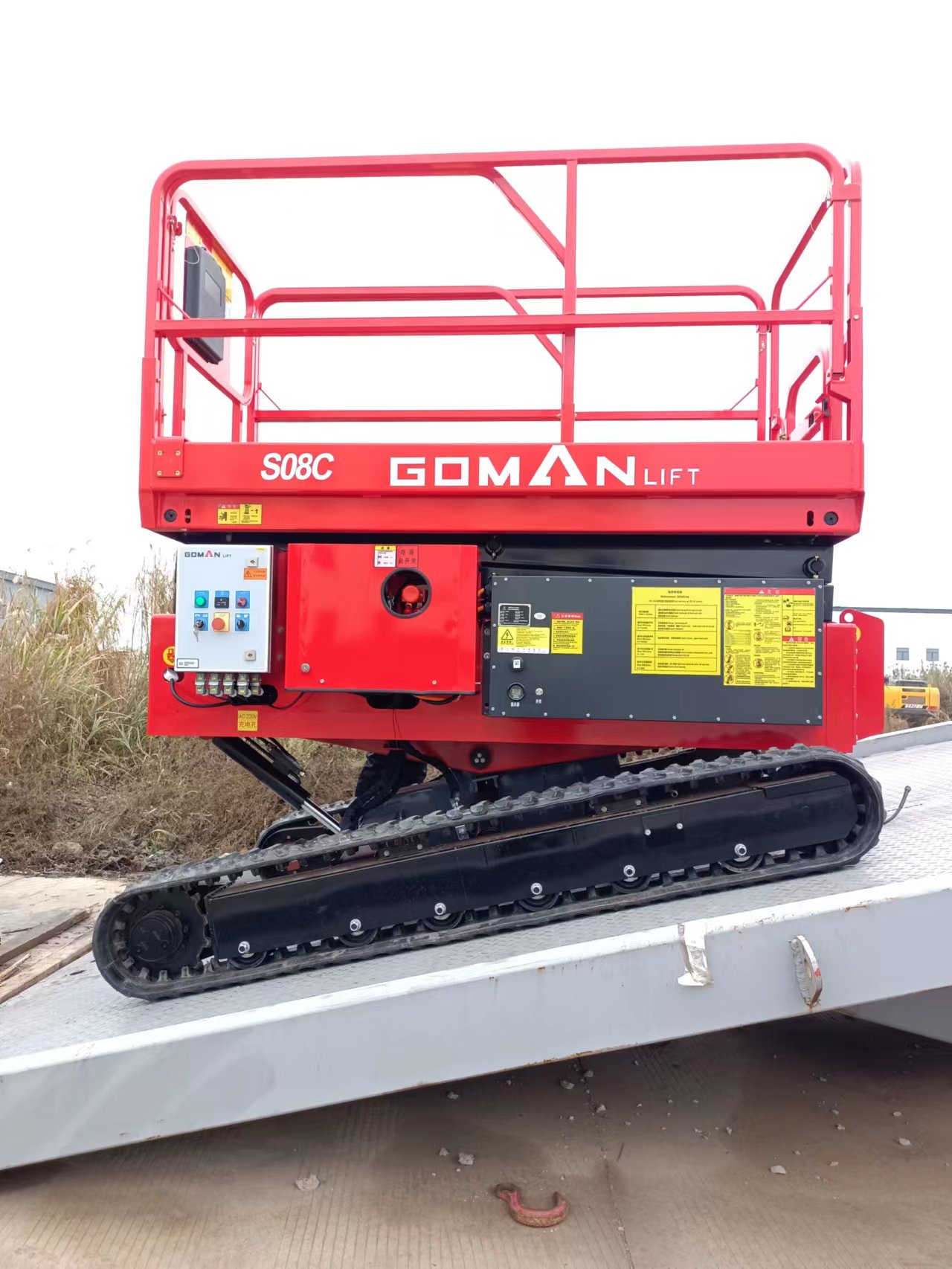
Wheeled lifts stop functioning on steep inclines. Tilt alarms disable elevation functions instantly. A tracked scissor lift for slopes ignores these physical limitations. It levels the base while the tracks bite into the hill. You need this specific capability for hillside solar farm installations. Retaining wall construction demands this type of stabilization.
Mountainous construction sites require dynamic elevation tools. Standard lifts simply cannot compete here. You cannot safely stack wooden cribbing on a 15-degree gradient. The risk of sudden collapse is too high. Tracked lifts lock into the hillside mechanically. They provide an unshakeable platform for your heavy tools and personnel.
Bogged-down equipment ruins project timelines quickly. Recovery operations cost money and risk worker injuries. A heavy wheeled rough terrain scissor platform sinks fast in soft dirt. Tracked machines float safely over these fragile surfaces. Landscapers love them for minimal turf rutting. Agricultural maintenance teams rely on them daily for orchard work.
Historical sites mandate extremely low ground pressure. Tracks protect sensitive archaeological topsoil from compression damage. Early-phase construction sites lack paved surfaces entirely. Spring rains turn these sites into deep mud bogs. Wheeled lifts sit idle while crawler lifts continue generating revenue. They push through the mud easily.
Static lifts kill operator productivity. You retract outriggers just to move ten feet. You drive forward slowly. You reset the heavy pads. You level the machine again manually. This repetitive cycle wastes hours every single week. Fast-paced jobs require better solutions.
Actively leveled crawlers eliminate this frustrating routine. You lower the platform. You drive to the next work spot. The machine auto-levels immediately upon stopping. You elevate again in seconds. Moving an actively leveled machine is fundamentally faster. You paint walls or install siding rapidly without workflow interruptions.
Hydraulic cylinders adjust the entire base frame uniformly. This happens before you raise the platform. It fixes simple front-to-back slopes easily. A standard self-leveling scissor lift excels on static uneven ground. It handles moderate site grading exceptionally well.
The standard system is mechanically simpler. It requires less complex maintenance overall. You use this technology for straightforward inclines. Driveways, gentle hills, and slightly rutted fields match this profile perfectly. It provides excellent stability without overcomplicating the machine's engineering.
Bi-leveling adds extreme lateral adjustments. The tracks move completely independently from each other. One track can sit high on a concrete curb. The other track sits low in a deep mud rut. The chassis still achieves a perfect horizontal plane. Multi-axis technology thrives on highly complex terrain.
Forestry and severe off-road applications demand bi-leveling. It handles compound slopes where angles shift in multiple directions. The onboard computers calculate both pitch and roll simultaneously. They adjust the undercarriage dynamically. This represents the pinnacle of rough terrain access technology.
Table: Standard Leveling vs. Bi-Leveling Matrix
Technology Type | Terrain Complexity | Axis of Adjustment | Best Application Scenarios |
|---|---|---|---|
Standard Auto-Leveling | Moderate / Predictable | Front-to-Back (Longitudinal) | Sloped driveways, gentle hills, graded dirt lots. |
Bi-Leveling | Severe / Unpredictable | Multi-Axis (Longitudinal & Lateral) | Forestry, deep ruts, curbs, multi-directional slopes. |
You can quantify the labor hours saved easily. Tracked units remove manual site-prep from the daily workflow. You stop digging leveling trenches. You stop dragging heavy wooden cribbing across muddy fields. You completely eliminate outrigger deployment time. Every minute saved directly boosts your daily productivity.
Faster elevation means more tasks completed per shift. Crews spend their time actually working at height. They stop wrestling with machine setup. The upfront premium pays for itself through raw efficiency. Projects finish ahead of schedule. Your team experiences less physical fatigue by the end of the day.
You must frame this investment through a risk management lens. Operator confidence increases dramatically. The machine actively fights tip-over conditions constantly. It aligns perfectly with strict OSHA and ANSI A92 elevation compliance rules. You prevent catastrophic accidents on uneven ground.
Safety incidents carry massive financial penalties. They halt project momentum instantly. A self-leveling chassis acts as your best insurance policy against terrain-related rollovers. It protects your workers and your company reputation. Safety features always deliver long-term return on investment.
You must acknowledge the maintenance downsides to maintain credibility. Tracked units require strict track tensioning maintenance. Loose tracks derail easily on steep slopes. You must schedule regular undercarriage inspections. Debris clearing is absolutely mandatory. Mud and rocks pack tightly into the track sprockets.
Furthermore, crawlers feature slower drive speeds than wheeled variants. You cannot race them across massive flat warehouses. Rubber tracks wear down faster on hot asphalt. You must budget for eventual track replacement. Understanding these hidden realities helps you make smarter deployment decisions.
You must clarify the difference between gradability and leveling. Gradability measures how steep a hill the machine can drive up safely. Leveling capability dictates the maximum angle at which the chassis can safely auto-level for vertical elevation. These numbers rarely match.
Always check the manufacturer spec sheet for exact leveling limits.
Understand that gradability might be 25 degrees.
Leveling capability might cap firmly at 15 degrees.
Never attempt to elevate beyond the stated leveling limit.
Complex leveling mechanisms affect overall payload capacities heavily. The heavy hydraulic chassis eats into the total weight allowance. You must calculate your tool and personnel weight carefully. Do not assume a crawler matches the capacity of a flat-slab lift.
Verify the maximum allowable weight for the extended deck.
Account for the weight of heavy materials like siding or glass.
Ensure the platform dimensions fit your specific workspace.
Remember that bi-leveling systems often reduce payload slightly.
You must choose the right power system for your environment. Diesel engines provide unmatched power for heavy outdoor use. They thrive in remote locations lacking charging infrastructure. However, they generate loud noise and exhaust emissions.
Select Diesel for off-grid, heavy-duty earthmoving sites.
Choose Lithium-Ion for noise-sensitive urban neighborhoods.
Utilize Hybrid systems for indoor/outdoor transitional projects.
Consider battery runtimes against your typical daily shift length.
A crawler self-leveling scissor lift is not a universal replacement for all aerial equipment. It serves as a highly specialized tool for complex terrain. Traditional lifts still dominate flat warehouse floors. However, when the ground turns steep or soft, wheeled lifts become useless. Tracked self-leveling machines take over.
The upfront premium is justified entirely by operational efficiency. Setup speed increases dramatically. Site-prep elimination saves massive labor costs. Most importantly, safety on steep grades protects your most valuable asset: your team.
Evaluate your typical job site topography before purchasing.
Factor setup time savings into your ROI calculations.
Commit to regular track tensioning and undercarriage maintenance.
Match the leveling capabilities to your most extreme gradients.
Do not let bad terrain dictate your project schedule. We encourage you to request a professional site assessment today. Consult with application engineers to match gradability specs directly to your specific job site topography.
A: Industry-standard leveling ranges typically fall between 10 to 20 degrees. Limits vary significantly by manufacturer and specific model. You must also account for payload weight. Always consult the operator manual, as exceeding these limits triggers safety lockouts.
A: Most manufacturers prohibit driving on slopes while fully elevated. Safety lockouts engage automatically to prevent tip-overs. While certain advanced bi-leveling models allow slight movement at very low elevations, standard protocol requires lowering the platform entirely before repositioning on gradients.
A: Non-marking rubber tracks generally protect paved surfaces well. They distribute weight evenly. However, steel tracks will destroy concrete rapidly. Even with rubber tracks, you must execute wide, careful turns. Sharp pivoting on hot asphalt can cause aggressive scuffing.
A: Yes, true self-leveling chassis designs internalize the stabilization process entirely. They use dynamic hydraulic geometry instead of external pads. However, a few hybrid heavy-duty models might still feature optional outriggers for extreme capacities. Most standard crawler models eliminate them completely.
