


No.188 Doubu Avenue, Hannan District, 430090 Wuhan, China


Views: 0 Author: Site Editor Publish Time: 2026-08-31 Origin: Site


Facility maintenance and tree care at extreme heights present a hidden danger. Dropping heavy equipment onto fragile surfaces creates immense reputational risks. Cracked marble tiles, rutted golf course turf, and scratched decorative concrete destroy property value instantly. You need a way to reach high access points safely without destroying the ground below. Enter the tracked spider lift. This machine operates as the industry-standard solution bridging the gap between extreme high-reach needs and strict ground-bearing pressure limits. It distributes weight brilliantly, keeping sensitive floors completely safe. We will explore how these machines operate safely across various delicate terrains. Facility managers, arborists, and contractors will gain a clear evaluation framework. You will quickly understand the physics behind low-impact travel. Furthermore, you will grasp the implementation realities required to guarantee zero surface damage during your next aerial project.
Tracked spider lifts distribute machine weight across a larger surface area, significantly reducing ground bearing pressure (PSI) compared to wheeled alternatives.
Equipped with non-marking tracks and electric power, a hybrid spider lift is uniquely suited for fragile indoor flooring like marble, hardwood, and polished concrete.
For outdoor applications, a narrow access spider lift can navigate tight residential gates and operate on manicured turf without causing deep ruts.
While tracks minimize travel damage, the outriggers (stabilizer legs) require strategic padding to disperse point loads on delicate surfaces.
Understanding surface preservation requires a basic grasp of physics. The core principle revolves around weight distribution. Traditional aerial platforms balance their massive chassis entirely on four small tires. This design concentrates the entire machine's weight onto tiny contact patches. Conversely, continuous rubber tracks spread the identical weight across a substantially wider, longer footprint. This massive contact area dramatically lowers the Pounds per Square Inch (PSI) exerted on the floor. Spreading force over a broader zone prevents heavy equipment from punching through delicate sub-bases or leaving deep indentations.
Benchmark ground bearing pressure data highlights this mechanical advantage clearly. Even heavy aerial platforms often exert less ground pressure than everyday objects. A 130-pound person wearing stiletto heels can easily generate over 400 PSI on a floor. A standard commercial ride-on lawnmower might exert between 10 and 15 PSI. Meanwhile, a specialized track-driven lift often operates below 7 PSI during travel. This exceptionally low ground bearing pressure prevents structural failure when traversing delicate landscapes or interior tiles.
Beyond static weight distribution, moving equipment introduces dynamic forces like friction and traction. Heavy wheeled machines frequently rely on aggressive acceleration to overcome soft spots. This sudden wheel spin gouges dirt and tears carpet instantly. Track treads operate entirely differently. They provide immense grip through sheer surface area contact rather than aggressive digging. Operators achieve seamless forward momentum. The rubber treads grip smooth surfaces securely without relying on destructive torque, preserving the integrity of the ground beneath.
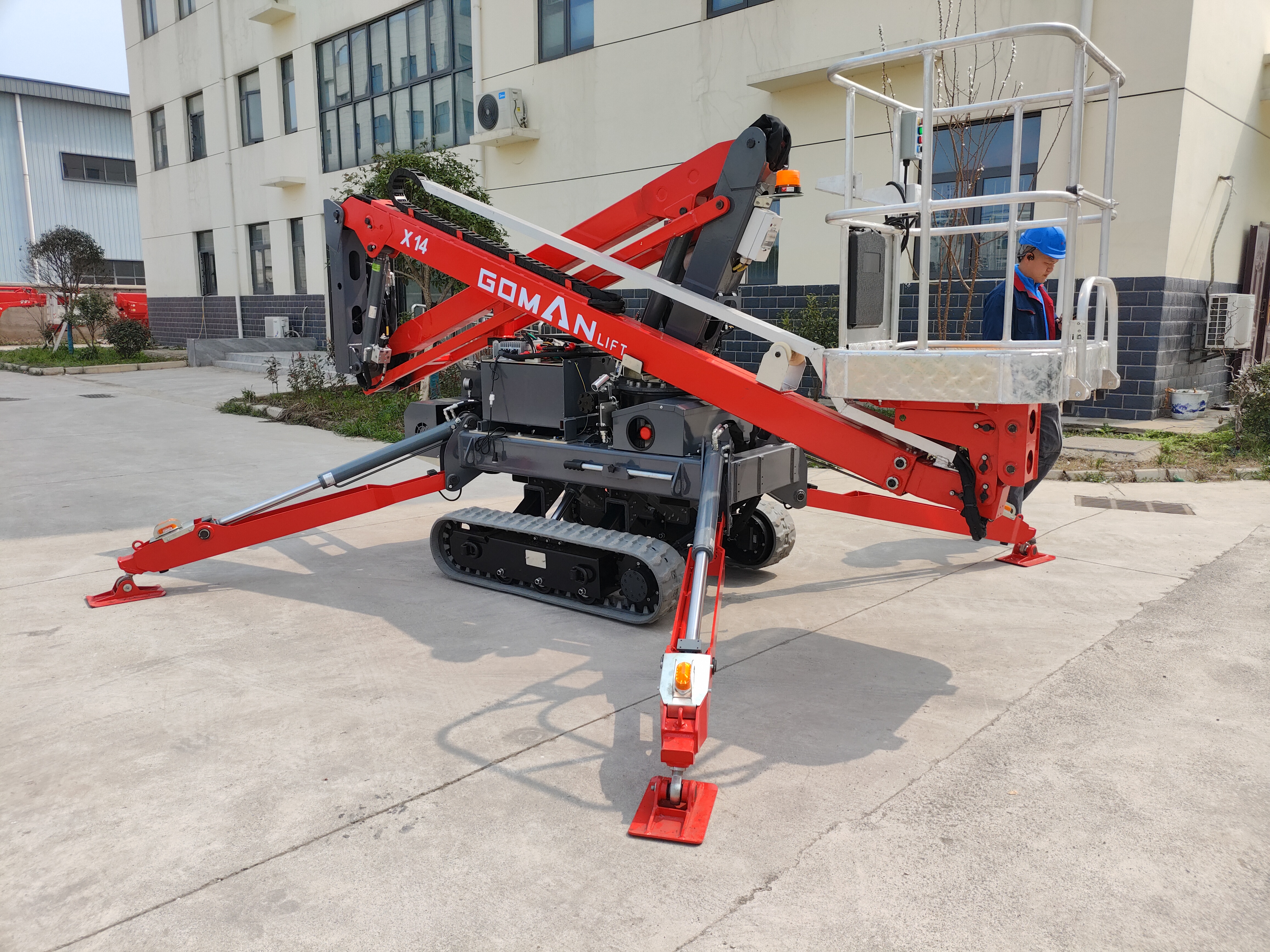
Working indoors introduces complex structural variables. Facility managers must constantly evaluate floor load capacities in multi-story buildings, shopping malls, and gymnasiums. Many modern architectural spaces feature suspended slabs. These floors have hollow areas beneath them, limiting the maximum allowable weight. Driving standard heavy equipment over suspended slabs risks catastrophic structural failure. Track-driven platforms distribute their mass evenly. They comply easily with strict building engineering limits. You must always consult structural engineers before bringing any machinery onto suspended slabs, but track systems make compliance highly achievable.
High-value commercial floors demand absolute visual preservation. Museum marble, gymnasium hardwood, and commercial ceramic tile scratch easily. Standard black rubber leaves stubborn carbon scuff marks across these surfaces. To solve this, premium aerial platforms utilize white, non-marking rubber tracks. Manufacturers substitute abrasive carbon black for softer compounds like silica. These specialized tracks glide across highly polished flooring. They prevent unsightly black streaks, eliminating the need for expensive post-project floor restorations.
Air quality and noise pollution represent another massive indoor hurdle. Diesel exhaust triggers fire alarms and poses serious health risks in enclosed spaces. A hybrid spider lift serves as the mandatory specification for sensitive indoor work. These units combine lithium-ion battery power alongside a traditional combustion engine. Operators rely on the combustion engine outside. Upon crossing the threshold into a building, they seamlessly switch to silent, emission-free electric power. This eliminates exhaust fumes entirely while preserving the floors beneath.
Atriums: Reaching high skylights over expensive lobby tiles.
Historical Buildings: Navigating ancient, irreplaceable stone floors safely.
Retail Spaces: Performing maintenance over delicate polished concrete without disrupting shoppers.
Aviation Hangars: Moving over epoxy-coated floors without leaving stubborn rubber scuffs.
Arborists and landscapers face unique environmental challenges. Transporting heavy machinery across manicured lawns usually compacts the soil. Severe soil compaction starves tree roots of vital oxygen, ultimately killing the plants you intend to maintain. Low-impact tread designs prevent this subsurface damage. The dispersed weight prevents lawn tearing. Tracks float over the grass rather than sinking into it. This capability acts as a critical success factor for winning premium residential landscaping contracts.
Access bottlenecks ruin outdoor project schedules frequently. Many backyards feature standard 36-inch gates. Traditional boom lifts cannot pass through these narrow constraints. Contractors normally dismantle fences or hire expensive cranes to bypass them. A compact spider lift solves this logistical nightmare effortlessly. Its slender chassis slides directly through standard residential gates. Furthermore, a narrow access spider lift easily traverses delicate hardscapes like pavers and stamped concrete. The broad tracks cross these expensive surfaces without cracking the delicate sub-base beneath them.
Construction sites rarely offer perfectly flat ground. Muddy slopes and sandy soils swallow traditional tires. Wheeled lifts sink, spin out, or tip over entirely. Track systems excel in uneven terrain. They maintain constant contact across wide surface areas, bridging ruts and small gaps seamlessly. Once positioned, the machine's outriggers independently deploy to self-level the basket. Operators achieve perfect stability on steep gradients. They can ascend safely regardless of the chaotic terrain below.
Evaluating access equipment requires contrasting their fundamental design philosophies. Traditional wheeled boom lifts utilize a massive counterweight system. Because they rely on a narrow wheelbase, they need heavily weighted chassis blocks to prevent tipping when the boom extends. This dead weight crushes soft ground. Track-driven platforms abandon the counterweight entirely. They stabilize through wide, spider-like outrigger legs. This drastically reduces the overall machine footprint and weight. The lightweight design floats over terrain, whereas traditional platforms bulldoze through it.
Turning mechanisms differentiate these machines further. Heavy wheeled lifts gouge the ground during sharp turns. The front tires twist against the earth, ripping up grass and scratching concrete. Tracked chassis utilize pivot steering. When steered correctly by trained personnel, the tracks execute gradual, sweeping turns. This pivot capability avoids the surface-tearing risks inherent to heavy wheeled vehicles. Operators maintain precise directional control without leaving permanent scars behind.
Decision-makers need a rapid mental framework for shortlisting equipment. Consider your site conditions carefully before booking a rental. If your path features narrow gates, expensive indoor flooring, or soft muddy ground, spider platforms win instantly. They offer unparalleled surface protection. Conversely, if your terrain consists of heavily paved, open, and rugged industrial concrete, traditional wheeled boom lifts may suffice. Assess the surface vulnerability first, then match the machine accordingly.
Evaluation Criteria | Track-Driven Platforms | Traditional Wheeled Boom Lifts |
|---|---|---|
Ground Bearing Pressure | Extremely Low (often < 7 PSI) | High (concentrated on 4 small tires) |
Chassis Weight | Lightweight (relies on outriggers for stability) | Very Heavy (relies on massive counterweights) |
Turning Impact | Gentle pivoting limits surface gouging | Sharp wheel turns tear grass and scratch surfaces |
Access Width | Ultra-compact; fits through 36-inch gates | Wide; requires large double gates or open spaces |
While track systems provide incredible protection during movement, operators must understand the point load caveat. Tracks protect the floor beautifully during transit. However, deploying the outriggers shifts the machine's entire weight onto four concentrated points. During operation, the stabilizer legs apply extreme downward force. Failing to manage this specific operational phase will result in instantly cracked tiles or deep yard craters. You must acknowledge this reality before elevating the basket.
Specialized outrigger pads or cribbing represent a mandatory requirement. You cannot simply drop steel outrigger feet directly onto a gymnasium floor. Outrigger pads disburse the concentrated point load outward across a broader surface area. When setting up on fragile tiles, thick rubber or composite mats act as a protective barrier. On soft lawns, heavy timber cribbing prevents the stabilizer legs from sinking deeply into the mud. Distributing this point load ensures the machine remains level while preserving the ground underneath.
Operator technique plays a massive role in damage prevention. Untrained users can easily cause problems despite having the right equipment. Establish strict operational guidelines.
Avoid sharp "skid steers" or zero-radius turns entirely when traversing delicate turf or carpet. These sudden movements twist the tracks forcefully, tearing the material underneath.
Perform multi-point, wide-sweeping turns instead to minimize shear forces on the ground.
Lay thick plywood panels or heavy-duty turf-protection mats along the primary travel path for extremely fragile situations.
Designate a spotter to watch the tracks and outriggers continuously during deployment.
Pre-entry track cleaning serves as a critical operational necessity. Moving a machine from outdoor construction dirt directly onto polished indoor flooring introduces severe risks. Track treads easily pick up abrasive gravel, small rocks, and metal debris. If operators drive indoors without cleaning the undercarriage, these trapped rocks will scratch expensive marble deeply. Crews must actively wash down the tracks and inspect them thoroughly before transitioning across environments. This simple procedural step prevents catastrophic visual damage.
Combining extreme working height with extreme floor preservation demands specialized equipment. A track-driven platform easily emerges as the safest, most effective access equipment choice for these sensitive environments. By utilizing wide rubber treads, lightweight chassis designs, and specialized outriggers, these machines bypass the destructive footprint of traditional heavy lifts. They conquer narrow gates, climb uneven mud, and glide across museum floors without leaving a trace.
Your next step involves auditing your specific project site thoroughly. Measure your gate widths carefully. Verify floor weight capacities alongside structural engineers. Determine your precise indoor emission requirements. Once you map these constraints, contact an equipment specialist. Request a comprehensive site assessment to guarantee you deploy the perfect low-impact machine for your challenging high-reach tasks.
A: Yes, but it requires specific operating techniques. Operators must use multi-point, wide-sweeping turns rather than aggressive zero-turn pivoting. Slow, gradual movements prevent the rubber treads from shearing the grass blades or tearing the topsoil.
A: No, true non-marking tracks utilize silica instead of carbon black, preventing black scuff marks. However, they must be kept immaculately clean. If gravel or abrasive debris gets stuck in the tread pattern, it will scratch the floor surface.
A: You must differentiate between the machine's travel weight (distributed over tracks) and its operational point load (concentrated on outrigger legs). Always consult a licensed structural engineer for suspended slabs to analyze exact loading capacities before deployment.
A: A hybrid model features a dual-power source. It utilizes a diesel or gas engine for robust outdoor travel, then seamlessly transitions to a quiet, zero-emission lithium-ion electric motor for safe indoor operation.
