


No.188 Doubu Avenue, Hannan District, 430090 Wuhan, China


Views: 0 Author: Site Editor Publish Time: 2026-07-08 Origin: Site


Operating aerial platforms on slopes, mud, or rugged landscapes traditionally forces a difficult compromise. You often have to choose between operator safety, setup time, and machine footprint. Standard lifts require extensive cribbing or wide outriggers on uneven ground. This physical limitation reduces operational efficiency and increases tip-over risks if crews bypass strict protocols to save time. We need better solutions for demanding environments. This article provides a vendor-neutral, evidence-based framework for evaluating dynamic access equipment. You will learn whether a crawler bi-leveling boom lift is the right technical and operational fit for your specific site requirements. We explore the mechanics of dynamic stabilization, compare tracked alternatives, and outline core evaluation dimensions. You will also discover how to navigate operator adoption, maintenance realities, and supplier vetting. Our goal is to equip you with clear insights for safer, faster hillside operations.
Dynamic Adaptability: Bi-leveling technology allows the chassis to actively adjust to longitudinal and lateral slopes, eliminating the need for outriggers.
Efficiency Gains: Continuous driving at height on uneven terrain reduces repositioning downtime compared to traditional static stabilizers.
Evaluation Mandate: Procurement decisions must weigh the higher upfront capital cost against labor savings, increased site access, and strict compliance with maximum gradeability limits.
Sourcing Strategy: Selecting an OEM crawler boom lift requires vetting their proprietary leveling software, parts availability, and ANSI/EN280 compliance documentation.
To understand the value of dynamic stabilization, we must examine how the undercarriage tilt mechanism operates in real-time. Traditional mobile elevating work platforms (MEWPs) rely on a rigid chassis. When they encounter an incline, the entire machine tilts. A crawler bi-leveling boom lift changes this dynamic entirely. Independent track adjustment mechanisms allow the undercarriage to articulate. Heavy-duty hydraulic cylinders extend and retract independently on each side. This action keeps the upper turntable, boom structure, and operator basket completely horizontal while the tracks conform to the uneven terrain below.
Modern bi-leveling systems process tilt data through redundant inclinometers. The electronic control unit (ECU) reads these angles and commands the hydraulic valves to adjust the tracks. However, you must understand the distinction between longitudinal (front-to-back) and lateral (side-to-side) compensation.
Typically, these machines handle up to 15 degrees of longitudinal slope and about 14 degrees of lateral slope. Note: Specific operating angles depend entirely on the manufacturer and must be verified against rigorous site surveys. Operating limits vary based on boom extension, basket load, and turret rotation. A common mistake is assuming maximum lateral and longitudinal compensation can occur simultaneously at full reach. You should always consult the exact manufacturer load chart before attempting extreme compound slopes.
Active chassis adjustment fundamentally changes site access. Standard rough-terrain lifts rely on outriggers to establish a level, widened base. Deploying outriggers takes time and drastically expands the machine's footprint. By removing the need for outriggers, dynamic stabilization minimizes the equipment's physical footprint. You can operate in confined hillside environments, narrow urban alleys, or congested construction sites where extending stabilizer legs is impossible. The machine essentially shrinks its operating width while maintaining strict stability compliance.
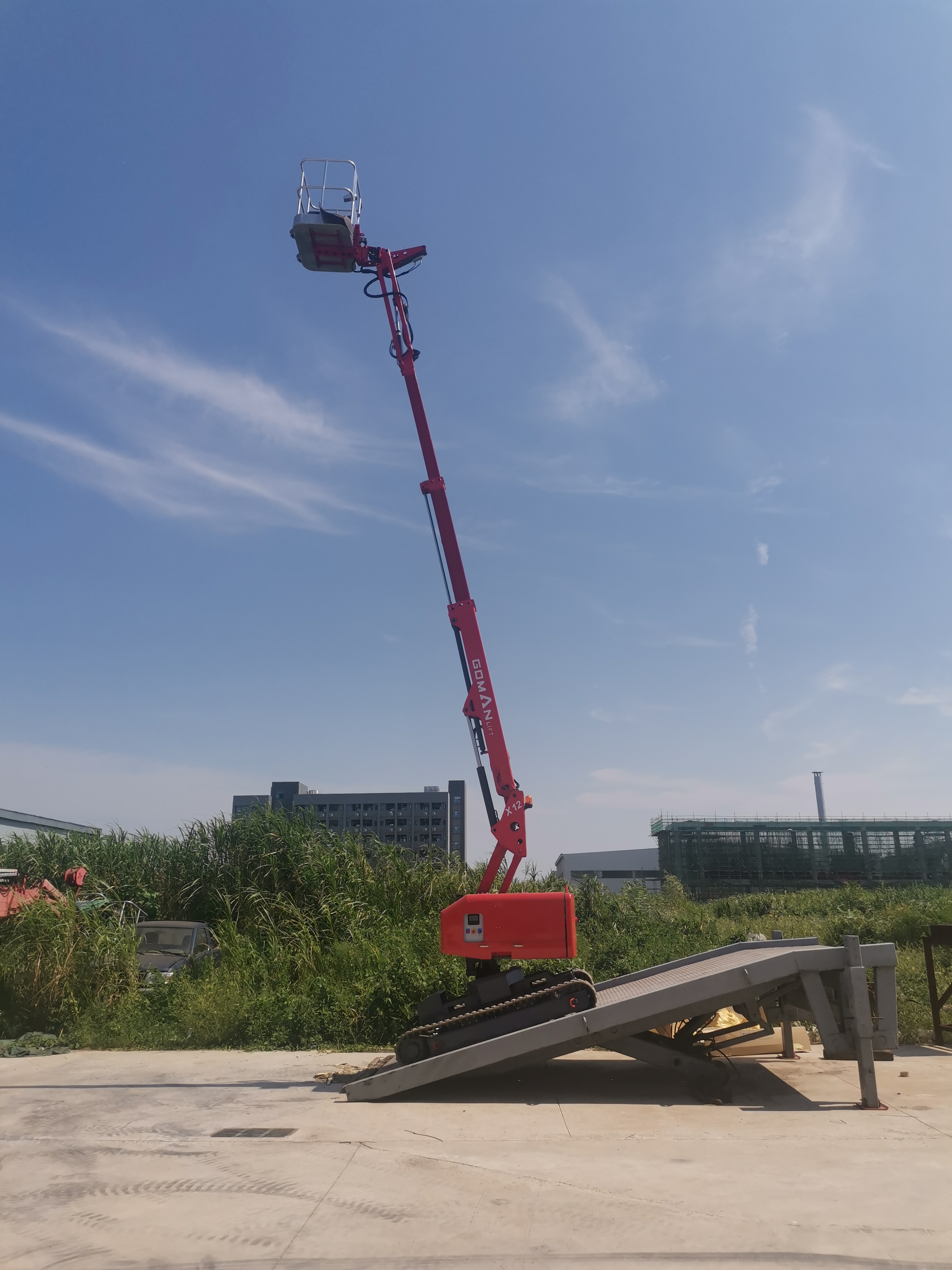
Selecting the right access equipment requires matching machine capabilities to specific tasks. Site managers frequently debate between using spider lifts and dynamic bi-leveling lifts. Both utilize tracks, but they solve different problems.
Spider lifts dominate high-reach, low-ground-pressure applications. They excel in tight indoor spaces and sensitive outdoor landscapes.
Pros: They offer extremely high vertical reach. Their lightweight design protects fragile surfaces like marble floors or decorative turf. They easily fit through standard single or double doors when stowed.
Cons: Operators must deploy outriggers (the "spider legs") and level the machine before elevating the basket. Crucially, they cannot drive while elevated on slopes. If your task requires moving ten feet down a slope, you must lower the boom, retract the outriggers, drive, and set up again. This causes significant repositioning downtime.
A dynamic bi-leveling boom lift is built for continuous movement across challenging topographies.
Pros: Operators can drive at height on uneven ground. You experience continuous operation without resetting stabilizers. This capability delivers dramatically faster task completion on linear jobs, such as installing retaining walls, managing tree lines, or inspecting long pipelines.
Cons: These machines are generally heavier due to the robust structural steel required for the articulating undercarriage. The undercarriage itself introduces higher mechanical complexity, requiring specialized maintenance.
We recommend mapping your equipment choice directly to the application. Use spider lifts for stationary, high-reach point work where setup time is secondary to reaching extreme heights or fitting through narrow doorways. Conversely, choose a bi-leveling tracked boom lift for continuous, mobile tasks across varied topographies. If your crew spends more time repositioning the lift than actually performing the work aloft, dynamic stabilization is the superior choice.
The chart below summarizes the functional differences between these two solutions.
Feature / Capability | Spider Lifts (Static) | Bi-Leveling Lifts (Dynamic) |
|---|---|---|
Primary Stabilization Method | Deployable Outriggers | Active Track Adjustment |
Drive at Height on Slopes? | No (Must stow to move) | Yes (Within safe limits) |
Ideal Application | Point work, extreme heights, indoors | Linear work, continuous hillside movement |
Setup Speed | Slower (Deploy & level) | Instant (Auto-levels while moving) |
Not all tracked access platforms perform equally. You must evaluate several core dimensions before integrating one into your fleet. Relying solely on max height specifications often leads to operational failures in the field.
Evaluating ground engagement goes beyond looking at track width. You need to assess ground pressure metrics and track compound types. Non-marking tracks suit indoor-to-outdoor transitions but may lack the aggressive grip needed for deep mud. Aggressive tread patterns tear up finished landscaping but provide essential traction on wet clay or loose gravel.
A critical best practice is verifying the difference between maximum safe climbing angle and maximum leveling angle. These are distinct metrics. A machine might climb a 25-degree grade when fully stowed. However, it may only compensate for a 15-degree slope while elevating the boom. Confusing these two numbers causes dangerous situations. Always consult the operator manual for specific phase limits.
Evaluation Criteria Matrix
Assessment Area | Key Metric to Verify | Why It Matters |
|---|---|---|
Ground Pressure | PSI or kPa fully loaded | Determines if the machine will sink in mud or crack concrete. |
Climbing Gradeability | Maximum angle (stowed) | Dictates whether the machine can physically access the work zone. |
Leveling Capacity | Max lateral/longitudinal angle | Determines safe operational angles when the boom is raised. |
Physics dictates that adapting to slopes alters the machine's center of gravity. You must rigorously analyze the payload drop-off curve when operating at maximum horizontal outreach on a slope. Standard lifts on flat ground maintain predictable moment limits. Dynamic lifts constantly shift their base geometry.
Evaluate the trade-off between standard telescopic boom reach and the added weight of the bi-leveling undercarriage. The heavy base provides excellent counterweight stability but limits the machine's overall vertical reach compared to a lighter spider lift of similar footprint. Understand your required working envelope before finalizing a selection.
Modern access equipment offers versatile power configurations. Your choice dictates where and how long you can operate.
Diesel Engines: Provide maximum torque for pure outdoor, heavy-duty hillside operations. They handle deep mud and steep climbs effortlessly without draining battery reserves.
Gasoline Engines: Offer a lighter alternative to diesel, often utilized in smaller models or dual-fuel configurations.
Lithium-ion / Hybrid Variants: Essential for sites requiring low noise or zero emissions. Hybrids allow you to drive to the site using combustion power, then switch to electric mode for quiet, indoor-to-outdoor transition work.
Deploying advanced machinery requires more than just dropping it off at the job site. The human element and daily maintenance routines play crucial roles in operational success.
You must address the psychological barrier of dynamic stabilization. Operating a crawler boom lift at height while the chassis tilts autonomously beneath the basket feels unnatural. Experienced operators are trained to recognize a tilting chassis as a catastrophic warning sign. Acclimatizing them to trust the leveling sensors takes time and controlled practice.
We recommend starting new operators on flat ground, intentionally introducing small slopes to demonstrate the self-leveling response. Do not rush this process. An operator who panics and attempts manual overrides during an automated leveling sequence can destabilize the machine.
The safety of dynamic lifts relies entirely on electronic feedback loops. Discuss the necessity of fail-safes with your maintenance team. The leveling system must feature redundant inclinometers. If one sensor fails or reports conflicting data, the ECU must halt all structural movement.
The machine should include automatic travel-cutoffs. If the tracks encounter a slope exceeding the maximum leveling capacity, the drive function must disable instantly, allowing only retraction and lowering movements. Regular calibration checks ensure these safety boundaries remain accurate over years of heavy vibration.
Tracked chassis with active hydraulic leveling cylinders require more rigorous daily inspections than standard wheeled lifts. Sliding structural components accumulate dirt. Mud and debris management in the track assemblies is critical.
Inspect leveling cylinder rods for deep scratches caused by flying rocks.
Clean mud from the track tensioners daily to prevent the rubber tracks from snapping or derailing.
Check hydraulic hoses routing through the articulating undercarriage for pinch points or abrasion wear.
Your relationship with the manufacturer determines the long-term viability of the equipment. Purchasing an OEM crawler boom lift requires intense scrutiny of their support infrastructure.
The core value of this equipment lies in its control software. Mechanical components rarely fail without warning; software glitches halt work instantly. Evaluate the OEM's onboard diagnostic interface. Can your mechanics read fault codes directly from the platform screen, or do they need a proprietary laptop connection? Furthermore, investigate remote troubleshooting capabilities. Top-tier OEMs provide telematics systems allowing factory engineers to diagnose sensor faults remotely, saving days of downtime.
Do not accept vague safety claims. Ensure the OEM provides transparent documentation regarding local compliance. In the United States, look for strict adherence to ANSI A92.20 standards. In Europe, verify EN280 compliance. Specifically, request data regarding dynamic load testing on slopes. The manufacturer must prove the machine maintains stability margins while moving laterally across an incline with a fully loaded basket. If they cannot produce this test data, find another supplier.
Bi-leveling undercarriages use proprietary parts. You cannot easily substitute leveling cylinders or custom ECU modules with aftermarket alternatives. Assess the manufacturer’s regional dealer network carefully.
Review warranty terms specifically covering the leveling cylinders and sensors.
Inquire about parts dispatch Service Level Agreements (SLAs). Do they guarantee 24-hour shipping for critical electronic components?
Determine if they offer advanced technical training for your in-house mechanics.
Choosing a partner with robust lifecycle support prevents your highly specialized lift from becoming an expensive yard ornament while waiting for parts from overseas.
A crawler bi-leveling boom lift is not a universal replacement for standard MEWPs. Instead, it serves as a highly specialized asset designed for fleets heavily engaged in rough terrain, forestry, complex construction, or demanding landscaping projects. By embracing dynamic stabilization, you eliminate the delays associated with static outriggers and dramatically improve linear work efficiency across slopes. However, success requires comprehensive operator training, strict adherence to load charts, and proactive undercarriage maintenance.
To move forward, recommend your operations team conduct a thorough site topography audit to identify average and maximum slope angles. Next, request a live demonstration from your shortlisted OEMs under controlled, loaded conditions. Observing the equipment perform on your actual terrain is the only reliable way to validate performance before initiating procurement or long-term rental agreements.
A: You must differentiate between driving gradeability (often up to 20-25 degrees when fully stowed) and elevated leveling capacity (usually capped around 14-15 degrees). Never exceed the elevated limits. Always adhere to specific manufacturer load charts, as exact capabilities vary heavily based on the model, basket load, and boom extension.
A: Yes, driving at height is a primary advantage over static spider lifts. The bi-leveling chassis continuously adjusts to keep the basket flat as you move over uneven terrain. However, the machine's safety system automatically restricts drive speeds to a crawl when elevated to prevent dynamic instability.
A: Yes. The integration of independent track suspension, dual hydraulic leveling cylinders, and continuous inclinometer systems introduces higher maintenance complexity. You must perform rigorous daily inspections and manage debris in the tracks. This maintenance effort must be offset by the significant labor savings gained from faster on-site setup and repositioning.
