


No.188 Doubu Avenue, Hannan District, 430090 Wuhan, China


Views: 0 Author: Site Editor Publish Time: 2026-09-14 Origin: Site


Industrial work sites frequently present complex geometries blocking direct access to elevated tasks. Structural beams, active production lines, and fixed infrastructure create significant navigational hurdles for maintenance teams. You cannot always position a machine directly beneath or beside a target overhead.
Traditional straight booms and vertical scissor lifts struggle heavily in these confined environments. They lack the structural flexibility necessary to bypass physical barriers safely. When your vertical ascent path contains obstructions, operators need specialized aerial equipment designed for dynamic positioning.
This guide provides a comprehensive technical evaluation framework for selecting the correct aerial platform. You will learn how to match articulation specifications, chassis designs, and power types to your site's physical realities. We also explore strict compliance standards to ensure safe, efficient access. Ultimately, you will understand how to bypass obstacles without compromising safety or workflow.
Project managers often default to telescopic lifts because they provide massive vertical reach. Telescopic models maximize pure height and straight horizontal distance. However, they operate in a single rigid line. In contrast, an Articulating Boom Lift is explicitly engineered as an up-and-over boom lift designed for complex geometries. It bends at multiple hinge points, allowing operators to navigate structural labyrinths.
These hinged sections act much like human fingers. Industry professionals commonly refer to these pivot points as knuckles. Multiple knuckles allow operators to bend the boom mid-air. You can maneuver the primary arm up and over a wall. Next, you articulate the secondary arm downward. Finally, you position the basket flush against a tight work surface. Throughout this complex maneuver, the heavy base remains safely offset from the obstructions below.
Many daily operations require a boom lift around obstacles. You must evaluate the specific physical barriers present on your job site. Common examples include:
Maximum working height rarely tells the whole story. You must determine the machine's up-and-over height first. This metric defines how high the primary lift arm must go before the secondary boom bends horizontally. If you need to clear a 30-foot structural wall, your lift must possess an up-and-over clearance exceeding 30 feet. Failing to check this specification leads to equipment swaps and costly site delays.
Once elevated, the machine must push the basket forward toward the target. You must assess the maximum horizontal distance the lift covers. Operating a horizontal outreach lift changes the machine's physics. Extreme horizontal extension aggressively shifts the equipment's center of gravity. Modern lifts utilize sophisticated range-of-motion envelopes. They feature automatic safety lockouts preventing the operator from extending past the tipping point.
Every aerial platform balances reach against payload. You must understand the capacity restrictions inherent to hinged designs.
Space constraints exist on the ground, not just in the air. You must assess whether the machine's rear counterweight swings outside its own footprint during rotation. We consider tailswing a critical risk factor in high-traffic or walled environments. A swinging counterweight can strike pedestrians or crush nearby drywall. Zero tailswing designs eliminate this hazard. The turntable rotates entirely within the width of the chassis tires or tracks.
Electric models dominate indoor facility maintenance tasks. They produce zero hazardous exhaust emissions. This characteristic is strictly mandated for enclosed environments like warehouses, shopping malls, and cleanrooms. Electric motors also maintain very low noise levels, minimizing disruptions to nearby workers. Most electric platforms pair perfectly with non-marking tires. These white rubber tires prevent ugly scuff marks on finished commercial floors.
Outdoor construction sites demand raw power. Sites often feature unimproved ground conditions, deep mud, gravel, and steep grades. Diesel engines provide the higher torque necessary to navigate these harsh environments. We categorize them as Rough Terrain (RT) lifts. They utilize heavily treaded, foam-filled tires and active oscillating axles. This keeps all four wheels planted firmly on uneven terrain.
Hybrid technology represents the ultimate bridge solution. Many large-scale projects begin outdoors during the steel erection phase. They eventually transition indoors for final fit-out. Bi-energy models carry a higher initial rental rate. However, they perform a brilliant function. They operate on diesel power outside, charging their internal batteries simultaneously. Once moved indoors, operators switch them to silent, emission-free electric mode. This eliminates the logistical headache of renting two separate machines.
| Power Type | Primary Environment | Key Benefits | Common Limitations |
|---|---|---|---|
| Electric (DC) | Indoors / Smooth Slabs | Zero emissions, silent operation, non-marking tires. | Lower ground clearance, requires daily charging downtime. |
| Diesel (RT) | Outdoors / Rough Terrain | High torque, aggressive gradeability, fast refueling. | Toxic exhaust, loud engine noise, heavy footprint. |
| Bi-Energy | Mixed Indoor/Outdoor | Maximum versatility, continuous operation outdoors. | Heavier chassis weight, complex dual drivetrains. |
Standard chassis designs feature a broad, stable wheelbase. They perform exceptionally well on open outdoor sites. They also suit heavy industrial facilities boasting wide aisles and thick concrete slabs. Their wide stance provides excellent stability while the boom swings laterally. Operators appreciate standard models because they usually do not require outrigger deployment before elevating.
Many environments suffer from extreme spatial limitations. A compact articulated lift solves these narrow-access challenges. Manufacturers engineer these narrow-chassis models specifically to squeeze through standard double doorways. They operate fluidly in tight warehouse aisles. You can elevate personnel safely without disrupting existing pallet racking systems. Keep in mind, narrow bases require tighter range-of-motion limiters to maintain stability.
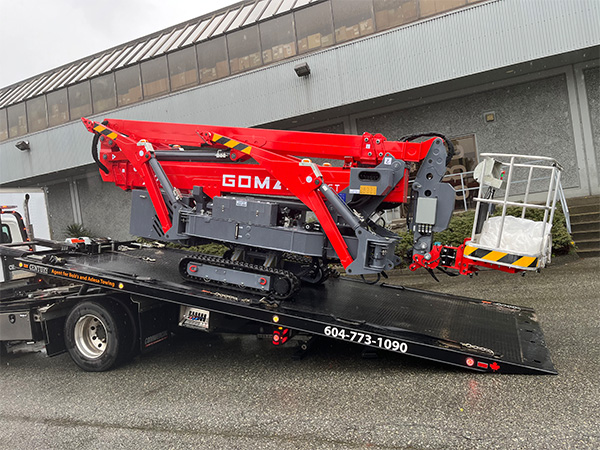
Sometimes, conventional wheels cannot safely traverse the work area. An articulating spider lift utilizes a tracked chassis instead of wheels. The rubber tracks disperse the machine's total weight across a much larger surface area. This results in an incredibly low ground bearing pressure.
Spider lifts are ideal for fragile flooring environments. We routinely deploy them on marble cathedral floors, sensitive gymnasium courts, and delicate outdoor landscaping. The tracks also grip steep inclines aggressively.
However, you must account for the outrigger footprint. While the machine remains impressively narrow during transport, it cannot elevate without deploying four stabilizer legs. These outriggers require significant setup space. You must measure the final deployment zone carefully before bringing a spider lift into an atrium.
The primary riser lifts the main boom assembly vertically from the base. Single riser architecture utilizes one heavy-duty lifting arm. This offers a simpler mechanical design with fewer hydraulic cylinders to maintain. It also generally keeps the overall machine weight lower. However, deploying a single riser often swings the boom structure forward or backward in an arc. It requires more horizontal space to deploy to its maximum height. You must account for this arc when working next to walls.
Double riser architecture utilizes a dual-arm, pantograph-style configuration. This structural design keeps the machine's center of gravity much tighter above the base. It allows operators to elevate vertically without moving the chassis forward or backward. You achieve true vertical "plumb line" lifting.
Operators strongly prefer double risers in highly congested, narrow-aisle environments. They minimize the risk of accidental collisions during the initial vertical ascent. Once the operator reaches the required up-and-over clearance height, they then articulate the secondary boom horizontally.
Follow these best practices when evaluating riser configurations:
Never rent or purchase aerial equipment based on visual guesses. You must mandate strict site measurement protocols. Measure doorway widths and elevator capacities accurately. Record ceiling heights and the exact dimensions of the target obstacles. Map out the turning radii required in every aisle. Thorough surveys prevent equipment returns and keep projects on schedule.
Heavy machinery cracks concrete and shatters tiles easily. Calculate the ground bearing pressure (PSI) of the machine weight against your floor slab's maximum capacity. Standard lifts apply concentrated point loads through their tires. Spider lifts distribute weight via tracks but apply intense point loads through their outrigger pads. You should utilize thick composite cribbing pads to spread the outrigger force safely across fragile floors.
Regulatory compliance dictates equipment design and site safety. Ensure the selected lift features mandatory modern safety sensors outlined in recent ANSI A92 updates. Look specifically for active load sensing systems. These prevent the machine from operating if the basket exceeds weight limits. Verify the presence of tilt alarms and automatic cut-offs. Additionally, overhead crush protection bars prevent operators from being pinned against ceiling structures.
Transportation logistics often derail the first day of work. Verify your drop-off access constraints beforehand. Heavy diesel RT models require large lowboy trailers and wide turning spaces for unloading. Conversely, compact units easily fit on standard flatbeds or tilt-deck trailers. Confirm unloading zones avoid soft mud or steep street inclines.
Choosing the correct aerial equipment requires matching precise machine capabilities to challenging site geometries. Your final selection rests entirely on balancing specific up-and-over clearance needs against floor load limits and power regulations. Do not let impressive maximum height figures blind you to horizontal outreach constraints. A machine that cannot weave through structural barriers safely holds zero value on a complex job site.
We strongly recommend a mandatory pre-rental or pre-purchase site inspection. Bring in a qualified lift specialist to confirm your calculated outreach envelopes. Taking this extra step guarantees you secure the safest, most efficient access platform for your operational demands.
A: Telescopic lifts use a straight, extending boom. They maximize pure vertical height and straight forward reach. Articulating lifts feature multiple hinged sections, or knuckles. These joints allow the boom arms to bend, providing the unique ability to reach up and over physical obstacles in complex work areas.
A: Horizontal reach varies heavily based on the machine's base weight and structural design. Compact indoor models typically offer 15 to 20 feet of horizontal reach. Larger outdoor industrial units can extend horizontally up to 60 feet or more. Always check the specific manufacturer's range diagram.
A: Yes, you can use them indoors safely. You must choose an electric or hybrid model to eliminate hazardous exhaust emissions. Ensure the lift features non-marking tires. Also, verify the machine's total weight and ground pressure strictly respect the building's floor load limits.
A: Zero tailswing is a critical safety design feature. It means the rear counterweight or turntable does not extend past the edge of the chassis tracks or tires during rotation. This prevents the rear of the machine from accidentally swinging into walls or personnel in tight spaces.
