


No.188 Doubu Avenue, Hannan District, 430090 Wuhan, China


Views: 0 Author: Site Editor Publish Time: 2026-10-03 Origin: Site


Utility and vegetation management fleets constantly face difficult environments out in the field. You often need to reach critical infrastructure in narrow, off-road, or highly complex terrains. Traditional bucket trucks simply cannot go into these restricted areas due to their massive size and weight. Therefore, you must evaluate your compact equipment options carefully to maintain productivity. Choosing between standard terrain mobility and strict dielectric compliance for energized environments presents a major challenge for fleet managers.
This decision directly affects your outage planning, crew safety compliance, and overall business efficiency. We will explore how these two lift categories impact your daily operations and project bidding capabilities. You will learn the stark differences between standard machines and insulated units. By the end, you will know exactly which platform best suits your specific operational demands and safety requirements.
Grid Uptime: Insulated tracked lifts allow for continuous live-line work without costly power de-energization, offering rapid ROI for utility contractors.
Safety Compliance: Standard spider lifts lack certified dielectric protection, limiting their use strictly to de-energized lines or outside the Minimum Approach Distance (MAD).
Maintenance Realities: Insulated models require strict, periodic dielectric testing (e.g., fiberglass boom integrity) not required for standard lifts.
Payload Trade-offs: Standard lifts generally offer higher basket weight capacities compared to insulated models of similar sizing due to the weight of fiberglass boom components.
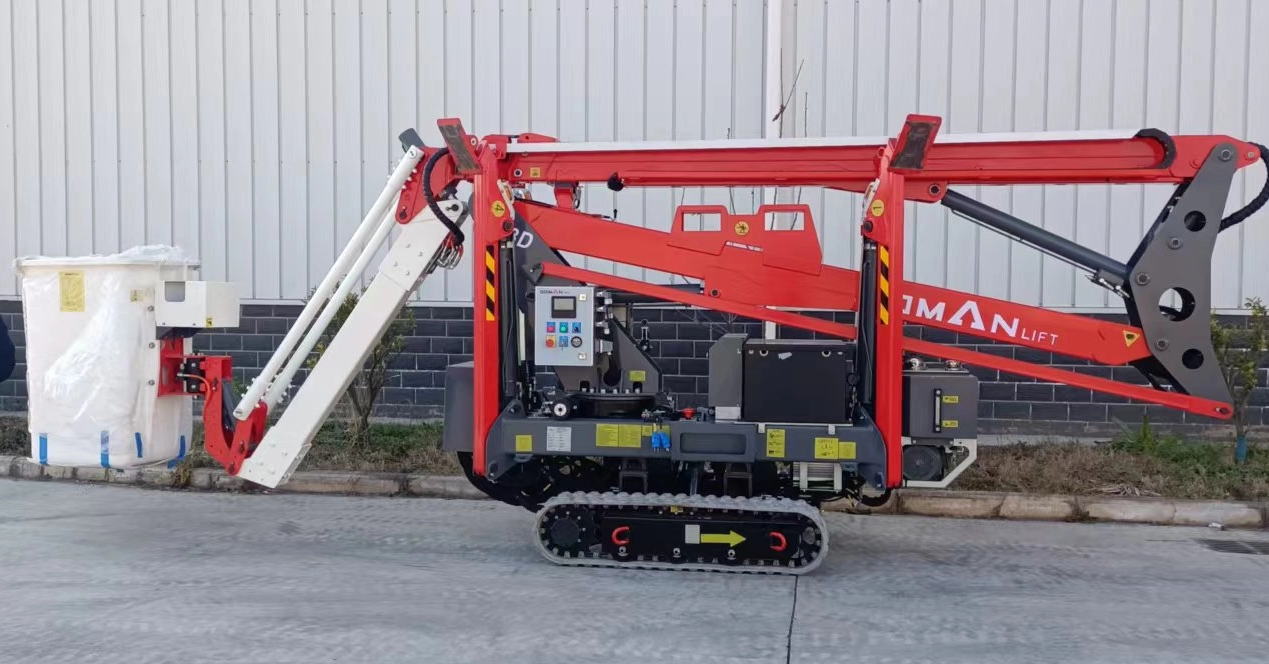
Field crews face a persistent struggle between reaching the job site and staying safe around electricity. Getting to the site safely represents only half the battle. Once you arrive, the equipment must protect your crew from high-voltage hazards.
Traditional insulated bucket trucks are incredibly heavy. They require highly stable ground to operate safely. They also possess large outrigger footprints. These traits render them useless in soft soil, residential backyards, or steep railway embankments. When a storm knocks out a distribution line in a muddy, heavily wooded area, heavy trucks simply sink. Crews lose hours trying to lay down plywood mats or waiting for the ground to freeze. You need machinery designed specifically for challenging off-grid environments.
Standard off-road lifts can easily navigate soft soils and tight gates. They can reach the physical location effortlessly. However, they expose operators to fatal arc flashes if they work near energized infrastructure. If a conductive boom crosses the Minimum Approach Distance (MAD), the results are catastrophic. Ground personnel also face severe electrocution risks if the chassis becomes energized. Standard equipment solves the access issue but magnifies the electrical hazard tenfold.
Operations demand a specialized solution to bridge this gap. You need a dedicated utility line work platform that perfectly merges compact, track-driven mobility with verifiable dielectric ratings. This baseline requirement ensures crews can travel across hostile terrains and immediately engage energized lines without waiting for the grid to power down. It combines true off-road independence with certified electrical isolation.
Standard platforms offer immense value for specific industries. However, understanding their exact limitations prevents dangerous misapplications in the field.
These machines dominate the commercial tree care and facility maintenance sectors. They feature an exceptional power-to-weight ratio. Without heavy fiberglass components, they offer maximum horizontal and vertical reach for their size. They fold up efficiently, allowing for compact storage and easy towing behind standard pickup trucks. If your work involves non-energized environments, these platforms provide unmatched agility.
Despite their agility, standard platforms fall short near active power grids. Manufacturers construct them primarily from steel and aluminum. The entire boom assembly and the operator basket remain highly conductive. If the basket touches a live wire, electricity travels directly down the boom to the ground. This instantly endangers the operator and anyone standing near the tracks. You cannot legally or safely use these units within the MAD of live power lines.
Using non-insulated equipment around electrical infrastructure triggers significant secondary burdens. These limitations dramatically affect project timelines.
Mandated Shutoffs: You must arrange complete grid shutoffs and planned outages before any work begins.
Secondary Grounding: Crews must execute complex secondary grounding procedures to manage induction risks.
Bidding Restrictions: Lacking dielectric compliance strictly limits the scope of utility contracts a fleet can legally bid on.
To safely handle energized environments, manufacturers completely re-engineer the lifting mechanism. An Insulated Tracked Lift relies on advanced materials to isolate the operator.
The primary innovation lies in the boom construction. Engineers incorporate heavy-duty fiberglass boom sections to break the electrical conductivity path. They also install specialized insulating liners inside the operator basket. These elements work together to completely isolate the operator from the ground. Furthermore, manufacturers use non-conductive hydraulic hoses and specialized fiber-optic control lines. This ensures no electricity can travel through fluid or wire pathways.
Dielectric ratings dictate exactly where you can deploy the machine. Most robust platforms feature Category C 46kV ratings. This covers the vast majority of standard distribution lines. For lower voltage applications, you might deploy a specific 10kV aerial lift configuration. These lower-rated models handle neighborhood distribution and street lighting efficiently. Always match the equipment rating strictly to the line voltage you intend to service.
Insulated platforms transform field productivity through double live-line work. Crews can repair or clear vegetation around live phases simultaneously. You accomplish this in complex terrain without dropping the load or shutting down customer power. Continuous power delivery keeps utility companies happy. It also prevents the logistical nightmare of notifying neighborhoods about planned outages. You drive the tracks into the woods, elevate the insulated boom, and work directly on the live system.
These units excel in highly specialized sectors. For example, transit authorities frequently deploy them as a railway electrification lift. Trackside gradients typically prohibit standard bucket truck access. However, railway catenary lines must often remain energized to keep trains running on parallel tracks. A tracked machine levels itself on the steep ballast, elevates the insulated boom, and allows workers to service the lines safely without halting regional transit.
Comparing these two equipment types requires a detailed look at compliance, terrain behavior, return on investment, and operator ergonomics. The right choice depends on your daily operational realities.
Table: Platform Capabilities Comparison
Evaluation Metric | Standard Spider Lifts | Insulated Tracked Lifts |
|---|---|---|
Material Construction | Aluminum and Steel | Steel, Aluminum, and Fiberglass |
Dielectric Rating | None | 10kV up to 46kV (Category C) |
Basket Capacity | Higher (Often 400-500 lbs) | Moderate (Often 300-400 lbs) |
Live-Line Legality | Strictly Prohibited | Fully Compliant (ANSI A92.2) |
Safety compliance standards vary drastically between the two machines. Standard lifts adhere to ANSI A92.20 or CSA B354.6 compliance for general access. They pass rigorous structural tests but receive zero electrical certifications. Conversely, insulated machines require strict ANSI A92.2 compliance for vehicle-mounted elevating and rotating aerial devices. They must arrive with documented proof of factory dielectric testing. You must maintain these certifications diligently to satisfy OSHA and utility regulators.
You must evaluate how the boom weight affects ground pressure. The added weight of the insulated fiberglass boom increases the overall machine weight. This slightly limits the track load-bearing capacity on extremely soft or swampy soil compared to aluminum models. However, when comparing outrigger leveling capabilities on uneven ground, both types perform equally well. They both use articulated outriggers to stabilize on slopes. The main difference is the center of gravity. Insulated booms carry more weight higher up, requiring operators to maneuver carefully on severe inclines.
Investing in an insulated spider lift fundamentally changes your revenue model. Standard lifts prevent you from bidding on lucrative live-line utility contracts. You lose hours waiting for utility companies to de-energize lines. Insulated lifts generate rapid returns through zero-downtime billing. You avoid severe outage penalties imposed by municipalities. By working on energized lines, you complete jobs faster and secure high-tier utility contracts. The operational efficiency easily justifies the initial investment.
You must address the physical compromises of dielectric safety. Heavy fiberglass booms add significant weight to the lifting structure. This often reduces the safe working load (SWL) in the basket compared to a standard steel-boom lift of the exact same footprint. Operators might need to carry fewer heavy tools into the air. They must plan their ascents carefully. Despite a lower payload capacity, the ergonomic benefits of working from a stable, insulated platform far outweigh the inconvenience of lighter payloads.
Adopting dielectric equipment introduces new responsibilities. Fleet managers must enforce strict maintenance and handling procedures to keep crews safe.
Fiberglass components are highly susceptible to environmental damage. Prolonged UV exposure degrades the outer gel coat. Physical impacts from falling branches create micro-cracking, allowing moisture to penetrate the boom. Furthermore, dirt, sap, and road salt accumulation create conductive tracking paths along the fiberglass surface. All these factors compromise the insulation. Operators must wash and wax the boom regularly to repel moisture and maintain its protective properties.
You cannot treat these units like standard construction equipment. The necessity of scheduling routine testing is absolute. You must perform annual or semi-annual dielectric testing to maintain compliance as a live-line maintenance lift. If the machine suffers any structural repair or suspected boom damage, you must test it immediately before returning it to service. Keeping a strict logbook is mandatory for utility audits.
Operating these platforms requires dual expertise. Crews must be trained thoroughly in tracked chassis maneuvering on steep slopes. More importantly, they need extensive training in specific live-line safety protocols. They must learn how to inspect the fiberglass boom section daily. They must understand the importance of keeping it clean and dry. A dirty boom is a deadly boom. Proper training bridges the gap between mechanical operation and electrical safety.
Making the final decision requires an honest assessment of your typical job sites and your targeted customer base. Let your primary revenue stream dictate the equipment.
Your operations are strictly focused on tree-trimming far away from power lines. They make perfect sense for indoor facility maintenance, window washing, or standard construction. They are ideal if you work on sites where power is definitively locked-out/tagged-out (LOTO) prior to your arrival. If electrical hazards simply do not exist in your daily workflow, standard models offer superior reach and payload.
You are aggressively bidding on active utility distribution contracts. They are mandatory for railway catenary maintenance. They are essential for emergency storm response where power status remains unpredictable. If you frequently encounter live wires in residential backyards or dense forests, dielectric protection is non-negotiable. This equipment turns inaccessible, dangerous jobs into routine, highly profitable tasks.
Audit your past twelve months of field operations. Calculate the total hours your crews lost waiting for mandated power outages. Add the hours wasted due to terrain-related truck stuck-incidents. Multiply these lost hours by your crew billing rate. You will quickly see how much revenue slips away. Use this concrete data to justify the investment of an insulated unit. Upgrading your fleet solves both the access bottleneck and the safety mandate simultaneously.
The choice between an insulated tracked lift and a standard spider lift goes far beyond basic equipment specifications. It remains a strategic decision dictating the types of contracts your business can legally and safely execute. Standard platforms dominate simple access scenarios, but they fail completely near live utility grids.
While standard lifts offer higher payloads and lighter footprints, insulated models provide the only compliant path for true live-line efficiency in inaccessible areas. By adopting dielectric technology, you protect your workers from arc flashes. You also protect your bottom line by eliminating grid-shutdown delays. Evaluate your terrain challenges, assess your electrical exposure, and equip your team with the platform that guarantees both safety and operational independence.
A: Yes, they perform exceptionally well in non-electrical scenarios like standard tree trimming. However, fleets must be extremely cautious to avoid damaging the fiberglass boom section during heavy debris work. Falling limbs can cause micro-cracking, which destroys the dielectric integrity required for future live-line tasks.
A: Ratings vary significantly by manufacturer and specific boom configuration. They commonly range from 10kV up to 46kV (Category C). Operators must always verify the specific machine certifications and test records before approaching any energized line.
A: According to strict industry standards like ANSI A92.2, they require at least annual dielectric testing. Furthermore, you must test them immediately after any structural repair, severe impact, or suspected fiberglass boom damage to ensure safety.
A: Generally, standard steel or aluminum spider lifts offer slightly greater horizontal outreach for their respective weight class. Fiberglass requires much thicker, heavier construction to achieve the same structural rigidity, which subtly reduces the machine's maximum outreach and payload capacity.
