


No.188 Doubu Avenue, Hannan District, 430090 Wuhan, China


Views: 0 Author: Site Editor Publish Time: 2026-09-20 Origin: Site


Selecting the right aerial work platform can make or break your construction schedule. Site managers face immense pressure when choosing heavy equipment for complex elevations. Selecting the wrong aerial lift leads to project delays, wasted rental budget, and potential OSHA safety violations on the job site. You cannot afford to guess when operators work at extreme heights.
This guide breaks down the exact operational thresholds, site constraints, and physical limitations required to evaluate your equipment options. We provide a clear, evidence-based framework for site managers and procurement teams to confidently source the correct high-reach equipment.
You will learn how to map your working envelope, calculate payload needs, and match machine specs to actual ground conditions. Understanding these parameters ensures a safer job site and prevents costly mid-project equipment swaps.
Telescopic Boom Lifts provide maximum horizontal and vertical reach, ideal for open job sites with heavy payload requirements.
Articulating Boom Lifts feature jointed sections for "up-and-over" access, essential for congested sites, indoor facilities, and navigating structural obstacles.
Terrain and ground pressure dictate specialty variants: standard wheels suffice for concrete, while a straight boom tracked lift or a telescopic boom spider lift is required for fragile or rough terrain.
Your final decision hinges on four variables: working envelope, horizontal outreach, payload capacity, and site accessibility.
Understanding machine mechanics helps you avoid fundamental sizing errors. Equipment behaves differently under load. You must know how each boom structure dictates movement, stability, and site placement.
This machine operates via a single, straight boom. Hydraulic cylinders push the sections outward and upward. This simple extension creates massive horizontal reach. Operators gain the greatest height and horizontal extension of any aerial platform. It serves perfectly as a dedicated long outreach lift.
However, you must accept a major trade-off. This mechanism requires a massive operational footprint. The chassis needs substantial counterweights to balance the extended boom. You must provide clear swing space around the machine base. The entire structure moves as one solid piece. It cannot bend around barriers.
This machine utilizes multiple boom sections. Hinges connect these sections together. Industry professionals often call these hinges "knuckles." The primary advantage lies in geometric flexibility. The boom bends over obstacles easily. You can bypass rooflines, HVAC units, and structural steel.
The chassis remains completely static. Meanwhile, the basket navigates complex working envelopes above. This agility comes with specific limitations. You generally accept a lower maximum weight capacity. You also face restricted overall vertical reach compared to straight boom counterparts. The complex hydraulic joints cannot support the same massive payloads at extreme horizontal distances.
Equipment Mechanics Comparison
Feature | Telescopic Boom Lift | Articulating Boom Lift |
|---|---|---|
Mechanism | Straight extension via hydraulic push | Jointed sections connected by hinges |
Primary Strength | Maximum height and horizontal distance | "Up-and-over" reach flexibility |
Core Trade-off | Requires large footprint and clear space | Lower payload and restricted max height |
Ideal Environment | Open outdoor construction sites | Congested indoor or urban areas |
Certain projects demand raw distance over maneuverability. You must identify when horizontal reach becomes your primary operational bottleneck.
Bridge construction projects require massive equipment. You often park the machine on solid embankments. Operators then extend the basket far over open water or active traffic lanes. Multi-story structural steel erection relies heavily on these machines. Workers need a stable platform to bolt heavy beams.
Exterior painting and large-scale industrial maintenance also benefit greatly. Painters can cover massive surface areas. They simply extend or retract the boom. They do not need to reposition the heavy chassis constantly. This efficiency speeds up production timelines significantly.
This equipment excels under specific conditions. You deploy it when operators must maintain maximum horizontal distance from the chassis. Sometimes you face deep excavations. You cannot park near the foundation wall. The straight boom bridges this hazardous gap safely. It delivers workers exactly where they need to go. You must measure this required standoff distance accurately.
Standard tires fail on unpaved or muddy outdoor terrain. Mud traps heavy equipment quickly. Uneven ground threatens machine stability. You should specify a straight boom tracked lift for these conditions. The tracks distribute the machine weight evenly. They maintain vital traction across slippery job sites.
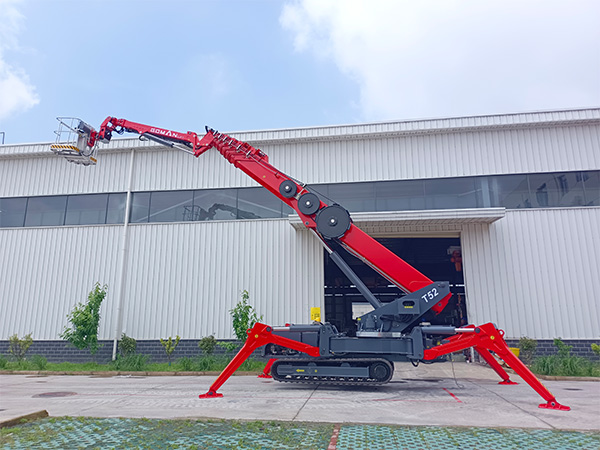
Sometimes you need extreme heights but face narrow access points. Traditional chassis dimensions will not fit through standard utility gates. You must evaluate a high-capacity telescopic boom spider lift. This variant utilizes compact outriggers. It stabilizes a massive boom on a very narrow base footprint. You get the high reach without demolishing fences or walls.
Flexibility solves complex access problems. You choose this machine when straight lines simply do not exist on your job site.
Plant maintenance operations rely on knuckle booms. Manufacturing floors feature dense networks of pipes and machinery. You cannot drive a straight boom through these aisles. Residential construction sites present similar challenges. Narrow lot lines restrict machine placement. Operators must navigate safely around steep roof pitches and existing power lines. Indoor arena rigging also requires this flexibility. Technicians must reach over seating tiers to install lighting trusses safely. Congested urban job sites demand zero-tailswing machines to prevent traffic accidents.
You need this equipment when ground-level barriers block your working area. Sometimes a newly poured concrete wall stands between your parking zone and the target. The knuckle boom simply reaches up and over the wall.
It proves essential when operators need multiple angles of approach. They can adjust the basket position in a single lift cycle. They do not need to lower the boom and move the entire truck. This angular flexibility saves countless hours during complex installations.
Modern job sites enforce strict emission regulations. Indoor environments require zero exhaust fumes. Narrow-chassis electric articulating models serve as industry standards here. They offer whisper-quiet, emission-free indoor operation. Hybrid models handle transition phases well. They run on diesel during rough framing. They switch to electric battery power for interior finishing.
Tight indoor spaces present severe weight restrictions. Sensitive flooring cannot support heavy construction machinery. Yet, you still require significant vertical access. An electric high reach spider lift with articulating joints bridges this gap perfectly. Its specialized outriggers displace weight across delicate tiles. Its joints navigate around expensive indoor fixtures without causing damage.
Sourcing equipment requires precise data. You must evaluate four critical dimensions before making a final selection. Guessing leads to immediate site failures.
Never evaluate height in a vacuum. A Telescopic Boom Lift maximizes horizontal outreach. An articulating lift sacrifices this horizontal range for geometric flexibility. You must map the exact "working envelope" required. Measure how far away you must park. Then measure how high you must go. Compare these two numbers against the manufacturer's load chart.
Payload limits dictate job site efficiency. You must factor in the weight of the operators. Include the weight of heavy tool belts. Add the specific materials they carry. Two workers, a welder, and steel plates add up fast. Telescopic models generally support heavier payloads. They often feature dual-capacity ratings. You might see 500 lbs for unrestricted maximum reach. You might see 1,000 lbs for restricted, closer-in work. Exceeding these limits triggers safety lockouts.
Space constraints dictate chassis selection. Articulating lifts typically offer zero or minimal tailswing. The counterweight stays entirely within the track width. Operators can rotate the turret safely in tight alleys. Telescopic lifts require significant counterweight clearance. The rear of the machine swings outward sharply during rotation. This creates severe crush hazards in high-traffic areas or walled-in sites.
Match the engine to the environment. Diesel engines provide massive torque. They dominate rough terrain and outdoor projects. Electric motors provide clean, quiet power. They rule indoor slab operations. Dual-Fuel or Hybrid systems offer project continuity. You deploy them on phased construction projects. The machine stays on site from rough outdoor grading all the way through to final interior finishing.
Ignoring the horizontal distance from the safe parking zone to the work target.
Forgetting to calculate the weight of specialized tools in the platform capacity.
Overlooking the tailswing radius near active public walkways.
Deploying heavy diesel units on freshly poured, uncured concrete slabs.
Operating high-reach equipment introduces serious logistical and safety hurdles. You must anticipate these challenges to protect your timeline and your crew.
Moving heavy machinery requires precise planning. Telescopic booms feature massive, solid structures. They are generally heavier and much longer when stowed. You cannot fit them on standard flatbed trailers easily. They often require specialized oversized transport permits. These permits inflate delivery costs and delay deployment. You must verify transportation route clearances. Low bridges and narrow urban turns often block delivery trucks entirely. Plan your logistics weeks in advance.
Safety compliance remains non-negotiable. Both machine types fall under specific regulatory categories. They require MEWP (Mobile Elevating Work Platform) Type 3, Group B certifications. Operators must complete rigorous training.
You must ensure operators receive machine-specific familiarization. The control panels differ wildly. Boom movement characteristics change drastically between straight and knuckle designs. Hitting a single joint toggle on a knuckle boom alters the basket trajectory entirely. Lack of familiarization causes the majority of collision incidents. Document all training protocols thoroughly before handing over the keys.
Ground conditions dictate operational safety. You must assess slab density and soil compaction rigorously. A heavy straight boom exerts massive downward force through its tires. It can crack a finished concrete driveway instantly. It can sink deep into rain-soaked mud.
Sinking halts production immediately. A trapped machine requires expensive recovery operations. You can mitigate this risk effectively. Choose tracked variants if your GBP limits are strict. Tracks distribute the heavy machine load over a much larger surface area. This protects the ground and ensures continuous operation.
You need a systematic approach to equipment selection. Follow these four steps to eliminate guesswork. This framework ensures you match the machine exactly to your site conditions.
Step 1: Map the Obstacles. Stand at your safe parking zone. Look up at your work target. Is there a direct, unobstructed line of sight? If yes, a telescopic machine works best. If no, an articulating machine is mandatory.
Step 2: Calculate the Reach. Grab a measuring tape or laser measure. Determine the required horizontal distance from the base to the target. Do not guess this number. Horizontal reach often limits your options before vertical height does.
Step 3: Audit the Terrain. Inspect the driving surface carefully. Are you driving on a cured concrete slab? Are you navigating freshly graded dirt? Do you need to cross fragile landscaping? Match your tires, tracks, or outriggers to this exact surface.
Step 4: Verify the Payload. Calculate your basket weight strictly. Total the weight of personnel. Add the exact weight of specific materials. Include welders, heavy steel pipes, and glass panels. Ensure your chosen machine supports this total load at your required extension.
Actionable Next Step: Compile these four specific data points. Write them down clearly. Present this envelope data before requesting quotes from equipment rental partners. This strict methodology ensures highly accurate machine matching. Analyzing a telescopic boom vs articulating boom becomes a mathematical certainty rather than a dangerous guess.
The choice between a straight boom and a knuckle boom defines your job site efficiency. It ultimately comes down to a battle of horizontal reach versus geometric flexibility. Making the right choice protects your budget and your crew.
Prioritize your site safety and physical access constraints over raw height metrics.
Map your working envelope meticulously to determine horizontal standoff distances.
Calculate exact payload requirements, including tools and heavy materials, before signing a rental agreement.
Audit your ground conditions to choose between standard tires, tracks, or specialized outriggers.
Never leave high-reach equipment selection to chance. Consult with an equipment specialist using your specific site envelope data to secure the exact right machine for the job.
A: A telescopic lift extends straight out using hydraulic cylinders. It provides maximum horizontal reach and height. An articulating lift features multiple jointed sections. These "knuckles" allow the boom to bend over and around structural obstacles.
A: Telescopic boom lifts offer vastly superior horizontal outreach. Their straight extension design makes them ideal for work areas where you cannot park the machine directly underneath the target site.
A: Yes, but it remains very rare. They feature large footprints, wide tailswings, and typically run on diesel engines. For indoor applications requiring high reach, an electric articulating model or an electric high reach spider lift is usually the compliant, safe choice.
A: You must select tracks when operating on mud, sand, snow, or sensitive terrain. Tracks distribute the heavy machine weight evenly. This prevents the equipment from sinking or causing severe surface damage to the job site.
