


No.188 Doubu Avenue, Hannan District, 430090 Wuhan, China


Views: 0 Author: Site Editor Publish Time: 2026-06-13 Origin: Site


A remote job site creates a different access problem from a fixed factory or a single construction project. The machine may need to travel between several locations in one week, pass through ordinary roads, enter narrow service areas, and operate where power supply is limited. In that situation, a trailer mounted work platform is selected as much for transportation efficiency as for working height.
The right decision starts with the complete route: towing vehicle, road access, entrance width, parking position, outrigger footprint, available power, and the task at height. A platform that reaches the work area but cannot be transported or stabilized at the destination is not a practical solution. This guide explains how to evaluate trailer-mounted access equipment for remote maintenance, municipal work, landscaping, lighting, communications, and multi-site service operations.
A trailer-mounted platform is built around frequent relocation. Unlike a tracked lift that may require separate transport equipment, a towable unit can be connected to a suitable towing vehicle and moved between jobs. That advantage is most valuable when a service team visits several sites, when the machine is stored away from the work location, or when hiring a separate transport truck would slow down the schedule.
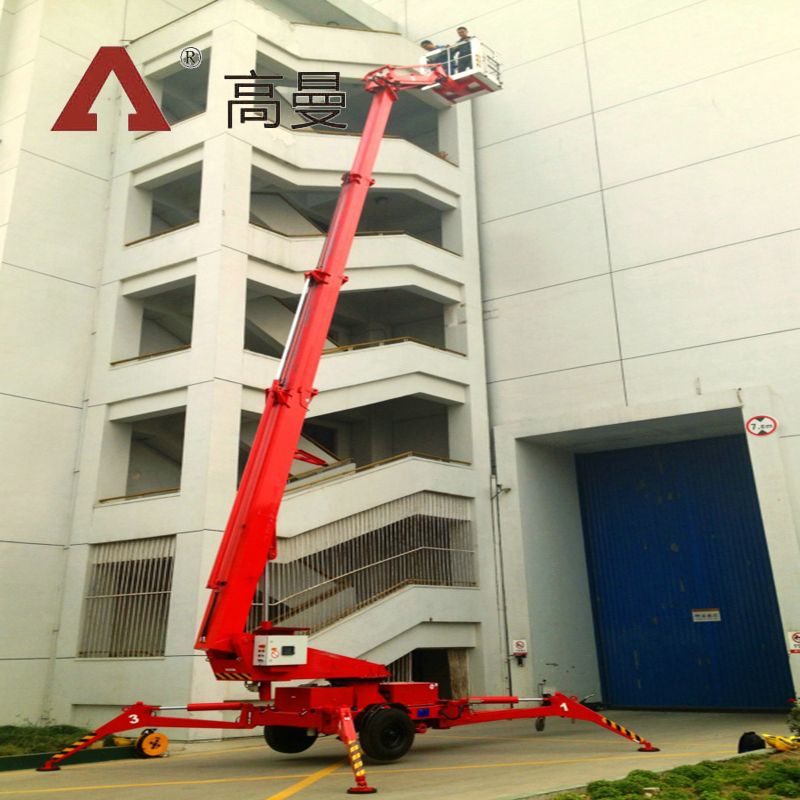
Transportation convenience does not remove the need for planning. Before selecting a machine, confirm the towing requirements, local road rules, overall stowed dimensions, turning space, and the condition of the access route. Remote sites often have narrow gates, soft shoulders, uneven entrances, or limited room for reversing. These details can matter more than one extra meter of nominal working height.
The towing vehicle must be suitable for the total trailer weight and local transport conditions. Buyers should review the platform's approximate weight, hitch arrangement, braking system, lighting, tire condition, and any registration or inspection requirements that apply in the destination market. A site team should also check whether the normal route includes steep grades, low bridges, weight-limited roads, sharp turns, or rough surfaces.
A platform may be compact when stored, but the towing combination still needs enough room to enter and position. Measure the narrowest gate, the lowest overhead obstruction, the turning area near the work zone, and the space required to disconnect the towing vehicle. If the site has only one access point, plan an exit route before setup begins.
Remote locations can include gravel, grass, compacted soil, paving blocks, roadside shoulders, and sloped ground. The machine must be positioned on a surface that can support the equipment and outrigger loads. Ground mats may be needed to distribute pressure. The crew should avoid drains, utility covers, recently filled soil, edges, and hidden voids. A portable platform is still a stabilized aerial machine, so setup quality directly affects the entire operation.
The 23m Trailer Mounted Work Platform provides a useful example of how transport and reach data should be read together. Its official page lists a 23.0m working height, 10.3m horizontal outreach at a 200kg load, an approximate total weight of 3500kg, and diesel, battery, or AC power options.
Planning item | P23 reference value | Why it matters on a remote site |
|---|---|---|
Working height | 23.0m | Defines the upper access range, but must be checked against horizontal offset. |
Horizontal outreach | 10.3m at 200kg | Helps determine whether the basket can reach over fences, roofs, trees, or equipment. |
Stowed dimensions | 7.98 × 1.7 × 2.4m | Used to check road transport, gate clearance, turning space, and storage. |
Basket dimensions | 1.2 × 0.8 × 1.1m | Influences operator space, tool handling, and task suitability. |
Approximate weight | 3500kg | Affects towing vehicle selection, road access, and ground support. |
Power options | Diesel, battery, or AC | Allows the power source to match remote, indoor, or noise-sensitive conditions. |
These figures should be treated as a starting point rather than a substitute for the current product manual and load chart. Actual operating decisions depend on basket load, boom position, wind, ground conditions, and the manufacturer's instructions.
Power availability changes from site to site. Diesel power is useful where the machine must work for extended periods without access to mains electricity. Battery operation is more suitable for indoor areas, residential zones, or sites where noise and local emissions must be reduced. AC power can be practical when reliable electrical supply is available and the work location permits safe cable routing.
A mixed fleet or a machine with several power options gives service contractors more flexibility. However, the team should still plan fuel, charging time, cable protection, and daily operating hours. A battery-powered platform that is moved through several short jobs may be efficient, while a long outdoor shift in a remote area may favor an engine-powered configuration.
Confirm the task location. Mark the target, the required height, the horizontal offset, and any obstacles between the machine and the work point.
Inspect the travel route. Check bridges, slopes, road width, gate dimensions, overhead hazards, and the turning area.
Select the setup zone. Choose firm ground with enough outrigger clearance and a controlled exclusion area.
Level and stabilize. Follow the manufacturer's outrigger procedure and verify that all interlocks and indicators show the machine is ready.
Test controls before elevation. Check normal movement, emergency lowering, communication, and the condition of the basket.
Monitor changing conditions. Stop work if wind, traffic, ground stability, or nearby activity creates a new hazard.
The format is particularly useful for teams that move frequently rather than remain on one large site. Typical work includes streetlight servicing, billboard and sign maintenance, tree care, rural communications work, facility inspections, roof-edge repairs, stadium maintenance, and service contracts covering several buildings.
The P23 page also describes proportional control, cable and remote control options, a self-leveling basket, automatic outrigger leveling, emergency lowering, a boom-and-outrigger interlock, and 360-degree non-continuous turret rotation. These features are relevant because remote projects often have smaller crews and less support equipment. Faster stabilization and clear control logic can reduce setup time when the machine is moved repeatedly during the day.
A towable machine is not automatically the right answer for every remote site. A tracked spider lift may be more appropriate where the route after unloading includes steep, muddy, soft, or highly irregular ground. A self-propelled boom may be better where the machine must travel continuously while working inside a large site. A scissor lift may be more efficient when the task is directly overhead and requires a larger platform area.
The selection should therefore compare the full work cycle: transport, entry, setup, repositioning, elevation, and removal. The most portable option is the one that reduces total project friction, not simply the one with a trailer chassis.
What is the highest work point and how far is it from the nearest setup position?
What is the heaviest expected basket load, including people, tools, and materials?
Can the towing vehicle legally and safely handle the machine?
What are the narrowest gate and lowest overhead clearance on the route?
Is the setup surface paved, compacted, soft, sloped, or sensitive?
Will the machine operate indoors, outdoors, near residences, or without mains power?
How many times will the platform be moved during a normal week?
No. Working height usually includes an estimated operator reach above the platform floor. Buyers should check both values in the current technical documentation.
The machine may not be able to park directly below the target because of fences, landscaping, roofs, traffic lanes, or unstable ground. Outreach determines whether the basket can reach the target from a safe setup position.
Outriggers can help level and stabilize the machine within its permitted operating range, but they do not make every surface suitable. Ground strength, slope, voids, edges, and outrigger support still require assessment.
The answer depends on operating time, noise restrictions, emissions requirements, and access to electricity. Diesel, battery, and AC each serve different working conditions.
A trailer-mounted work platform should be chosen as part of a transport-and-access system. Working height matters, but towing compatibility, stowed size, horizontal outreach, ground support, power source, and repeated setup time determine whether the machine will perform efficiently across remote locations. By surveying the route and work zone before comparing models, buyers can select portable access equipment that supports the whole job rather than only the final movement at height.
