


No.188 Doubu Avenue, Hannan District, 430090 Wuhan, China


Views: 0 Author: Site Editor Publish Time: 2026-07-15 Origin: Site


Facilities and contractors constantly push the limits of high-reach equipment. You often outgrow standard 200kg capacity lifts when requiring two operators plus specialized tooling at height. Glass manipulators and heavy masonry equipment demand serious payload capabilities. Upgrading to a higher capacity creates a unique procurement challenge. You need equipment capable of handling heavy payloads without compromising confined-space access or terrain adaptability. Balancing these conflicting demands dictates job site efficiency and operator safety. This guide provides an objective framework for evaluating a versatile spider lift claiming a 230kg safe working load. We emphasize reading restricted versus unrestricted load charts and assessing true ground bearing pressure. You will also learn how to validate manufacturer performance claims before making a final procurement decision. Equipment reliability ultimately depends on matching machine specifications to your exact facility constraints.
A 230kg load capacity standardizes safe two-person operation alongside heavy equipment, reducing the need for secondary material hoists.
True versatility relies on variable outrigger configurations and bi-energy/lithium power sources to transition seamlessly from rough outdoor terrain to sensitive indoor flooring.
Evaluating the working envelope strictly at the 230kg limit is critical, as maximum horizontal outreach often decreases significantly at peak load capacity.
Prioritizing an established OEM heavy-duty spider lift ensures compliance with current safety standards (e.g., EN280, ANSI A92) and guarantees long-term parts availability.
Upgrading payload capacity fundamentally changes job site logistics. Standard elevating work platforms often max out at 200kg. Industry standards typically calculate a single operator’s weight at 80kg. Two operators immediately consume 160kg of your allowance. This leaves a mere 40kg for tools, hardware, and safety rigging. You quickly hit safety limits. Moving to a 230kg boom lift resolves this bottleneck.
We frame this capacity shift as a true productivity multiplier. You gain 70kg of usable payload after factoring in two operators. You no longer need separate material handling workflows. Teams can carry their supplies directly in the basket. This eliminates the dangerous practice of overloading standard baskets. It also reduces the need to rent secondary material hoists. Your crews complete aerial tasks in fewer trips, which drastically cuts labor hours.
Manufacturers often market maximum heights alongside maximum weights. You must read load charts carefully. A 230kg payload heavily dictates horizontal reach limits. We differentiate these as restricted and unrestricted working envelopes. An unrestricted envelope allows full boom extension regardless of basket weight up to the limit. A restricted envelope limits your horizontal outreach when carrying maximum capacity. For example, your lift might reach 10 meters horizontally with an 80kg load. However, a full 230kg payload might restrict horizontal reach to just 7 meters. Sensors actively prevent further extension to avoid tipping.
Specific industries demand this heavier weight class. They require specialized heavy equipment lifted simultaneously with personnel. Common scenarios include:
Structural Steel Inspection: Inspectors carry heavy torque wrenches, ultrasonic testing gear, and robust safety harnesses.
Large-scale Window Installation: Glaziers transport heavy glass panels alongside vacuum lifting manipulators.
Heavy Arboriculture Operations: Arborists operate safely with multiple chainsaws, heavy rigging gear, and cut branches.
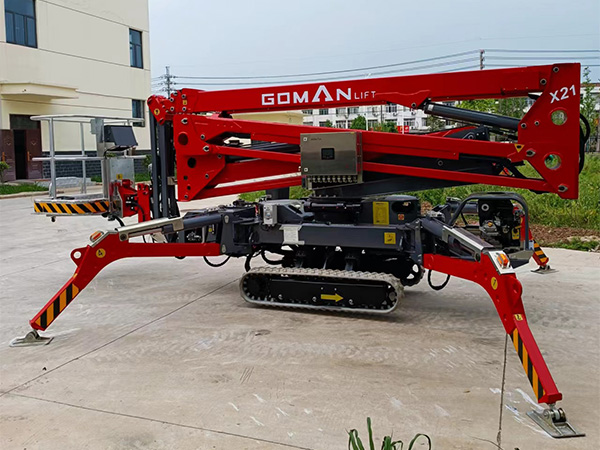
A true multi-application spider lift excels in restrictive environments. Wheeled boom lifts require flat, stable ground. Spider lifts adapt to complex topographies. Their specialized outriggers and adaptable track systems redefine site access. They operate where traditional machines simply cannot go.
Standard outriggers deploy in a fixed, symmetrical square. Spider lifts utilize multi-position, asymmetrical outrigger setups. You can deploy one side narrowly against a wall while extending the other side fully. Sensors read the specific outrigger footprint. The machine's computer then adjusts the safe working envelope dynamically. This allows stabilization on steep gradients, narrow staircases, and tight corridors. Standard mobile elevating work platforms fail completely in these areas.
Modern job sites blend outdoor and indoor tasks. Your equipment must adapt to different environmental regulations. Dual-power options provide vital flexibility. Many units combine a diesel engine for outdoor travel and a 110V/220V AC electric motor for indoor use. Alternatively, full lithium-ion battery systems offer comprehensive zero-emission solutions. You can transition seamlessly from rough outdoor terrain to noise-restricted indoor zones. Hospitals, shopping malls, and active office buildings require clean, quiet operation. Bi-energy systems prevent you from renting two separate machines for one project.
Track materials determine where you can operate safely. Standard machines use aggressive treads. Sensitive indoor locations require specialized materials. You must select the right track composition for your primary work environment.
Track Composition Comparison
Track Type | Primary Material | Best Environment | Key Advantage |
|---|---|---|---|
Non-Marking | White/Gray Synthetic Rubber | Polished Concrete, Hardwood, Tile | Leaves zero scuff marks on sensitive floors |
Aggressive Tread | Black Heavy-Duty Rubber | Mud, Gravel, Slopes, Turf | Provides maximum traction and gradeability |
You must scrutinize physical dimensions before purchasing a heavy-load spider lift. High capacity often means a heavier, wider machine chassis. You need equipment capable of squeezing through standard architecture. Failing to verify dimensions leads to stranded equipment.
Compact stowed dimensions remain paramount. Many facilities feature standard double doors. A highly capable machine must compress its footprint for transit. Top-tier models reduce their width to under 0.9 meters. They achieve this by retracting their track base and folding the basket. You must also measure standard freight elevator dimensions. The stowed height often dictates whether a machine can access upper building floors safely. Detachable baskets offer a simple way to shave crucial centimeters off the overall transit length.
A machine carrying 230kg inherently weighs more than a lighter-duty model. You must balance this machine weight against floor fragility. Suspended floors, raised access flooring, and decorative tiles crack under extreme point loads. You must calculate the exact pressure exerted by the outrigger pads. Use this structured approach to evaluate floor limits:
Determine the machine's total operating weight (including max payload).
Identify the surface area of a single outrigger pad.
Calculate the worst-case scenario load (often assumed at 80% total weight on one pad during specific slewing maneuvers).
Divide the max load by the pad area to find the maximum point load.
Compare this figure directly against the structural engineer’s floor rating.
Height brackets for this capacity typically fall into 18m, 21m, and 22m classes. Manufacturers utilize articulating jibs at the end of the boom. These jibs provide crucial up-and-over clearance. You can reach over balconies, roof parapets, and industrial pipework. Ensure the load chart maintains your required 230kg capacity when the jib is fully articulated.
Adding advanced aerial equipment introduces new maintenance challenges. You must prepare your service team for complex hydraulic and electrical systems. Neglecting these areas guarantees expensive downtime and compromises operator safety.
Battery performance varies wildly across different climates. Lithium-ion systems offer fast charging and zero maintenance. However, extreme cold weather heavily impacts their discharge rates. Lead-acid batteries require constant watering and strict charging discipline. Poor charging habits destroy battery cells prematurely. You must mandate specific charging protocols at the end of every shift. Store batteries in climate-controlled areas if winter temperatures drop significantly.
Maintaining a safe 230kg limit relies entirely on complex sensors. Modern lifts utilize sophisticated load-moment indicators. These sensors constantly measure basket weight and boom angle. Interlock safety sensors stop machine movement instantly if an overload occurs. These electrical systems demand rigorous upkeep. Poorly sealed junction boxes invite water ingress. Moisture causes electrical faults, which immobilize the machine. You must inspect sensor wiring harnesses regularly. Keep hydraulic valves clean to ensure smooth boom operation.
Transitioning crews to tracked equipment requires patience. Standard boom lift operators rely on simple steering wheels. Spider lifts utilize dual-track skid steering. This mechanism feels jerky to inexperienced users. Operators must undergo specific training on asymmetrical outrigger deployment. They must learn to read the machine’s active load chart display. Proper training prevents accidental property damage and ensures smooth daily operations.
Buying complex machinery requires methodical evaluation. You cannot rely on brochures alone. You must rigorously test a OEM heavy-duty spider lift against your hardest job site challenges. Selecting a highly engineered versatile spider lift guarantees safer high-altitude tasks.
Require dealers to conduct comprehensive on-site demonstrations. Do not accept parking lot tests. Ask them to navigate your tightest corridors and steepest ramps. Crucially, you must place a full 230kg test weight in the basket. Extend the boom to its absolute horizontal limit. Measure the actual reach against the published load chart. Watch how the machine’s computer handles the maximum stress. This physical validation exposes exaggerated marketing claims immediately.
Downtime destroys project margins. You must assess the manufacturer’s local support infrastructure. Ask dealers about their regional warehouse inventory. Proprietary components fail occasionally. Determine typical lead times for specific replacement parts. Load cells, custom hydraulic valves, and specialized track belts often ship from overseas. Partner only with dealers who stock these critical spares locally. A robust service network ensures your machine stays productive year-round.
Selecting the right versatile machine requires strict technical analysis. You must look past marketing terms and rigorously study restricted load charts. Evaluate the maximum horizontal outreach specifically at the 230kg limit. Tracked lifts offer incredible access, but only if they fit through your doors. Map your facility's physical constraints directly against the equipment specifications. Validate ground bearing pressures against your floor ratings before initiating vendor negotiations. Real-world testing guarantees you secure a machine capable of handling your heaviest demands safely.
A: Working height usually remains unaffected by maximum load limits. You can still reach the highest vertical point safely. However, maximum horizontal outreach is often heavily restricted by safety interlocks when carrying maximum capacity to prevent machine tipping.
A: Transport weight requires careful consideration. Standard towing limits in many jurisdictions dictate the type of vehicle required. Machines in the 20m+ height and 230kg capacity class often exceed the safe towing capacities of standard pickup trucks, requiring specialized commercial transport vehicles.
A: An unrestricted envelope allows the boom to use its full range of motion regardless of load, up to the maximum limit. A restricted envelope actively limits boom extension and horizontal reach based on the actual weight placed in the basket.
