


No.188 Doubu Avenue, Hannan District, 430090 Wuhan, China


Views: 0 Author: Site Editor Publish Time: 2026-09-07 Origin: Site


Equipment selection fundamentally impacts project profitability, safety, and site liability. This rings especially true when working on sensitive surfaces or complex topographies. Making the wrong choice delays schedules and ruins budgets. While standard wheeled boom lifts dominate open construction sites, they often fail in restricted zones. Deploying heavy wheeled machinery in confined or fragile environments frequently causes expensive structural damage. Planners need a smarter solution for these demanding workspaces. A Rubber Tracked Lift solves specific access and ground pressure challenges effectively. This guide outlines how to evaluate if this equipment is the right operational and financial fit for your next project. You will learn the mechanical benefits of continuous tracks over traditional tires. We will explore high-value applications across various demanding industries. Finally, you will discover the implementation risks to watch out for before renting or buying.
Rubber tracked lifts distribute machine weight over a larger surface area, preventing damage to delicate indoor floors and outdoor landscapes.
Their compact chassis designs allow them to navigate standard doorways and narrow residential gates that block traditional equipment.
Independent outriggers enable safe, leveled operation on severe slopes and uneven terrain.
Evaluating these lifts requires balancing their superior access capabilities against higher rental/purchase costs and specialized transport requirements.
Understanding the fundamental design reveals why these machines excel in tough environments. A rubber tracked aerial lift acts as a highly specialized work platform. Industry professionals often call them spider lifts. They mount the platform on a continuous rubber track chassis rather than traditional wheels. Most models feature articulating or telescopic booms. They also utilize stabilizing outriggers to secure the machine before elevating.
The core advantage lies in weight distribution physics. Standard wheeled boom lifts concentrate thousands of pounds onto four localized tire contact points. This localized pressure crushes weak surfaces. Conversely, a track footprint drastically reduces Ground Bearing Pressure (GBP). The tracks spread the machine weight over a massive surface area. You can drive a heavy tracked unit over soft grass without sinking.
Power source versatility adds another layer of mechanical superiority. Manufacturers now offer bi-energy or hybrid models. These machines combine diesel or gas engines for outdoor transit. They also include electric or lithium-ion motors for indoor operation. You get robust outdoor climbing power and zero-emission indoor functionality in one unit.
Site managers face constant access barriers on modern projects. Tracked lifts turn specific engineering features into direct operational outcomes.
Tight spaces frequently halt project momentum. Standard equipment simply cannot fit through narrow pathways. Spider lifts feature retractable track widths and compact stowed dimensions. This feature shrinks the machine profile dramatically. The outcome eliminates unnecessary demolition. You bypass the need to remove fences, doors, or architectural elements to access the work zone. Teams save days of prep work.
Working on slopes introduces severe safety risks. Traditional lifts require flat, graded ground to operate safely. A tracked lift for uneven terrain solves this using multi-position, independently adjustable outriggers. Operators call them spider legs. These outriggers read the ground topography. The outcome provides a perfectly level chassis on hillsides, stairs, or tiered landscaping. You achieve safe elevation without requiring expensive ground excavation.
Property damage claims destroy profit margins instantly. Heavy machinery easily cracks driveways and shatters tiles. Spider lifts utilize non-marking tracks and dispersed weight profiles. This design acts as a surface protection aerial platform. The outcome prevents cracked driveways, crushed turf, or shattered interior tiling. You protect both the client property and your bottom line.
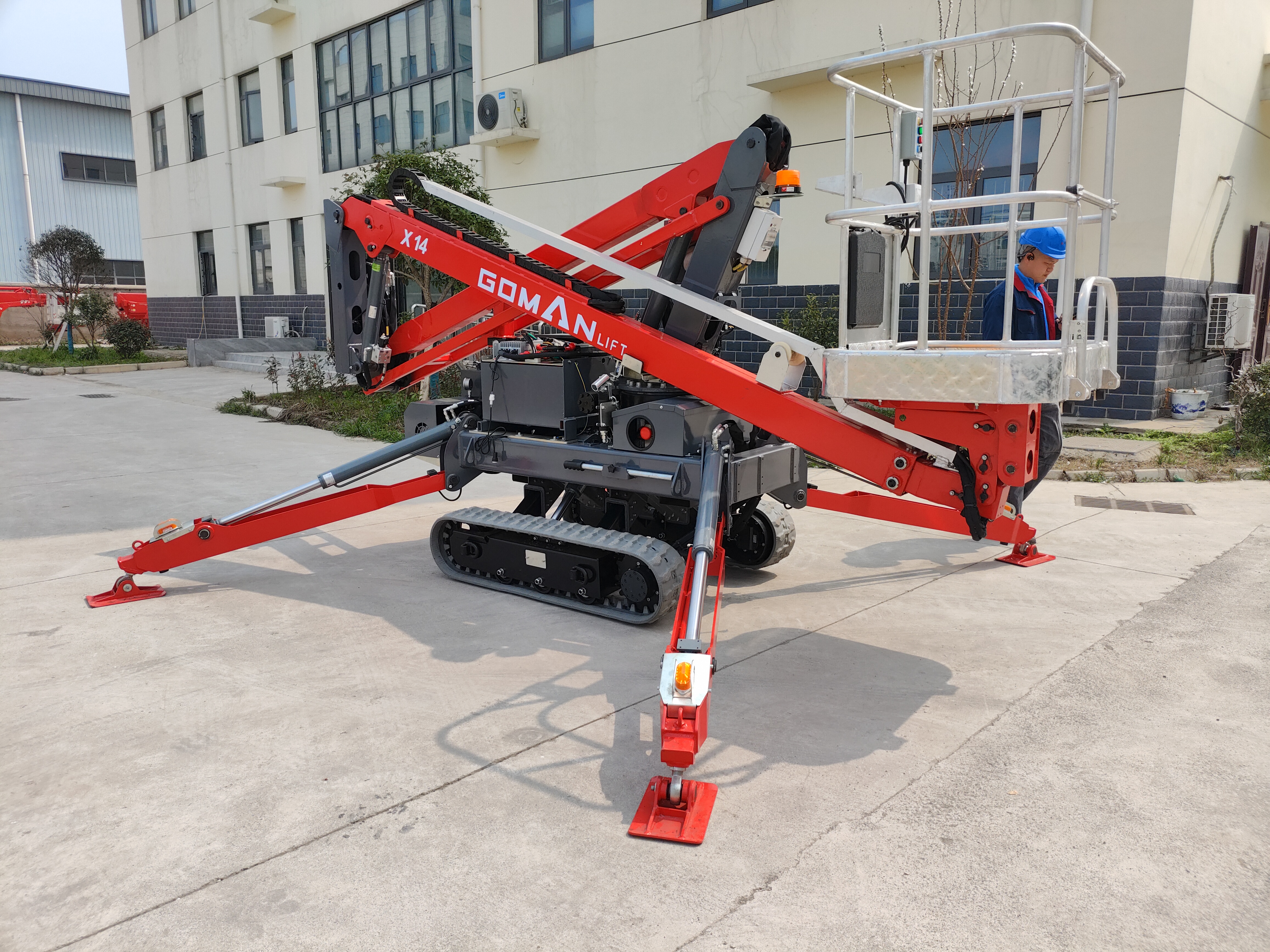
Choosing between tracks and wheels dictates how efficiently your team works. Both machine types serve distinct operational purposes. You must match the equipment to your specific site conditions.
Feature / Condition | Tracked Lifts | Wheeled Boom Lifts |
|---|---|---|
Ground Pressure | Very low (spread across tracks) | High (concentrated on tires) |
Drive Speed | Slow (walking pace) | Fast (efficient on flat ground) |
Slope Leveling | Excellent (independent outriggers) | Limited (relies on oscillating axles) |
Elevated Driving | Rarely possible (must stow first) | Standard capability |
Soft or muddy ground demands tracked machinery. Superior traction prevents the machine from sinking or getting stuck. Muddy sites quickly trap wheeled lifts, delaying projects for days. Tracks keep project timelines intact during poor weather conditions.
Weight-restricted infrastructure presents another primary use case. Planners frequently specify tracked units for working over underground utilities. They also prove ideal for vaulted sidewalks or suspended concrete slabs. Heavy wheeled machines pose severe structural risks in these environments. Tracks distribute the load safely across the fragile substructure.
Large, flat job sites favor traditional tires. Wheeled lifts deliver significantly faster drive speeds. Tracks perform inefficiently for covering long distances on flat concrete. If your team needs to cross a massive warehouse floor repeatedly, choose wheels.
Budget constraints also influence this decision. If access is wide open and the ground remains solid, choose wheels. Standard wheeled lifts generally offer a lower baseline rental or acquisition cost. Their simpler mechanics require less specialized maintenance.
Constant repositioning dictates wheeled equipment. Wheeled booms can often be driven while elevated within safety limits. This speeds up linear tasks like painting a long wall. Many tracked lifts must be fully stowed. You must retract the outriggers before moving the machine. This repetitive setup wastes time on open sites.
Certain industries extract massive value from these specialized machines. A versatile indoor outdoor tracked lift bridges the gap between rough terrain and delicate interiors.
Tree care and arboriculture depend heavily on compact tracked units. Crews navigate narrow residential backyards easily. They set up safely on sloped lawns. Arborists reach high canopies without causing heavy ground disruption. Homeowners appreciate the zero-impact footprint on their expensive landscaping.
Facility maintenance and atrium management represent another massive market. Maintenance teams transition seamlessly from outdoor parking lots to interior spaces. They drive through standard double doors to access high interior ceilings. Operators utilize electric battery modes inside. This complies strictly with indoor air quality standards and noise ordinances.
Historic restoration projects and churches require extreme care. Contractors operate on fragile historic flooring. They set up on multi-level sanctuary stairs safely. Erecting scaffolding proves too slow, invasive, or structurally risky. The spider lift provides immediate, non-destructive vertical access.
Telecommunications and utility sectors face brutal topographies. Technicians must access off-road utility poles or remote cellular towers. These assets frequently sit in wooded, hilly, or muddy right-of-ways. Tracked lifts conquer these landscapes effortlessly. They bring heavy lifting power to areas previously restricted to manual climbing.
You must evaluate potential downsides before committing to tracked equipment. Specialized machinery introduces unique logistical and operational challenges.
Moving tracked equipment requires precise planning. You must assess towing requirements carefully. While lighter than massive wheeled booms, spider lifts still demand robust transport. They require appropriately rated trailers and heavy-duty tow vehicles. Never underestimate the transport weight.
Load-in angles demand special attention. Steep trailer ramps cause major headaches. You must evaluate these angles to avoid high-centering the tracks. High-centering leaves the machine stranded on the ramp crest. Using extended ramps or tilt-deck trailers solves this issue effectively.
Operating a spider lift demands higher skill levels. Highlight the absolute necessity for specific familiarization training. Standard boom lift experience does not translate perfectly. You must train teams on several distinct systems:
Outrigger Deployment: Operators must understand proper weight distribution and ground pad placement.
Auto-Leveling Systems: Teams must know how to interpret the digital leveling sensors correctly.
Dual-Power Management: Users must learn how to switch seamlessly between combustion and electric modes.
Outrigger deployment, auto-leveling systems, and dual-power management require a higher degree of operator competence than standard lifts. Skipping familiarization training leads to tipping hazards or machine damage.
Planners often misunderstand how tracks interact with hard surfaces. You must address the reality of track scuffing. A low ground pressure lift disperses weight excellently. However, aggressive zero-turn maneuvers on hard surfaces still cause damage. Rapid pivoting can leave thick rubber marks on concrete. It can also shear delicate turf completely off the dirt.
Highlight the need for extreme operator care. Drivers should execute wide, gradual turns whenever possible. During tight pivoting on sensitive floors, crews must deploy heavy-duty track mats. Protective matting eliminates friction scuffs entirely. Proper driving technique separates a successful job from an expensive repair bill.
Rubber tracked lifts are not direct replacements for traditional wheeled lifts. They operate as specialized problem-solvers for restrictive access, fragile surfaces, and extreme terrain. They protect delicate floors, climb steep grades, and squeeze through narrow gates. Their unique engineering prevents costly site damage while enabling impossible reach.
Decision-makers must audit their typical job site constraints carefully. Review your doorway widths, ground bearing limits, and slope gradients. Gather this data before shortlisting a specific reach height or model. Proper site assessment guarantees you rent the correct machine.
Consult an equipment specialist to conduct a formal site survey. Review exact machine specifications alongside a professional for your upcoming project. Proactive planning ensures you maximize safety, protect your margins, and complete the job efficiently.
A: Yes, provided they feature non-marking tracks. Operators must use proper turning techniques to prevent friction scuffs. For extreme caution on highly polished or historic floors, crews should lay down protective matting before driving.
A: Yes, the tracks allow it to climb steep grades, often reaching 30-40% inclines. The adjustable outriggers then allow the platform to be safely leveled and elevated once in position.
A: They feature complex engineering including independent outriggers, dual-power systems, and track drives. The industry considers them highly specialized equipment. This complexity results in higher initial acquisition and maintenance costs for rental fleets.
