


No.188 Doubu Avenue, Hannan District, 430090 Wuhan, China


Views: 0 Author: Site Editor Publish Time: 2026-10-30 Origin: Site


Accessing high indoor areas presents a unique operational challenge for facility managers. Reaching the ceilings of sprawling atriums, retail malls, or historical buildings requires highly specialized equipment. You need machines capable of reaching extreme heights safely. However, they must never damage fragile flooring or exceed strict subfloor weight limits. Choosing the wrong equipment often leads to cracked tiles, crushed subfloors, or costly surface repairs.
This guide explores the two primary chassis options designed to solve these constraints: wheeled bases and tracked bases. Our main objective is clear and practical. We provide facility managers and contractors an evidence-based framework for evaluating both options. You will learn to assess these lifts based on floor loading, maneuverability, and deployment speed. By understanding these mechanical differences, you can safely specify the exact right lift for your unique indoor environment.
Weight Distribution: Tracked lifts offer superior weight dispersion for fragile subfloors, while wheeled lifts concentrate weight but eliminate track-skid friction on delicate surface finishes.
Maneuverability: A wheeled mounted spider lift typically provides a tighter turning radius with less surface scuffing on polished floors.
Deployment: Wheeled units function as a fast-deploy aerial platform, traveling faster across expansive, flat indoor facilities.
Power & Compliance: Both chassis types are available with indoor-compliant lithium-ion or dual-power systems to meet zero-emission requirements.
Indoor high-reach work demands strict operational parameters. First, you must meet zero-emission requirements to maintain safe indoor air quality for building occupants. Second, equipment must easily pass through standard commercial doorways or freight elevators. Third, they must navigate over highly delicate flooring materials safely. Finding a machine balancing these requirements often leads operators to narrow, lightweight solutions. Understanding your specific site constraints prevents catastrophic structural damage and expensive project delays.
Many contractors confuse surface protection with structural capacity. We must distinguish between the two clearly. Surface finishes include polished concrete, marble, hardwood, or luxury vinyl tile. Protecting them means preventing scratches, rubber scuffing, or chemical marks. The structural subfloor lies underneath the finish. Protecting the subfloor means preventing cracking, collapsing, or sheer failure under heavy machinery. You might have an incredibly strong concrete subfloor covered by delicate museum marble. Alternatively, you might have durable carpet laid over a fragile, hollow raised access floor. Each structural scenario requires a totally different chassis strategy.
You must measure entryways, tight hallways, and elevators before renting equipment. Often, operators only measure the front doorways. They forget to account for corner turning radiuses in narrow corridors. Measure the maximum weight capacity of service elevators carefully. Additionally, the machine's stowed chassis dimensions only matter during transit. Once inside, you must deploy outriggers to safely elevate the boom. The outrigger footprint usually spans much wider than the machine base itself. Measuring the actual working zone ensures you have adequate space for full deployment. It prevents you from discovering too late that a machine fits through the door but cannot set up inside.
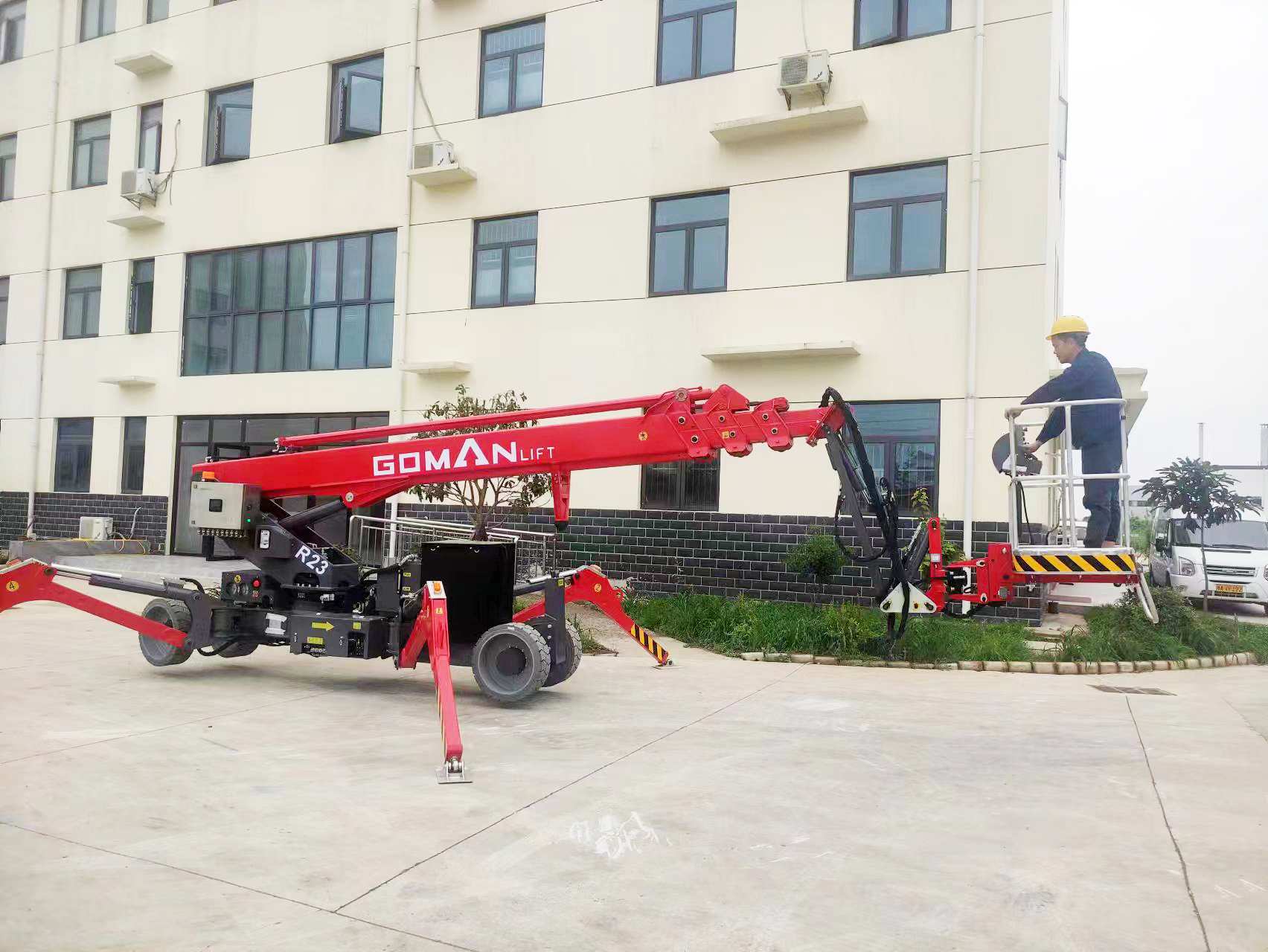
A Wheeled Mounted Spider Lift utilizes a traditional four-wheel or multi-wheel chassis instead of continuous rubber tracks. Engineers design these units specifically for flat, finished surfaces found in modern commercial facilities. They rely on standard steering mechanisms similar to warehouse forklifts or golf carts. This practical design provides smooth, rolling movement across hard floors.
Tracked machines typically use skid-steering to turn. Skid-steering means the tracks rotate in opposite directions, scrubbing aggressively against the ground. This action creates immense friction. Conversely, a non-marking wheel lift navigates tight corners using articulated or Ackermann steering. The wheels pivot smoothly without grinding into the floor. This drastically reduces the risk of tearing carpet, cracking ceramic tile, or scuffing polished concrete. They preserve the aesthetic integrity of high-end surface finishes seamlessly.
Wheeled units function beautifully as a fast-deploy aerial platform. Moving tracks across a large building takes time due to lower top speeds. A wheeled chassis offers much higher travel speeds across expansive, flat indoor spaces. You can move them swiftly across massive warehouses, airport terminals, or sports arenas. This travel efficiency cuts down transit time significantly. Less transit time means more active working hours for your crew.
A wheeled spider lift is best suited for environments boasting high structural load capacities but highly sensitive surface finishes. Think of a commercial shopping mall containing thick concrete subfloors covered by expensive terrazzo. If your project involves long travel distances between work zones on a single level, wheeled units excel. They offer rapid repositioning without destroying the decorative flooring underneath.
Rubber-tracked chassis utilize continuous belts over drive sprockets and idlers. Manufacturers design this undercarriage to maximize ground contact. For indoor access, they typically equip these machines with non-marking white or grey rubber tracks. This prevents leaving dark black carbon trails across the pristine work area.
The physics of tracks provide one massive structural advantage. They spread the machine's total weight over a much larger surface area. This significantly lowers the pounds-per-square-inch (PSI) ground pressure during transit. Lower ground pressure prevents heavy machines from punching through weak subfloors. Below is a comparison of how chassis type affects floor loading.
Chassis Floor Loading Profile Comparison
Specification Category | Wheeled Chassis | Tracked Chassis |
|---|---|---|
Ground Contact Area | Minimal (4 tire patches) | Maximum (2 continuous belts) |
Transit PSI Pressure | Very High | Significantly Lower |
Subfloor Risk (Transit) | High (punctures weak floors) | Low (floats over weak floors) |
Not all indoor jobs offer perfectly flat approaches. Tracked lifts reign supreme if the machine must climb stairs to enter a building. They easily cross high thresholds, navigate uneven exterior terrain, and traverse landscape barriers before entering the workspace. Wheels often get stuck on minor lips or steps. Tracks aggressively grip edges and pull the machine upward safely. If your access route involves stairs or rough terrain outside the door, you almost certainly need tracks.
You must address the harsh reality of tracked steering. As mentioned earlier, tracks rely on skid steering. Even when fitted with non-marking rubber, turning a tracked machine in place creates severe friction. This friction can peel up linoleum, tear commercial carpet, or heavily scuff epoxy floors. If you use an indoor spider lift utilizing tracks, you must lay down specialized floor protection boards before making any sharp turns. Failing to do so almost guarantees surface damage.
You must rigorously evaluate how the machine distributes its mass. Four wheels create intense point-loading. All the machine's immense weight pushes down onto four very small contact patches. Tracks disperse this weight across a long, wide footprint. For transit across hollow floors, tracks are inherently safer structurally. However, remember this applies only to moving the machine. Once in position, you deploy the outriggers. Outrigger pads ultimately dictate the operational working load, regardless of the chassis type. Ensure your engineers calculate both moving transit loads and stationary operational outrigger loads.
Navigating around interior pillars, retail kiosks, and glass display cases demands extreme precision. A self-propelled spider boom lift on wheels usually handles micro-adjustments in confined spaces better. Wheel articulation allows operators to nudge the machine forward on an angle gently. Track pivoting can sometimes be jerky. A slight bump of the joystick on a tracked machine can swing the chassis aggressively. For micro-movements near glass walls or delicate historical artifacts, articulated wheels provide a smoother, more controlled repositioning experience.
Time heavily impacts your project schedule. Transit times favor wheeled models in flat, large buildings. They simply drive faster from point A to point B. Outrigger deployment speeds remain largely similar between both chassis types. The hydraulic leg mechanisms are functionally identical. However, wheeled units still save time overall. You do not have to repeatedly lay down and pick up protective turn-mats like you do for skid-steering tracks.
Proper site preparation mitigates disastrous floor failures. You should never drive heavy equipment onto delicate indoor surfaces blindly. Use thick plywood, heavy-duty track mats, or specialized composite floor protection boards. This strict rule applies regardless of whether you choose non-marking wheels or tracks. Wheels can still crack thin ceramic tiles under high point-load pressure. Tracks will scuff unprotected finishes during turns. Always protect the path.
Indoor environments mandate strict emission standards. Check your facility's power infrastructure before the lift arrives. If using a full lithium-ion model, confirm you have adequate 110V or 220V outlets to charge the machine overnight. If renting a hybrid model, ensure the building possesses adequate ventilation. You might need to run the combustion engine temporarily during initial exterior transit before switching to electric mode indoors.
Do not underestimate the differing learning curves between chassis types. Standard operators often find wheel steering highly intuitive. It feels exactly like driving a car or forklift. Track controls require specific operator familiarity. Dual-joystick track controls can cause sudden jolts if the operator lacks basic experience. Ensure your crew receives specific familiarization training for the exact undercarriage they will operate. This simple step prevents accidental collisions with interior walls.
Selecting the right chassis comes down to balancing structural limits against surface sensitivities. Use this shortlisting logic to guide your process:
Choose wheeled if: The primary concern is surface scuffing on a strong subfloor, you need faster transit across large flat areas, and access routes have zero steps or curbs.
Choose tracked if: The primary concern is subfloor weight limits (hollow floors, raised access floors), or if the unit must climb stairs to reach the work zone.
Always verify assumptions with real data. We encourage facility managers to consult with a structural engineer regarding specific floor load limits. Have them calculate both pounds per square foot (psf) and pounds per square inch (psi) before equipment selection. Request a comprehensive site walk-through from an equipment rental specialist before finalizing your procurement. This ensures your access routes, floor limits, and height requirements align perfectly with the selected machine.
A: While they do not leave traditional black carbon marks, non-marking rubber can still leave a slight "clean" track or minor dust transfer. The rubber compounds are softer to prevent floor damage. For pristine environments like museums or luxury retail showrooms, we still strongly recommend using floor protection boards during transit to ensure zero visual impact.
A: Generally, no. Wheeled models can typically only navigate very minor thresholds or low curbs. They lack the aggressive grip and continuous surface contact needed for climbing steps safely. If your access route requires ascending stairs to reach the indoor workspace, you must specify a tracked unit designed for dedicated stair climbing.
A: Tracks significantly lower the PSI ground pressure during transit. They distribute the machine's mass across a large, flat surface area. Four wheels concentrate that same weight onto four tiny contact patches, resulting in higher transit PSI. However, once the outriggers are deployed for operation, the ground pressure on the floor becomes similar for both.
A: Most modern indoor units offer electric options to meet zero-emission regulations. They are commonly available as full lithium-ion battery models or bi-energy hybrid models. Hybrid units allow operators to use a plug-in electric motor or battery indoors, while utilizing a small diesel or gas engine for faster exterior transit to the building.
